
As Hamas rebuilds in Gaza and Egypt expands its military presence in Sinai, Jonathan Pollard warns that Israel risks facing a devastating new threat on its southern border.
By Jonathan Pollard | World Israel News | October 11, 2026
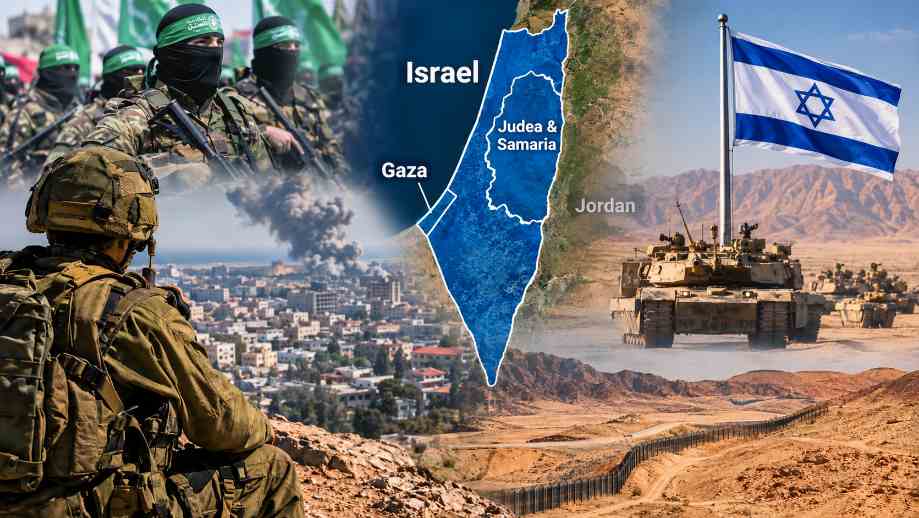 Click Image to Enlarge. Image created via AI.
The shock reverberating through the Israeli public following reports that the IDF allowed a major daylight Hamas military exercise to proceed in Gaza without targeting it has exposed a deeply troubling reality.
For a nation still carrying the scars of the intelligence failures that preceded October 7, watching an enemy openly rehearse combat operations raises the disturbing possibility that the same mistakes are being repeated.
The military establishment appears stubbornly committed to an outdated defensive doctrine, relying on targeted strikes against individual terrorists while leaving much of Hamas’s organizational structure intact.
Such tactical measures may temporarily disrupt enemy operations, but they cannot, by themselves, prevent Hamas from rebuilding the capabilities required to launch another devastating attack.
The Doctrine of Containment Failed on October 7
To understand the fundamental weakness of this approach, one need only examine how the paradigm of “mowing the grass” contributed to the catastrophe of October 7.
For nearly two decades, Israel’s security establishment operated under the assumption that periodic military campaigns, coupled with advanced border surveillance and technological defenses, could successfully contain Hamas.
The doctrine treated the terrorist organization not as an enemy whose military capabilities had to be permanently dismantled, but as a manageable threat that could be periodically weakened. Every round of escalation ended with airstrikes that degraded rocket launch sites and eliminated commanders, after which Israel withdrew, believing that deterrence had been restored.
In reality, “mowing the grass” provided Hamas with a predictable and repeatable pattern that it learned to exploit. During the quiet intervals between operations, the organization expanded its underground infrastructure, adapted its tactics, and rehearsed large-scale infiltration operations, sometimes in plain sight of Israeli intelligence.
Because Israel prioritized the illusion of short-term calm and placed excessive confidence in technological barriers, it failed to appreciate the enemy’s long-term strategic intentions.
The policy fundamentally mistook a tactical pause for strategic defeat, ultimately allowing Hamas to develop the capabilities that made October 7 possible.
Reports of another daylight military exercise, therefore, deserve far more than a routine operational explanation. They demand a serious examination of whether Israel’s political and military leadership has truly abandoned the assumptions that contributed to the worst security disaster in the country’s history.
Growing Danger Along the Yellow Line
This concern becomes even more urgent when examining the immediate tactical reality along the Gaza border. Israeli security officials have warned of Hamas’s intentions to attack IDF forces operating along the so-called “Yellow Line,” including the possibility of attempts to capture soldiers or strike military positions.
Yet questions remain about whether the rules of engagement governing our soldiers provide sufficient freedom to respond immediately to emerging threats.
Any operational restrictions that force front-line troops to hesitate when facing an imminent attack must be urgently reviewed, because the lives of our soldiers cannot be subordinated to bureaucratic procedures that fail to reflect battlefield realities.
Israel has already paid an unbearable price for underestimating Hamas’s intentions. It cannot afford to repeat that mistake simply because its commanders have become accustomed to managing threats rather than decisively confronting them.
Egypt’s Military Buildup and the Threat from Sinai
This dangerous pattern of strategic complacency cannot be separated from developments along Israel’s border with Egypt.
Although the two countries have maintained a formal peace treaty for decades, Cairo’s military buildup in Sinai raises legitimate questions about the future balance of power on Israel’s southern frontier.
Egypt’s historical failure to prevent the extensive smuggling networks that supplied Hamas through the Sinai-Gaza border also deserves renewed scrutiny.
Whatever Cairo’s stated intentions, those networks contributed to the military infrastructure that eventually enabled Hamas to challenge Israel on an unprecedented scale.
At the same time, Egypt has strongly opposed proposals involving the relocation of Gaza’s population into Sinai, while continuing to expand military infrastructure and capabilities in the peninsula.
The combination of these developments should compel Israel to reassess the assumptions underlying its long-standing security relationship with Cairo.
The Camp David Accords established important limitations on Egyptian military deployments in Sinai, although subsequent security arrangements have permitted certain deployments through mutual coordination.
Israel must therefore carefully distinguish between activities authorized under those arrangements and military developments that could eventually undermine the strategic balance envisioned by the peace treaty.
it would be irresponsible to assume that a peace treaty, however important, guarantees that today’s strategic relationship will remain unchanged indefinitely.
The IDF must seriously examine whether Egypt’s growing military capabilities could present a future threat, particularly if political circumstances in Cairo were to change dramatically.
Such an assessment should include the full range of diplomatic, intelligence, defensive, and military options available to Israel, including the circumstances under which preventive military action should be considered.
A military confrontation with Egypt would carry enormous consequences for both countries and for the entire region. Precisely because those consequences would be so severe, Israel cannot afford to ignore developments that could make such a confrontation more likely.
Israel’s Current Gaza Strategy Cannot Succeed
The failure of containment also reflects a deeper political problem, one in which Prime Minister Netanyahu has allowed international considerations to exercise substantial influence over the question of Gaza’s future.
Outside powers may have their own legitimate regional interests, but those interests do not necessarily coincide with Israel’s overriding obligation to prevent another October 7.
Reports of plans to increase humanitarian aid deliveries into Gaza raise additional questions about how such assistance is distributed and whether Hamas can exploit civilian supply networks to reinforce its remaining influence. Humanitarian assistance must reach civilians who need it, but Israel must also ensure that the mechanisms governing its distribution do not inadvertently strengthen the very organization it is attempting to dismantle.
While both Netanyahu and opposition figures such as Gadi Eisenkot have called for the elimination of Hamas’s military capabilities, the practical question of who will enforce that objective remains unresolved.
Proposals involving an Egyptian-trained Palestinian security force may offer one possible framework, but they cannot be accepted without convincing guarantees that such a force would be capable of confronting Hamas rather than eventually accommodating it.
The IDF remains Israel’s ultimate guarantor of security. Yet simply ordering our soldiers back into Gaza under the same operational assumptions that governed previous campaigns risks producing another prolonged and costly war of attrition.
Any renewed ground campaign must be based on an entirely different operational approach, one that makes full use of Israel’s military and technological advantages before committing our soldiers to the dangers of close-quarters urban combat.
This should include a serious examination of whether specialized weapons, including thermobaric munitions, could be employed lawfully and effectively against verified military targets, particularly heavily fortified positions and underground installations.
Such weapons carry extraordinary destructive power and potentially devastating consequences for anyone within their blast radius. Their use would therefore require rigorous target verification, assessment of civilian risks, and compliance with the laws of armed conflict, rather than treating entire neighborhoods or tunnel networks as indiscriminate targets.
Protecting our soldiers demands both decisive military capabilities and the discipline to employ them responsibly.
Israel Must Reconsider Gaza’s Long-Term Future
The larger strategic issue is that Gaza can never again be allowed to function as an independent military platform for organizations committed to Israel’s destruction. After October 7, returning to a system in which Hamas is periodically weakened but permitted to rebuild would represent a profound failure of national security policy.
Israel should therefore seriously examine alternatives to the arrangements that existed before the war, including the possibility of maintaining long-term security control over strategically important areas of Gaza.
The establishment of permanent defensive zones, and even proposals involving changes to the territory’s political status, deserve rigorous examination of their security benefits, legal implications, and long-term consequences.
The question of Gaza’s civilian population is equally difficult and cannot be resolved through slogans or unrealistic diplomatic formulas. Israel should seriously examine whether a comprehensive regional arrangement could facilitate the large-scale relocation of Gazans, including to Egypt or other receiving countries, with international supervision, security guarantees, and appropriate protections.
At the same time, Israel must confront the difficult question of how to prevent Hamas from rebuilding its military and political infrastructure among the remaining population.
That requires examining long-term security control, the dismantling of terrorist institutions, and alternative civilian governance arrangements capable of preventing Gaza from once again becoming a launching ground for attacks against Israel.
None of these options is simple, and none can substitute for a coherent long-term strategy. What Israel cannot afford is another temporary arrangement that allows Hamas to survive politically, rebuild militarily, and prepare for the next confrontation.
The Danger of a Wider Regional War
The Egyptian question becomes even more serious when considered alongside the changing military balance elsewhere in the region. Turkey’s growing regional ambitions and military capabilities present Israel with additional strategic uncertainties, particularly if Ankara’s relationship with Jerusalem continues to deteriorate.
Israel must therefore consider the possibility that a future crisis on its southern border could coincide with a confrontation involving another major regional power. The prospect of simultaneous threats from Hamas, Egypt, and Turkey, even if such a combination remains uncertain, deserves serious attention from Israel’s military planners.
This is precisely why allowing potential threats to develop without adequate preparation would be so dangerous.
Israel should strengthen its intelligence capabilities, review its contingency plans, and examine the full range of measures necessary to deter aggression before a crisis develops into open warfare.
A preventive military operation against Egypt should not be treated as an inevitable or desirable outcome.
Nevertheless, Israel’s leadership must be prepared to consider every lawful option if credible intelligence establishes an imminent and serious threat that cannot be addressed through less destructive means.
Israel’s Next Government Faces a Historic Decision
The bottom line is that Israel can no longer afford a prolonged war of attrition with Hamas, nor can it accept a situation in which the organization retains the ability to rebuild and launch cross-border offensives whenever circumstances permit.
Achieving lasting security on Israel’s southern frontier will require a strategy that goes beyond temporary deterrence and addresses the military and political conditions that have repeatedly allowed the threat to regenerate.
As for Egypt, we must recognize that the continuation of peaceful relations cannot be taken for granted simply because those relations have endured for decades.
The possibility of a future confrontation must be incorporated into Israel’s strategic planning, even as every reasonable effort is made to preserve the peace and prevent an unnecessary war.
The emergence of a simultaneous threat from Egypt and Turkey, compounded by the continued presence of Hamas in Gaza, would create an exceptionally dangerous strategic environment. Preventing such a development must be among the highest priorities of Israel’s political and military leadership.
With Israel’s October 27 elections approaching, these questions deserve serious public scrutiny. The next government will inherit difficult decisions concerning Gaza, Egypt, and Israel’s wider regional security, and its willingness to confront those challenges will have consequences extending far beyond the coming electoral cycle.
Israel has already learned, at an unbearable cost, what happens when its leaders confuse the temporary absence of war with genuine security. We cannot afford to learn that lesson again.


Leave a Reply
You must be logged in to post a comment.