
New Solutions Needed
Stephen Bryen | Weapons & Strategy | October 11, 2026
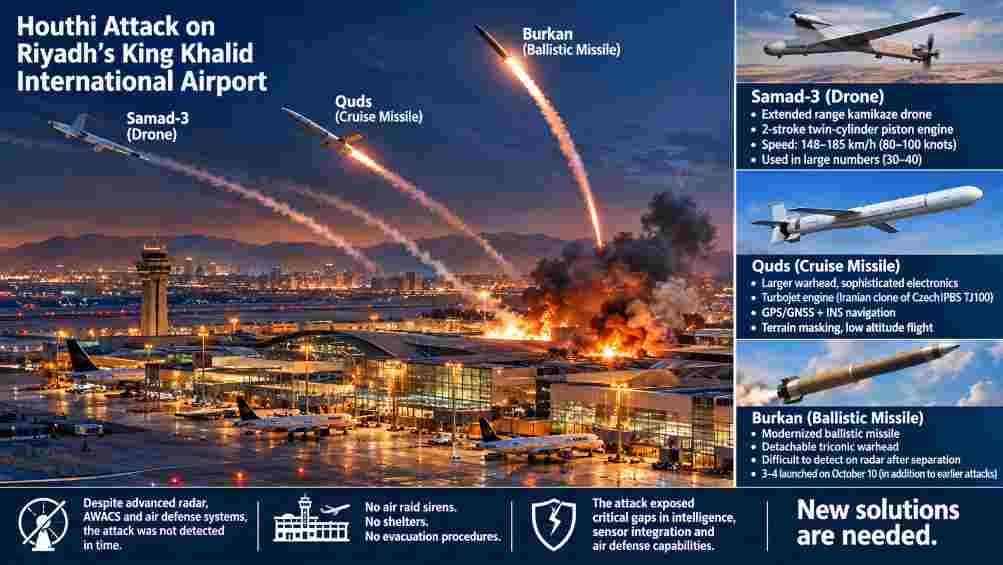 Click Image to Enlarge. Image created via AI.
The successful attacks on Riyadh’s King Khalid International Airport was an intelligence and operational failure that led to at least 12 dead and more than 300 wounded, some critically. Despite Saudi Arabia spending hundreds of billions and building an integrated air defense system, the Houthi attacks were remarkably successful. It is increasingly clear that even the best air defense systems based on current technology do not protect key assets from damage or destruction.
The Houthi attack mixed together suicide drones, cruise missiles and ballistic missiles. Because these weapons travel at significantly different speeds, the drones were launched first, followed by the cruise missiles and lastly by the ballistic missiles. Reports say the entire attack on October 10, starting at around 3PM local time, lasted around 45 minutes. The strikes on Terminal 3 and 4 (which are interconnected) probably took place in a 20 minute time frame. Most of the casualties and damages were at these two terminals, with the worst at Gates 401 to 403 which were hit initially by Quds cruise missiles (each with 150 kg payloads). Making matters more complicated, parts of Patriot missiles fell on the terminals, causing fire and generating shrapnel.
There were no air raid sirens or any early warning of the attack. The airport has no civil defense system, no shelters, and no announced evacuation procedures. Terminals 3 and 4 are used for domestic flights and low cost regional airlines. It is clear these terminals were deliberately targeted and the Houthis intended to cause a mass casualty event and punish Saudi Arabia for its support of government forces in Yemen.
King Khalid International Airport was attacked by the Houthis on September 19th, October 8 and 9th, and on October 10th. The Houthis gave numerous public warnings of their intentions. While Riyadh was not their only target, the Houthis made clear they intended to shut the airport down.
Despite modern radars and airborne warning systems the launch of drones, cruise missiles and ballistic missiles were not detected. Saudi Arabia has five E-3A AWACS aircraft, 2 SAAB 2000 Erieye AWACS with modern AESA radars (the E-3A radar is an older pulse doppler system), and a number of other specialized tactical reconnaissance platforms (RE-3A, RE-3B). These and coastal radar installations are integrated in a central defense network that links to air defense systems such as Patriot, THAAD, and up to 10 batteries of Korean KM-SAM Block-II (Cheongung-II) for lower-tier air defense against short-range ballistic missiles (SRBMs), cruise missiles, aircraft, and unmanned aerial vehicles (UAVs).
There are no reports that others, especially the US and Israel, either picked up the Houthi launches or, if they did, warned Saudi Arabia. Generally speaking, the launch of drones and cruise missiles is easily concealed and it takes good intelligence (typically HUMINT) to detect such operations. Missiles like the Burkan, which is the short to medium range ballistic missile used against Riyadh, is somewhat easier to pick up since the missiles are liquid fueled and have to be prepared before launch, exposing them to overhead systems such as satellites.
Saudi Arabia’s initiative setting up what is called the Mecca Joint Defence Agreement (also referred to as the Mecca Defence Alliance) with Pakistan and Turkey, locking out the United States and thwarting Washington’s effort to extend the Abraham accords to the Kingdom, may have played a role in off-putting US interest in helping the Kingdom deal with the Houthis and Yemen. One can add to this Washington’s primary interest is in focusing on Iran and the Hormuz straits and conserving ammunition and smart weapons, helping orient Washington away from getting involved in the Yemen mess. Whether Washington now intervenes remains uncertain.
The Houthi strike was a saturation attack that featured either novel or improved technology that came from Iran, perhaps with assistance from Russia and China.
The suicide drone used by the Houthis was the Samad-3. The Samad-3 is an extended range Kamikaze drone powered by a 2 stroke twin-cylinder piston engine (commonly identified as a 3W110i B2 or DLE 170-class model) driving a rear-mounted pusher propeller. During long-range operations (such as extended flights over 1,500 to 2,600 km), it typically travels at a slower average cruising speed of 148 to 185 km/h (80 to 100 knots, or about 92 to 115 mph) to conserve fuel. Western experts do not think the Samad-3 is very accurate although the latest models have been improved with better low-jamming satellite links. In successive attacks at King Khalid airport between 30 and 40 Samad’s were used.
The Quds cruise missile is more lethal, carries a larger warhead, has sophisticated electronics, and is powered by a clone of the commercial Czech PBS TJ100 turbojet (frequently labeled as “Model T10S” in recovered wreckage). The clone is manufactured in Iran. The Quds-2 employs satellite-assisted navigation (GPS/GNSS) and inertial navigation systems (INS). As a low-flying cruise missile, it can terrain-mask to bypass standard radar coverage and air defense systems. The fact that Quds cruise missiles successfully hit Terminals 3 and 4 indicates effective guidance and anti-jamming electronics.
On October 10th between 3 or 4 Burkan ballistic missiles were launched in combination with the Quds and Samad-3s. Before that, on October 8th and 9th, another 3 or 4 Burkan’s were fired at the airport. Saudi authorities claim to have shot some of them down using Patriots, but a full accounting is not available. However, the major damage was not caused by the Burkan’s, as far as we know.
The Burkan is a modernized ballistic missile. After the completion of the boost phase after launch, the missile warhead separates from the body of the missile. The warhead alone, traveling at high speed, is difficult to image on radar. The Burkan-2H and Burkan-3 feature a detachable, triconic (”baby bottle” shaped) warhead inherited from the Iranian Qiam-1 and Shahab-3 designs. It does not possess active control surfaces (like grid fins or thrusters) on the separated warhead to execute evasive maneuvers or terminal guidance changes against interceptors like the MIM-104 Patriot. Even so, the missile body travels along the same trajectory as the warhead, creating discrimination and targeting problems for systems such as Patriot.
It is noteworthy that the damage done by the Houthis to the King Khalid International Airport is more or less equivalent to Iranian strikes on a number of US and Israeli bases, starting in 2020 with Iran’s operation Martyr Soleimani hitting the Air al-Assad air base in Iraq. In January 2024 Iran launched attacks using its proxy the Islamic Resistance in Iraq on Tower 22 in Jordan. On March 1st in Kuwait Iran launched successful attacks on the Port of Shuaiba Operations Center. In July and August Iran launched successful attacks on the Muwaffaq Salti Air Base and King Hussein air bases in Jordan. King Hussein air base is a major operational and logistics hub for U.S. Air Forces Central (USAFCENT) and allied coalition forces in the Middle East.
Israeli air bases and intelligence complexes also were attacked by Iranian ballistic missiles, including Nevatim and Tel Nof in October 2024.
What emerges from all this are serious intelligence gaps, inadequate integration of sensors including radars, some of which were targeted and destroyed by Iran including a half-billion dollar THAAD radar (AN-TPY-2) at Muwaffiq Salti in March, 2026, the AN/FPS-132 Block 5 upgraded Early Warning Radar (UEWR) located in northern Qatar near Al Khor which supported U.S. and Qatari ballistic missile tracking, and additional early warning radars in the UAE, and a lack of air defenses that work well enough to prevent significant damage.
The US has focused on trying to improve old systems such as Patriot and has introduced some intermediate systems such as NASAMS, but otherwise has not emphasized finding new air defense solutions. Systems like THAAD and the Navy’s SM-3 also could play a role, but their utility has been limited. In the Riyadh attack, THAAD was not used.
If the Houthis and Iranians can smash through US and allied air defense networks, the entire system is greatly in need of improvement. Moving away from Middle East bases is not really a solution, just a short term palliative. Even getting chased out of the UK should be a wakeup call that a rethinking of base defenses is badly needed.


Leave a Reply
You must be logged in to post a comment.