
Harry Liberman
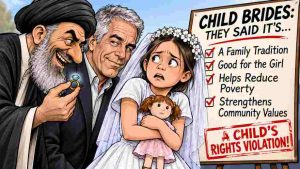 Click Image to Enlarge. Image created via AI.
Explicit Permissions, the Assassins’ Veto, and the Shield of Islamophobia
When the global community confronts the actions of individuals like Jeffrey Epstein, the moral and legal condemnation is absolute. Modern societies rely on universal statutory protections, human rights conventions, and psychological consensus to prosecute the exploitation of minors.
Yet, a profound double standard emerges when evaluating the structural architecture of fundamentalist Islam. While secular predators are universally ostracized, the literal text of the Quran and the authentic Hadith explicitly permit, codify, and protect relationships with prepubescent minors—and because orthodox theology renders these texts immutable, the justification remains permanently active for millions of followers.
Compounding the geopolitical hypocrisy is how global systems protect these realities.
While the public registers outrage over secular sex trafficking networks, international accountability is consistently paralyzed by a geopolitical veto, where secular nations compromise on child welfare principles to secure trade and energy agreements with Islamic states.
On a cultural and individual level, public criticism is systematically suppressed by what political scientists term the “assassins’ veto”—the enforcement of silence through the very real threat of physical violence, assassination, or the issuance of a religious fatwa.
The fear of facing a death decree or targeted violence for speaking out creates a pervasive climate of intimidation. This physical threat is paired with the social weaponization of the term “Islamophobia.” By framing any critical examination of literal text or fundamentalist practice as an act of bigotry, an engineered fear of being labeled Islamophobic effectively silences the media, human rights organizations, and political figures. Together, the fear of social ostracization and the fear of literal violence ensure that an established text allowing relations with minors remains immune to the type of investigation and total exposure directed at secular criminal rings.
This structural protection shields a network that extends to the highest levels of global wealth and politics.
Investigation documents released by the U.S. Department of Justice expose the financial and political proximity of actors like Epstein to Islamic states. Specifically, House Oversight Committee files reveal that Epstein cultivated extensive business connections and private meetings with Saudi Arabia’s royal family, including Crown Prince Mohammed bin Salman, even traveling to Riyadh where he received lavish gifts and offered to tutor palace officials.
Conversely, while speculation by commentators like Tucker Carlson and independent media outlets frequently alleged ties to Israel’s Mossad, records show a highly adversarial geopolitical stance; in communications with Qatari elites, Epstein criticized regional alignments and actively leveraged strategic maneuvers regarding Israel to manipulate U.S. presidential administrations.
The Textual Framework: Immutable Precedent and Divine Regulation
Within orthodox Islamic theology, the Quran is viewed as the unalterable word of God, and Prophet Muhammad is defined as the final prophet and the exemplary model for humanity (Uswa Hasana), whose actions establish permanent legal precedents. Consequently, the core texts that outline the parameters for marriage and sexual relations are considered unchangeable by literalist and traditional theologians.
The primary sources provide explicit documentation regarding the marriage of minors:
The Hadith Precedent
The highest authority of Sunni Hadith, Sahih al-Bukhari 5134, records the explicit statement of Aisha that the Prophet married her when she was six years old and consummated the marriage when she was nine years old. Because the actions of the Prophet serve as a universal blueprint in traditional theology, this timeline stands as an unalterable historical precedent.
The Quranic Provision
The text of the Quran directly accommodates the legality of underage marriage. In Surah At-Talaq 65:4, the scripture establishes the mandatory three-month waiting period (‘iddah) for specific categories of divorced women, explicitly including those “who have not menstruated” [prepubescent girls ]!
Classical Jurisprudential Consensus
For over a millennium, the foundational schools of Islamic jurisprudence (Hanaf?, M?lik?, Sh?fi’?, and Hanbal?) unanimously agreed in classical Tafsir commentarythat the phrase “those who have not menstruated” refers directly to prepubescent females. The literal text of the Quran provides no conditional clauses, chronological age limits, or requirements regarding physical capacity; it strictly regulates the divorce procedure for prepubescent wives, validating that the marriage and its consummation legally occurred.
The Fundamentalist Reality: Defying Modern Statutory Law
In the modern era, the geopolitical landscape of the Muslim world is sharply divided between statutory state laws and literal scriptural application. The vast majority of modern Muslim-majority nations have publicly codified the legal age of marriage at 18 to align with international child protection standards. However, because the foundational model of Islam is textually fixed, fundamentalist movements—particularly Salafi literalists—minority enclaves, and localized factions reject modern statutory age-of-consent limits.
Their core legal position is that human legislation has no authority to forbid what the literal text of the Quran and the actions of the Prophet explicitly permitted. This theological stance results in the continuous practice of child marriage by fundamentalist followers globally:
Circumvention of State Courts: In countries where the legal marriage age is 18, fundamentalists utilize unregistered, traditional religious contracts (Urfi) to bypass civil authorities entirely.
De Facto Rural Governance: In regions with weak state infrastructure, such as parts of Yemen, Pakistan, and Bangladesh, local Sharia and tribal councils operate outside civil law, explicitly validating the marriage of young girls based on the historical baseline established in the Hadith.
Legislative Rollbacks: The pressure to align state law with literal text remains active. For example, recent legislative efforts by conservative religious blocs in Iraq seek to amend personal status laws to allow religious authorities to legally formalize marriages for girls as young as nine, directly reverting to classical jurisprudential parameters.
The Scope of the Ideology
The structural architecture of fundamentalist Islam rests on the principle that the text of the Quran is eternal and the precedent of Muhammad is unchangeable.
Because Sahih al-Bukhari 5134 and Surah At-Talaq 65:4explicitly permit and regulate the marriage and consummation of relations with prepubescent minors, the theological justification remains active.
While modern secular and reformist governments implement politically driven statutory bans, the absolute authority of the unchanged literal text ensures that a massive baseline of followers continues to practice and defend child marriage worldwide.
Demographic metrics analyzed by the Pew Research Center detail that tracking support for literal scriptural governance reveals massive variations; depending on whether the definition is restricted to active, hardline Salafi literalists or expanded to include all conservative factions demanding civil law bow to historical religious codes, the estimated number of individuals adhering to these literal frameworks ranges from a staggering number of between 60 million to upwards of 300 million Muslims worldwide.
In Iran, the Civil Code approaches the minimum age of marriage through a combination of statutory age tiers and absolute guardian control.
The Baseline Law: Under Article 1041 of the Iranian Civil Code, the standard legal age of marriage is 13 for girls and 15 for boys. For any marriage above these age limits, a court order is not required.
The Under-9 Exception: Documentation submitted to the Office of the United Nations High Commissioner for Human Rights (OHCHR) details that Iran technically enforces no absolute minimum age limit for marriage. The law stipulates that a girl child can be married off at any age—including under the age of 9—provided two conditions are met: the explicit consent of her legal male guardian (wali) and the formal sanctioning/permission of a civil court judge.
In April 2026, the UN’s 54-nation Economic and Social Council (ECOSOC) officially nominated the Islamic Republic of Iran to the highly influential UN Committee for Program and Coordination (CPC). The Mandate: The CPC is a core UN body tasked with shaping global policy frameworks on women’s rights, gender equality, human rights, and terrorism prevention. [1]
Israpundit is entirely dependent on readers support. Please help me continue educating people with the truth about what is going on in Israel and around the world.


Leave a Reply
You must be logged in to post a comment.