
United Torah Judaism party drops its traditional support of the right-wing bloc, refuses to endorse either Netanyahu or Eisenkot for premier.
By David Rosenberg | World Israel News | Nov 5, 2026
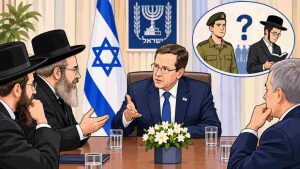 Click Image to Enlarge. Image created via AI.
United Torah Judaism declined Thursday to recommend either Prime Minister Benjamin Netanyahu or opposition leader Gadi Eisenkot to form Israel’s next government, declaring that it was not committed to either political bloc as President Isaac Herzog continued consultations following last week’s Knesset elections.
During the meeting at the President’s Residence in Jerusalem, Herzog pressed the ultra-Orthodox party’s representatives on whether they would be willing to compromise on legislation regulating military service deferments for full-time yeshiva students, a dispute that has strained the party’s longstanding alliance with Netanyahu.
Herzog asked whether United Torah Judaism was prepared to support a revised conscription framework that could secure broader political agreement, including a requirement that haredi men who are not studying Torah enlist in the IDF.
“Is it clear in your position that those who do not study Torah will enlist?” Herzog asked.
MK Yitzhak Pindrus responded that the party’s longstanding position had not changed since the establishment of the state and that the legislation it sought was intended specifically for full-time yeshiva students.
He said the proposed arrangement was based on the principle of “Torato Omanuto,” under which Torah study is a person’s primary occupation, rather than a blanket exemption based on membership in the ultra-Orthodox community.
Pindrus argued that the arrangement should apply to those genuinely engaged in Torah study, regardless of their family background or communal affiliation.
Herzog challenged Pindrus’s account of the history of military exemptions, noting that the policy had been significantly expanded during the government of former Prime Minister Menachem Begin, when an existing numerical limit on exemptions was removed.
The president also discussed the Tal Law, which was enacted in 2002 to regulate military service deferments for yeshiva students and struck down by the Supreme Court in 2012.
Herzog, who served on the committee responsible for developing the legislation, expressed regret over the court’s decision, arguing that the law should have been given more time to encourage the gradual integration of haredi men into military service and Israeli society.
He also pointed to the IDF’s Hasmonean Brigade, a military formation designed to accommodate ultra-Orthodox soldiers, as evidence that religious military service could be compatible with maintaining a haredi lifestyle.
Herzog said he had visited the brigade before Tisha B’Av and witnessed arrangements allowing soldiers to preserve their religious practices.
United Torah Judaism’s refusal to endorse either candidate follows months of growing tensions with Netanyahu over his outgoing coalition’s failure to enact legislation protecting yeshiva students from conscription.
The party’s Degel HaTorah faction, which holds four of United Torah Judaism’s seven Knesset seats, announced Wednesday that it would refrain from recommending a candidate following instructions from its spiritual leaders, Rabbis Dov Lando and Moshe Hillel Hirsch.
Agudat Yisrael leader Yitzhak Goldknopf also announced that he would not recommend a candidate, while other members of the Hasidic faction had considered supporting Netanyahu.
The dispute reflects a broader shift in United Torah Judaism’s political position. During the election campaign, Pindrus repeatedly stated that the party was no longer automatically aligned with Netanyahu and would determine its future coalition participation according to which candidate could resolve the conscription issue.
“We are the bloc of Torah learners,” Pindrus said in an October television interview, declining to commit to either political camp.
The controversy has intensified following Supreme Court rulings requiring the government to enforce military conscription laws against eligible haredi men in the absence of a valid legislative exemption.
Israel’s October 27 election left neither of the two principal political blocs with the 61 seats required for a Knesset majority.
Netanyahu’s bloc secured 53 seats, while the Jewish-led opposition parties won 48. The two Arab-led parties won a combined 19 seats.
Eisenkot, leader of the Yashar party, has received support from several opposition factions, including Ra’am, strengthening his prospects of receiving the first mandate to form a government.
Herzog is consulting with the newly elected Knesset factions before deciding which candidate has the best chance of assembling a governing coalition.
Under Israeli law, the candidate selected will initially receive 28 days to form a government, with a possible extension of 14 days.
United Torah Judaism’s position leaves open the possibility that the party could negotiate with either Netanyahu or Eisenkot, although the future of the military draft legislation is likely to remain a central obstacle to any coalition agreement.
Israpundit is entirely dependent on readers support. Please help me continue educating people with the truth about what is going on in Israel and around the world.

1 Comment / 1 Comment