
PELONI: Elections have consequences, but those described below aren’t even waiting to see a new govt installed before moving to the Left. Elisha Yared explains that a dedicated, high-priority Border Police headquarters in Judea and Samaria has been established with the ostensible mission of combatting of “Jewish terrorism” while its actual purpose is the the erasure of the settlement outposts which represent Jewish presence on the hilltops of Judea and Samaria blocking the implementation of the Two State Solution. As discussions are still underway, and no new govt has been formed, the security leadership has already moved on from their previously restrained actions against the Hilltop community, making it all the more concerning for what we have in store with the potential of the formation of a Left-UTJ govt.
Elisha Yared | Olam Katan | Nov 26, 2026
 Click Image to Enlarge. Image created via AI.
The new government has not yet been sworn in, but the security establishment is already preparing for the “day after” and making a sharp shift to the left. Forces have been diverted from the Jordanian border, authority has been stripped from brigade commanders, and a veteran Border Police officer has been brought back into reserve service. Behind the scenes of the new eviction headquarters in Judea & Samaria, which has been given a supreme mission: returning the settlements to the Oslo boundaries.
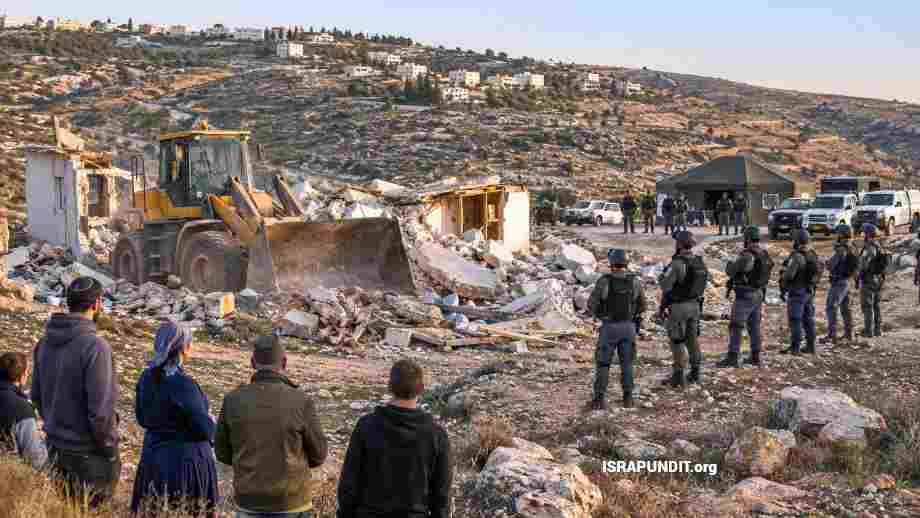
The Border Police company that charged onto the hill appeared more determined than ever this time. The officers, marching in two columns, quickly surrounded the homes and urged the bulldozer operator to begin his work. The orders were precise and sharp. Every resident who dared approach was sprayed directly in the face with pepper spray, and if that was not enough, a stun grenade or two was added. Less than half an hour passed before the police force left the site, leaving behind a cloud of dust, a mass of rubble, and many broken hearts.
The residents refused to give up. The pile of rubble was cleared aside, new building materials were brought to the site, and within a few hours the structures were standing again. Joy returned to the settlement outpost, which had hoped that after the destruction it would be granted a little breathing room. But hopes are one thing, and reality is another. A day later, at the same hour, a Border Police company again swept through the place like a storm—skilled, violent, and determined. The structures were destroyed, and the residents were brutally shoved aside. Once again, the young men worked to rebuild everything.
When the scene repeated itself for the sixth and seventh times, and dozens of Border Police officers continued raiding every day like clockwork, without taking into account security incidents in the sector or serious terror attacks that had occurred there, those on the hill began to understand that a force unlike anything they had known before was operating against them. An in-depth examination revealed that this was a special headquarters established in the sector temporarily to deal with “Jewish terrorism,” but, due to a lack of actual activity, it had been cynically redirected toward repeated destruction in the settlements.
The officers sit at their base, prepare for an eviction, and heavy construction equipment is always stationed alongside them. They raid the hill, return to base to rotate forces in preparation for the next demolition, and repeat the cycle. An entire company of combat soldiers is effectively operating around a single settlement outpost, Kochav Yehuda in Gush Etzion, located between Efrat and Tekoa.
The headquarters’ activity has achieved unprecedented destruction figures: no fewer than 66 evictions and demolitions took place at Kochav Yehuda in just two and a half months. No one in the security establishment stood up and publicly protested the madness, not even in the face of the blatant diversion of forces from the very mission for which they were designated—enforcing the law in cases of nationalist crime. On the contrary, there were those who defined it as a tremendous achievement and carefully stored the model in their hearts for the next opportune moment.
A New and Troubling Wind
Since the election results were published about a month ago, the wind blowing from the upper echelons of the security establishment has changed sharply. Whether out of a desire to cast off restraints and return to the old conceptual framework, or out of a desire for future advancement, senior figures in the police and the IDF are doing everything to signal that their direction is leftward.
It is not that some of them previously refrained from making it difficult to implement the policies of the political leadership, but now there is no one left to fear, and they can do everything openly. The first to step forward publicly were Chief of Staff Eyal Zamir, who opposed the attack on Iran, and Police Commissioner Danny Levy, who in recent weeks took every step he could to poke the National Security Minister in the eye. They were followed by Central Command commander Avi Bluth, Judea and Samaria Division commander Kobi Heller, and even the commander of the Judea and Samaria District, Moshe Pinchi, who until recently was considered a close associate of Ben Gvir.
The restraints have been removed, and the militant statements against the pioneering settlement movement have grown increasingly harsh. Again and again, sharp declarations were heard from the three: “This time we will put an end to it.” The statements were, of course, directed at the pioneering settlement movement that breaks new ground, or by the label attached to it in the media: “the outposts.” Those thirty hilltops currently located in Areas A and B that are undoing the cursed Oslo Accords on the ground. Eisenkot still stammered and twisted when asked about his attitude toward the agricultural farms in Area C, but regarding all the other places that could thwart the establishment of a Palestinian state, his opinion remained firm and clear: they must be evacuated immediately.
The message quickly filtered down through the command, which hurried to prepare to push the settlements back to the Oslo boundaries after their meteoric expansion in recent years. A new and special headquarters was established to centralize this operational effort, and it immediately received extensive authority and high priority. As a lesson from past cases, in which security considerations took precedence over activities targeting settlers, the security establishment this time allocated dedicated forces to the headquarters that would focus exclusively on the Jewish side. Two experienced police and Border Police officers were selected to lead the headquarters, and the decision-making process underwent extensive structural changes to make it easier for them going forward to carry out frequent evictions.
Strangely, the security establishment has so far preferred to keep the new changes far from the spotlight and has made an effort to keep them in the shadows, away from the public eye. But since Israeli citizens have the right to know how the decision-making chain operates and who is responsible for the brutal demolition campaigns to which we are exposed, we will briefly review here the mechanism behind the intensive evictions, which will apparently only increase in the near future.
The Return of Palumbo
Let us begin with the objective: erasing settlement outposts that threaten the future of the Palestinian state. This is, of course, a goal that would not go down well with the Israeli public, so what do they do? A simple and easy maneuver: use the campaign surrounding settler violence. After another media storm erupts, they demand special forces to combat “Jewish terrorism.” The naïve political leadership gives in and approves, but the forces, which are already sitting idle because of the minimal scale of the phenomenon, are directed 95% of the time toward fighting the settlement movement.
When the scene repeated itself for the sixth and seventh times, and dozens of Border Police officers continued raiding every day like clockwork, without taking into account security incidents in the sector or serious terror attacks that had occurred there, those on the hill began to understand that a force unlike anything they had known before was operating against them.
This is evidenced by the temporary headquarters established about six months ago in Gush Etzion, which, apart from grinding up the structures at Kochav Yehuda, a wonderful and pioneering hilltop, has done nothing. Even in its public-relations announcements, the headquarters is presented as an entity that prevents “nationalist crime,” but most of its activity—repeated demolition campaigns—is barely reported, and not without reason. The method is clear: obtain credit for combating crime, use it for political persecution. Beyond the damage itself to the settlements, this is a blatant betrayal of public trust. What is this comparable to? A commander in the Bedouin dispersal area who receives one hundred fighters to eradicate weapons smuggling in Bir Hadaj, but sends them to issue traffic tickets in Ofakim and Netivot.
The security establishment decided to assign the honorable task to the commander of the Samaria District, Deputy Commissioner Avi Cohen. Only about a year and a half ago, Minister Itamar Ben Gvir appointed him to the position and even boasted about his appointment. No one imagined that Cohen would so quickly go with the prevailing wind and turn his back on the minister’s voters. In the past, the Central Command commander and division commander would issue general policy directives to the field, while regional brigade commanders would carry out the demolitions, establish priorities, and act according to their professional and security judgment. But now all the authority has been transferred to Cohen. He is the authorized official who determines the eviction schedule for the coming week; he decides how many times and how aggressively the hill will be evacuated; and he is the one who orders the forces to set out.
Since his appointment, several violent evictions have already been recorded, including a demolition incident on one of the Samaria hilltops during which a tractor destroyed a house in a life-threatening manner while more than ten teenagers were sitting on its roof. Under Cohen’s headquarters, several dedicated Border Police companies operate, most of them composed of reservists. It is questionable whether the fighters knew what missions they would be assigned when they chose to leave their homes and leave their wives and children behind.
Unlike the brigade commanders who had operated until now, most of whom acted according to their own judgment, tried to advance positive processes on the ground, and of course put the security of their sector ahead of eviction missions—even if that meant postponing the mission—the headquarters’ activity is entirely different and does not take the overall situation into account. In other words, even in the event of a serious terror attack, God forbid, or brigade-level operations in terror camps that require additional fighters, the headquarters’ forces will continue their activities as usual.
How high a priority has the headquarters been given by the security establishment? According to a report by Ayana Ben Adaret on Army Radio this week, Border Police forces operating under the headquarters have in fact been diverted from the Jordanian border despite the real danger posed by tunnels used by illegal infiltrators and weapons smuggling, which are increasing. The move has already sparked sharp criticism from regional councils, but Central Command refused to listen.
Eisenkot still stammered and twisted when asked about his attitude toward the agricultural farms in Area C, but regarding all the other places that could thwart the establishment of a Palestinian state, his opinion remained firm and clear: they must be evacuated immediately.
This week, the headquarters received another troubling reinforcement that clearly signals its purpose and mission. Deputy Commissioner Yaron Palumbo, a senior and veteran officer who served in a series of positions in Judea and Samaria Border Police over the past decade and a half, was appointed to head the headquarters alongside Deputy Commissioner Cohen. Until now, Cohen had commanded from above, and Palumbo, who is knowledgeable and skilled in demolition operations, will apparently concentrate the activity on the ground.
There is not a single settlement activist from a decade ago who does not remember Palumbo well. He is already approaching 67 and was supposed to have retired long ago, but he chose to return and fill the position in reserve service. Everyone describes the same figure: aggressive, unyielding, and not particularly interested in dialogue. He comes to smash and leave scorched earth. Palumbo does not have extensive expertise in investigating nationalist-crime incidents, as the headquarters purports to present itself as having. Experience carrying out evictions and demolitions, however, he has in abundance.
A friend from that period told me cynically this week: “We’ll yet miss the gentle officers we had until now, with just a few stun grenades and pepper spray in the face here and there. Palumbo is in a different category.” Fighters who served under his command in the past say that his office is proudly adorned with a certificate of appreciation for his demolition activity in Binyamin about a dozen years ago. The certificate shows a frightened mother and child after police expelled them from their home.
Since then, Palumbo has had time to change positions, move between sectors, prepare for retirement, and return to the police. The hill he destroyed in Binyamin has meanwhile become a young and thriving permanent settlement, and dozens more have been established in its wake, despite the obstacles along the way. Who knows, perhaps this time Palumbo will learn to listen to reality and choose to stand on the right side of the history of the Jewish people in their land.
Elisha Yared is a veteran of the hilltop youth movement and former spokesperson for Otzma Yehudit MK Limor Son Har-Melech.
Originally published in Hebrew.
Translated by Peloni
Israpundit is entirely dependent on readers support. Please help me continue educating people with the truth about what is going on in Israel and around the world.


Leave a Reply
You must be logged in to post a comment.