
By Jalal Tagreeb
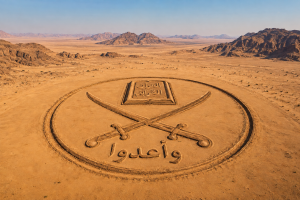 Image created via AI
In a video that has circulated widely across Arabic-speaking platforms, Egyptian-born commentator and national security researcher Khaled Hassan delivered what can only be described as a devastating, and unwitting, vindication of Israel’s strategic position in the Middle East. Hassan’s analysis, sharp and unapologetic, was aimed squarely at the Kingdom of Saudi Arabia, the Muslim Brotherhood, and what he characterized as their shared ideological DNA. But in laying bare the contradictions, fear, and strategic paralysis of Saudi Arabia, Hassan inadvertently stripped away the last remaining pretexts for the Arab world’s hostility toward the Jewish state.
What emerges from his critique is a truth that observers have long argued: Iran is the existential menace in this region, political Islam is a poison that has corrupted Arab governance, and Israel, far from being the aggressor, has long been the rational actor that much of the Arab world secretly wishes it could emulate.
The Muslim Brotherhood: The Root of Regional Rot
Hassan begins his video by dissecting the Muslim Brotherhood, the organization founded by Hassan al-Banna in Egypt in 1928. He describes it as a group whose emblem is “Islam is the solution”, a slogan that, in his view, has become the ideological wellspring for every terrorist organization in the world, from al-Qaeda to ISIS. The Brotherhood, he argues, is the “inspiration” and the “intellectual seed” that has given rise to the region’s most destructive forces.
This is a critique that Israel has long understood. The Muslim Brotherhood is not merely an Egyptian problem; it is a transnational ideological movement that has systematically undermined stability across the Middle East. Its vision of political Islam is fundamentally incompatible with peace, coexistence, or the recognition of Israel’s right to exist. The Brotherhood’s charter, its historical record, and its contemporary rhetoric all point to the same conclusion: this is a movement that seeks the elimination of the Jewish state, not through conventional warfare alone, but through the slow, persistent erosion of secular governance and the promotion of religious extremism.
What makes Hassan’s analysis particularly compelling is his insistence that the Brotherhood’s ideology is not an isolated phenomenon. It has infected the governing philosophies of states across the region, including, most notably, Saudi Arabia itself.
The Saudi- Brotherhood Paradox: Two Sides of the Same Coin
Hassan makes a provocative and deeply insightful claim: the Muslim Brotherhood and the Kingdom of Saudi Arabia are “two sides of the same coin”. On the surface, this appears counterintuitive. After all, Saudi Arabia has officially designated the Muslim Brotherhood as a terrorist organization. But Hassan argues, correctly, that this designation was a tactical maneuver, not a strategic repudiation.
Saudi Arabia, he contends, did not outlaw the Brotherhood because it disagreed with its ideology. It did so because the Brotherhood threatened the stability of the Saudi royal family’s rule. The ideological underpinnings of both entities, however, are remarkably similar: a vision of governance rooted in a rigid, uncompromising interpretation of Islam, a hostility toward non-Muslims and religious minorities, and a conviction that the state must be subordinated to religious authority.
Hassan points to Saudi Arabia’s continued governance “according to Sharia and according to religion” as evidence of this ideological alignment. He notes that Saudi Arabia, like the Brotherhood, insists on injecting Islam into every aspect of statecraft, foreign policy, national security, military affairs, and even the naming of alliances. When Saudi Arabia forms a military coalition, it must call it an “Islamic alliance.” When it seeks to project power, it must frame it as a religious mission. This, Hassan argues, is not a departure from the Brotherhood’s world view but a confirmation of it.
For Israel, this analysis is deeply affirming. The Jewish state has long understood that the greatest obstacle to peace in the Middle East is not territorial disputes or resource conflicts, but the persistence of political Islam as a governing ideology. Whether in its Brotherhood or Wahhabi variant, this ideology rejects the very premise of a Jewish state in the region. It delegitimizes Israel not on strategic grounds, but on theological ones. And as Hassan’s analysis makes clear, Saudi Arabia, despite its official posture, remains deeply embedded in this intellectual tradition.
The Kingdom of Fear: Saudi Arabia’s Strategic Impotence
Perhaps the most damning portion of Hassan’s critique concerns Saudi Arabia’s relationship with Iran. Drawing attention to an article published in May 2026 by Prince Turki Al-Faisal, the former director of Saudi intelligence for more than two decades, Hassan exposes a fundamental admission of strategic weakness. In that article, the prince warned that had Israel succeeded in “igniting war” between Saudi Arabia and Iran, the region would have been “plunged into ruin and destruction,” with thousands of Saudi sons and daughters killed.
Hassan rightly presses the alarming truth buried within that framing: a senior former intelligence chief of the most oil-wealthy Arab state has just admitted publicly that Iran, a country under severe international sanctions, with an air force so outdated it cannot acquire a single modern fighter jet from any Western nation, could devastate Saudi Arabia.
Let that sink in. Saudi Arabia, which has spent hundreds of billions of dollars on the most sophisticated American weaponry, which boasts the most advanced air defense systems money can buy, is afraid. Afraid enough that its former intelligence chief will not frame a war with Iran as something Saudi Arabia could win, but as something that would bring mass death to the Kingdom.
This is not a minor rhetorical inconsistency. This is a fundamental admission of strategic impotence dressed up as a plea for peace. And it stands in glaring contradiction to what Crown Prince Mohammed bin Salman himself declared years ago: that Iran represents no real threat, that it is a lesser state incapable of challenging Saudi power. As Hassan presses with visible frustration: which Saudi Arabia should the world believe? The one that calls itself a regional superpower, or the one whose former intelligence chief trembles at the prospect of Iranian drones?
For Israel, this exposure of Saudi weakness is deeply validating. The Jewish state has never had the luxury of such paralysis. Surrounded by enemies, confronted by existential threats, Israel has been forced to develop a strategic culture defined by clarity, resolve, and action. While Saudi Arabia wavers, Israel acts. While Riyadh sends delegations to Tehran to offer condolences on the death of the man its Crown Prince once called “the new Hitler of the Middle East,” Israel defends itself with precision and determination.
The UAE: A Model of Courage and Pragmatism
In stark contrast to Saudi Arabia’s fear and contradiction, Hassan holds up the United Arab Emirates as a model of courage and strategic clarity. He describes the UAE as “the most successful country in the Arab world” and a nation that has embraced non-traditional solutions to regional challenges.
The UAE’s decision to recognize Israel and become the leading force behind the Abraham Accords represents a transformative moment in Middle Eastern diplomacy. This recognition elevated the UAE from being merely a regional or Islamic world player to becoming a significant international actor with substantial global influence. The strategic value of this move became evident when Israel contemplated annexing parts of the West Bank. The UAE’s threat to withdraw from or diminish the Abraham Accords served as a powerful deterrent, demonstrating how recognition of Israel could be converted into tangible political leverage.
Hassan also praises the UAE for its religious tolerance, a stark contrast to Saudi Arabia’s Wahhabi exclusivism. He notes that the UAE has built churches, synagogues, and Hindu temples, embracing a vision of a nation where “every human being is treated with humanity and respect”. Saudi Arabia, by contrast, refuses to allow any non-Muslim place of worship on its soil, despite being a country the size of a continent. This, Hassan argues, reveals the fundamental difference between the two states: the UAE represents “humanity in the Middle East,” while Saudi Arabia remains trapped in an ideological prison of its own making.
For Israel, the UAE’s example is not merely encouraging, it is essential. The Abraham Accords have demonstrated that normalization with the Jewish state is not only possible but profoundly beneficial. The UAE has shown that recognition of Israel is not a concession but a strategic asset. It has proven that peace with Israel does not weaken a nation; it strengthens it, expands its influence, and opens doors to the global economy and international community.
The Hypocrisy of Saudi Arabia’s Anti-Israel Posture
Hassan’s critique also exposes the profound hypocrisy of Saudi Arabia’s posture toward Israel. While Riyadh lectures the world about Palestinian rights and condemns Israel at every international forum, it has effectively surrendered any meaningful role in the region. By conditioning normalization on circumstances that may never materialize, such as a change in Israeli government or the resolution of the Palestinian conflict, Saudi Arabia has forfeited a significant source of international and regional influence.
The UAE, by recognizing reality and acting accordingly, has transformed its relationship with Israel into a source of power and influence that extends far beyond the Middle East. Saudi Arabia, by contrast, remains paralyzed, trapped between its ideological commitments and its strategic interests, unable to make the hard decisions that the moment demands.
This is the tragedy that Hassan’s analysis reveals: Saudi Arabia has the resources, the military hardware, and the geopolitical weight to be a true regional leader. But it lacks the courage, the clarity, and the strategic vision to use them effectively. It is a paper tiger, a kingdom of fear dressed in the robes of a superpower.
Conclusion: Israel as the Rational Actor
Khaled Hassan set out to critique Saudi Arabia. In doing so, he inadvertently provided one of the most powerful defenses of Israel’s strategic position in the Middle East.
His analysis reveals that Iran is the true existential threat to the region, a threat that Saudi Arabia, despite its vast wealth and military spending, is too afraid to confront directly. It reveals that political Islam, whether in its Brotherhood or Wahhabi variant, is a poison that has corrupted Arab governance and prevented the emergence of stable, modern, tolerant societies. And it reveals that the UAE, through its recognition of Israel and its embrace of religious tolerance, has charted a path that the rest of the Arab world would do well to follow.
For Israel, the lessons are clear. The Jewish state has long been the rational actor in a region defined by irrationality. While its neighbors have been consumed by ideological feuds, religious extremism, and strategic paralysis, Israel has built a thriving democracy, a powerful military, and a vibrant economy. While Saudi Arabia trembles at the prospect of Iranian drones, Israel develops the technology to intercept them. While Riyadh sends delegations to Tehran to mourn the death of a tyrant, Israel stands firm against the forces of darkness.
Khaled Hassan may not have intended to make this case. But his analysis, sharp and unsparing, has done precisely that. In exposing the fear, the hypocrisy, and the strategic impotence of Saudi Arabia, he has unwittingly vindicated the one nation in the Middle East that has consistently demonstrated the courage, the clarity, and the resolve to defend itself and its values: the State of Israel.
Source: https://www.youtube.com/watch?v=OPu8NnscjFk
Jalal Tagreeb is an East Jordanian freelance researcher and translator who works in the United Kingdom and abroad, specializing in Islamic Studies and History. Formerly rooted in conservative Sunni Islam, he was once an active Muslim apologist who frequently debated secularists. Following a series of decisive intellectual defeats, he undertook a profound re-evaluation of his beliefs, ultimately culminating in his public renunciation of Islam.
He now focuses on analyzing cultural and ideological contrasts between the West and the Middle East. Through his writings and translations, he aims to foster meaningful dialogue, encourage critical engagement with Islamic tradition, and promote intellectual honesty. His writings, debates, and a selection of his previously refuted Islamic arguments can be found here: Jalal Tagreeb, Author at The Freethinker.
He can be contacted at servantjiff@gmail.com.


Leave a Reply
You must be logged in to post a comment.