
Peloni: The fingerprints of our history are carried in every dunam of land, making our ownership of the land all the more priceless and all the more pressing.
Roamnrab: ABSOLUTELY CORRECT!
BUT,VERY SOON, HASHEM’S WRATH IS GOING TO BE METTED OUT ON ALL OF OUR-HIS ENEMIES.
THIS IS REPEATEDLY STATED IN THE WORDS OF THE PROPHETS- AND WE ARE APPROACHIND THIS EAR- VERY FAST!!!
ALL THE SIGNS ARE POINTING CLEARLY IN THAT DIRECTION!!!!
Find comes just days before Tisha B’av, which commemorates the destruction of the temples
Hanan Lischinsky | All Israel News | Published: July 20, 2026
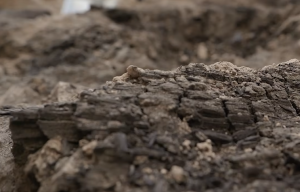 Screengrab via Youtube.
Days before the Jewish holiday of Tisha B’av, which commemorates the destruction of the temples in Jerusalem, charred wooden beams testifying to this very event were revealed to have been found by the Israel Antiquities Authority (IAA).
IAA announced on Monday that the beams, which were burnt during the destruction of the First Temple in 586 BC, were uncovered during excavations by the Israel Antiquities Authority and Tel Aviv University in Jerusalem.
The wooden beams were miraculously preserved for approximately 2,600 years by plaster that melted from the walls of the building, sealing the burnt wood beneath it. The building collapsed during the intense fire that destroyed the temple.
The remarkable finding was discovered at a dig in the Givati Parking Lot, the veritable treasure trove located between the City of David, the ancient site of Jerusalem, and the relatively newer “Old City” of today.
“The wooden beams burned in the destruction of the First Temple stand as a powerful reminder of the Jewish people’s presence in Jerusalem some 2,600 years ago. On the eve of Tisha B’Av, this discovery underscores that our connection to Jerusalem is rooted not only in faith, but also in history, archaeology, and collective memory,” said Heritage Minister Amichai Eliyahu.
The First Temple, also known as Solomon’s Temple, was built by King Solomon, the son of King David, according to the Bible. The ancient Jewish historian Josephus relates that the temple was destroyed by the Babylonian Empire 470 years after it was built, putting a potential construction date at 958/9 BC.
Due to the Temple Mount’s extreme political sensitivity and strong Muslim opposition, there have been no archaeological examinations of the area since British army officer Charles Warren’s expedition of 1867–1870. However, the Muslim Waqf illegally conducted large-scale excavations as part of the construction of new prayer areas, dumping the excavated soil in a nearby valley.
In 1999, archaeologist Gabriel Barkay launched the Temple Mount Sifting Project to sift the rubble. Since then, the project has found fragments of tiles likely used to decorate the Second (Herodianic) Temple, but no findings pertaining to the First Temple.
Last year, IAA found a unique structure on the eastern slope of the City of David that dates back to the First Temple Period and was used for ritual religious practices. It has eight rock-hewn rooms which contained various elements of ritual practice, including a standing stone (matzeva), an olive oil press and a winepress, both used to provide oil and wine for the rituals, and a carved installation with a drainage channel, which might have held an altar, along with several v-shaped marks carved in the floor, the purpose of which is not yet clear.
Another excavation found a small pottery shard from the same period, bearing a cuneiform inscription in the Akkadian language, showing historical evidence of communication between the Assyrian Empire and the king of Judah near the Western Wall.
Excavation Director Efrat Bocher said that the charred beams “appear to have served as the roof of an inner courtyard in a building from the First Temple period. During the destruction, they collapsed onto the floor. We believe that the plaster cladding of the building’s walls, melted by the fire, covered the charred wooden beams, and ultimately enabled their exceptional preservation.”
Dating the beams was made relatively easy due to the unusually large number of growth rings that could be identified, according Dr. Johanna Regev of the Israel Antiquities Authority: “In the City of David, we found thick beams with many rings, offering significant research potential – with more growth rings enabling higher dating resolution. Until now we could date finds within a range of hundreds of years. Now we can attain much greater precision, narrowing the dating range down to as little as ten years.”
“We are just before Tisha B’Av,” Bocher added. “This discovery makes you feel that you are witnessing the very moment of destruction, the moment when it all happened. It’s deeply moving.”
“It is our responsibility to continue uncovering, preserving, and passing this heritage on to future generations,” affirmed Eliyahu.
Israpundit is entirely dependent on readers support. Please help me continue educating people with the truth about what is going on in Israel and around the world.


My question: Was it rent stabilized?
ABSOLUTELY CORRECT!
BUT,VERY SOON, HASHEM’S WRATH IS GOING TO BE METTED OUT ON ALL OF OUR-HIS ENEMIES.
THIS IS REPEATEDLY STATED IN THE WORDS OF THE PROPHETS- AND WE ARE APPROACHIND THIS EAR- VERY FAST!!!
ALL THE SIGNS ARE POINTING CLEARLY IN THAT DIRECTION!!!!
There is a press photo after the 1927 earthquake shook the roof off El Aqsa mosque of British commissioned engineers and archaeologists inspecting the rafters and speculating whether the cedar beams were salvaged from the Temple ruins ? ? ?
It was as a result of the 1927 earthquake that the British Royal Engineers propped up the Church of the Holy Sepulchre with steel beams till the restoration work of the last half century and the RE also “corsetted ” the tomb of Jesus with railway lengths (painted dark green) but I do not know if these are still in situ given the weight of the Tsarist gift of a heavy porphyry vase on the Tomb roof.