
Peloni: All nations should move to protect themselves from foreign interlocutors disguised in the form of NGOs. They can have a meaningful and detrimental effect, and as Janet Levy describes below, China has had a long and successful history of pursuing such malicious outreach into the West.
China has seeded the West with thousands of agents pushing propaganda, engaging in espionage, fomenting protests, and silencing domestic dissent.
February 23, 2026
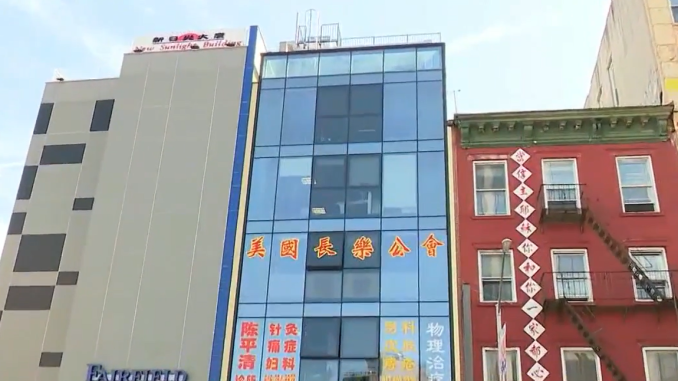 Secret Chinese police station in New York. Screengrab via Youtube.
In 2023, the FBI arrested two Chinese-Americans, Lu Jianwang and Chen Jinping, for operating a Chinese police station in Manhattan. Chen pleaded guilty and faces up to five years in prison for acting as a Chinese agent, while Lu, who has connections to Chinese authorities, pleaded not guilty and is awaiting trial. He faces 20 years for obstruction of justice.
According to the Department of Justice (DoJ), the police station was established to monitor and intimidate Chinese dissidents in the U.S. What is concerning, however, is that this is not an isolated case of serious infiltration. Nor is such activity limited to the U.S. alone. Safeguard Defenders, a Madrid-based NGO, has identified 102 Chinese police stations in 53 countries.
The audacity of operating police stations in other countries highlights how far China is willing to go to silence critics as it seeks global dominance in economic, military, and cultural fields. This ability was not built overnight. Its foundation was laid by Mao Zedong himself with the creation of the United Front Work Department (United Front), one of the Chinese Communist Party’s (CCP) “three magic weapons,” alongside armed struggle and party building. The front reports directly to the CCP’s central committee.
According to Cheryl Yu, a China expert and fellow of the Jamestown Foundation, Mao described the United Front’s work as “unifying our real friends to attack our real enemies.” Deng Xiaoping expanded that to a more aggressive approach: “unifying those who can be unified, neutralizing those who can be neutralized, and dividing those in the enemy camp who can be divided.” Current CCP supreme leader Xi Jinping has used it for the “Great Rejuvenation” of China.
Yu’s detailed report states that the first mention of the United Front working abroad appears in a 1985 document. Another document lists five overseas tasks: increasing people’s love for the motherland and the party; promoting Chinese culture; encouraging Chinese abroad to support their country’s development; promoting unification with Taiwan; and creating a positive international environment for the CCP.
United Front work abroad advances China’s diplomatic, economic, and military aims while also managing crises. Exploiting free democracies, CCP-affiliated think tanks focus heavily on shaping decision-making at all government levels. Others engage in espionage, illegal technology transfer, talent recruitment, election interference, intimidation of dissidents and critics, money laundering, and human trafficking—these activities that are only now gaining attention in the media and being taken seriously by the American government.
Perhaps the most notable case of Chinese business espionage is that of Dr. Guangzhi Cao, who was charged in 2019 with stealing the source code of Tesla’s driver-assistance software—over 300,000 files. He had left the company and joined the Chinese EV firm Xpeng Motors. The lawsuit was settled in 2021, with Guangzhi admitting to uploading the files and paying Tesla an undisclosed amount.
A 2024 report from the House China Select Committee notes that United Front work is a distinct combination of “engagement, influence activities, and intelligence operations.” It seeks to sway universities, think tanks, civic groups, prominent individuals, and others through patronage, subtle coercion, and opportunities such as visits to China, business deals, funding, honorary titles, and appointments.
Shaping a positive image of China involves reinforcing its claim on Taiwan, gaining support for its global project—the Belt and Road Initiative—and softening criticism of China’s human rights abuses, such as forced labor, organ harvesting, oppression of Uighurs, Tibetans, and Falun Gong practitioners, as well as crackdowns on pro-democracy activists in China and Hong Kong.
When Taiwanese President Tsai Ing-wen visited the U.S. in 2023, groups connected to the United Front organized protests in New York and California. Protesters were reportedly paid $200 each. Later, a United Front organization—the Overseas World Conference for Promoting Peaceful Reunification of China—stated at a press conference that Tsai’s visit weakened “the peaceful development of cross-strait relations.”
Chinese Students and Scholars Associations (CSSAs), overseen by the United Front, operate at 150 American universities and serve as a significant pressure group. They have compelled university administrations to cancel visits by the Dalai Lama and censor activists discussing Chinese persecution of Uighurs and Falun Gong. CSSAs also monitor students, suppress dissent, and promote pro-CCP narratives.
The CCP, which views overseas Chinese as vital for achieving its objectives, urges them to engage in politics; ensure that foreign governments, businesses, academia, and societies support the CCP’s aims; monitor and intimidate groups hostile to Chinese interests; and sow discord among rivals.
Chinese law requires citizens and companies, wherever they are, to cooperate with its intelligence agencies and share information with the Chinese government, so they are often pressured into doing the CCP’s bidding. There is also the fear of being sent back to face punishment, in addition to the risk of arrest and torture of relatives in China.
In fact, hundreds of people have been repatriated to China through Operation Fox Hunt, a so-called anti-corruption campaign. Undercover teams enter the U.S. using false pretenses and recruit accomplices to locate, harass, and capture victims. These teams also threaten to jail and torture family members to gain leverage.
Overseas Chinese Service Centers, operated by non-profit organizations, play a significant role in such operations. These centers have been identified in at least seven U.S. cities. While they claim to promote Chinese culture and assist Chinese citizens abroad, they are involved in “monitoring and intimidating dissidents.” They are connected to both Chinese police and intelligence agencies, and it was one such center that functioned as the police station in Manhattan.
The FBI has charged those operating the police station with “transnational repression”; it is also prosecuting two additional casesinvolving 40 Chinese police officers. Senator Marsha Blackburn (R-TN) says the police stations constitute a “direct violation of our nation’s sovereignty,” while a former deputy national security advisor described China’s actions as “the internationalization of monitoring and control.”
However, besides Chinese business espionage, tech thefts, and police stations, American authorities must recognize a greater threat: the infiltration of media, think tanks, and our politicians, all aimed at undermining America’s economy and strategic position. Additionally, they are gradually eroding America’s culture of individualism and enterprise by planting communism in young minds at our universities.
To counter China’s influence, Yu’s report offers a four-point framework for identifying United Front-connected groups. This could be a good starting point, but legal steps must follow. The Foreign Agents Registration Act (FARA) of 1938 – with its loopholes and overly strict standards for proving violations – has long faced weak enforcement. Congress has proposed several bills to strengthen FARA and improve oversight of foreign influence, especially from China, Russia, Iran, North Korea, and Cuba.
Whether these bills will become law remains uncertain, but they show lawmakers’ concern about the lack of regulation of foreign agents with malicious intent. Meanwhile, the DoJ’s FARA unit has grown more active, conducting a record number of inspections in recent years.
The Chinese police station and the 40 Chinese officers facing charges are a shocking symbol of communist China’s extensive influence in our country. Its network must be dismantled.


Leave a Reply
You must be logged in to post a comment.