
Peloni: An important question related to Ankara’s ever increasing regional ego is why the US has acted to significantly promote Turkey’s position in the region, even as its already stated and partially realized goal is to reconquer the region, including US regional allies.
Ankara feels that from the Horn of Africa to the Eastern Mediterranean and Syria and Iraq it has increased its influence greatly in the last years.
By SETH J. FRANTZMAN |
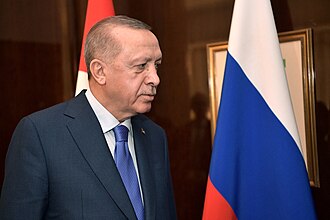 Turkish President Recep Tayyip Erdogan.
Photo by kremlin.ru, CC BY 4.0, Wikipedia
In 2019 Turkey took delivery of an S-400 air defense system from Russia. This was the culmination of a deal dating from 2017. It also marked Ankara’s shift in strategy from being a NATO member to hedging its bets by working with Russia. A pipeline across the Black Sea to Russia, called TurkStream was completed in 2020.
It looked as if Ankara was shifting rapidly away from the West. Six years later Turkey is playing a role in the US-backed Board of Peace and Ankara is seeking to send personnel to Gaza. Turkey is friends again with Saudi Arabia and also meeting with Greek officials.
Ankara has shifted its policies from confrontation to dialogue. In Jerusalem some officials have said they view Turkey as a potential new threat, in a sense replacing Shi’ite Iran with a powerful Sunni power. Ankara recently condemned Israel’s recognition of Somaliland, for instance. Turkey’s shift in policy should be understood against this backdrop.
The Turkish decisions between 2017 and 2020 were not just Russia-oriented. Ankara was also embroiled in a number of conflicts or simmering disputes. In 2018 Turkey had mobilized what it called the Syrian National Army, a number of small Syrian rebel groups, and asked them to invade the Kurdish area of Afrin in Syria.
It unleashed these groups as Turkey also invaded alongside them. The groups attacked Kurds and caused around 160,000 people to flee the area of Afrin in northwest Syria. The attack was devastating.
Why did Turkey invade Afrin? It was part of a campaign against the Syrian Democratic Forces, the mostly Kurdish group the US was backing in Syria. Turkey couldn’t confront the SDF directly and end up in a crisis with Washington, so it chose Afrin.
Afrin was defended by the Kurdish YPG, a group that also worked with the SDF. Afrin was one part of Turkey’s role in Syria. Ankara had also launched an operation back in 2016 aimed at stopping the SDF from moving past the city of Manbij near the Euphrates.
Turkey’s involvement in Syria developed over the years. By the time Ankara was acquiring S-400s, it was also setting its sights on dismantling the SDF completely.
The backdrop of this came amid Ankara’s discussions with the first Trump administration. Turkey’s president Recep Tayyip Erdogan pressured the US to approve an operation in an area called Serekaniya in northeastern Syria. This would push the SDF out of an area that the SDF had liberated from ISIS.
In 2019 Turkey launched the attack. With a NATO ally rolling into Syria the US felt it had to withdraw and the SDF was left alone to defend an area on the border. Sensing collapse, the SDF sent feelers to Damascus and the Assad regime.
Eventually a complex deal was worked out that saw Ankara take over an area of northern Syria, and saw Russia and the Syrian regime deploy to areas where the US had previously been patrolling with the SDF.
The crisis in 2019 almost led to US withdrawal from Syria. It’s worth recalling this today. The US is now actually withdrawing from Syria as the Syrian government takes over eastern Syria. However, back in 2018-2019 the first Trump administration weighed withdrawal.
If the US had withdrawn then, Syria would have been carved up into spheres of Iranian, Turkish and Russian influence. Instead, the US held on tenuously and the SDF remained.
This enabled the space for Hayat Tahrir al-Sham in Idlib, the last remaining independent rebel group, to train and prepare for the 2024 offensive against the Assad regime. Israel’s pounding of Hezbollah in 2024 enabled the offensive in late November 2024. Assad fell on December 8, 2024.
This has been a game changer for Turkey. It’s worth recalling that Turkey’s AKP party has been in power more than 20 years. Like Israel’s Prime Minister, Turkey’s Recep Tayyip Erdogan has become a mainstay of the region, a long serving leader who has dominated the region for 20 years.
When Erdogan and the AKP entered power their first goal was a domestic revolution in Turkey, pushing back against years of secular nationalist rule. They went to war with what they called the “deep state,” which mean going after what they assumed to be coup plotters in the army and also pursuing judicial reform to get rid of judges they viewed as hostile.
Having clipped the wings of the judiciary and weakened independent media in Turkey, cracking down on the 2013 Gezi park protests; the AKP then set about pushing a new foreign policy. Turkey went from a policy of “zero problems with neighbors” to an offensive doctrine of crisis.
Ankara’s shift to a crisis doctrine was accelerated by a 2016 coup attempt and also the breakdown in a ceasefire with the Kurdistan Workers Party (PKK) in 2015.
The defeated coup attempt enabled the AKP to concentrate power. The PKK also launched an insurrection, apparently inspired by YPG successes against ISIS in 2015. The PKK badly miscalculated, leading to destruction in Kurdish areas as war spread. The Turkish state that emerged from the 2015-2016 crisis was emboldened.
By 2019 Turkey was also pursuing new policies in the Eastern Mediterranean. It reached out to Libya to sign a deal which essentially put Turkey astride Greek claims. This “blue homeland” concept envisions Ankara dominating the Eastern Mediterranean. It is no surprise that as Ankara was doing this, it provoked closer ties between Israel, Greece and Cyprus.
Turkey also confronted Israel over the US decision to move the Embassy to Jerusalem in 2018, and over the Abraham Accords in 2020. Although both these policies were actually due to Washington’s decisions and support; Ankara was angered and wanted to push back.
At the time Turkey was picking fights with everyone. It was almost clashing with Greece; and in Libya it was almost clashing with Egypt over influence. But quietly things were shifting behind the scenes. With the death of former Egyptian leader, and key Muslim Brotherhood leader member, Mohammed Morsi in 2019, Turkey could move on from its anger at Egypt regarding the 2013 overthrow of the Muslim Brotherhood.
The AKP has roots in the Brotherhood, but it also recognizes the realities of the region. Ankara’s war of words with Riyadh over the killing of Jamal Khashoggi in 2018 also faded with time.
The Biden administration’s failure to prevent the Ukraine war and failure to end the Gaza war led to Ankara shifting its policies. It sensed a weak US and saw that its time in the region was now or never. The victory of the Syrian revolution against Assad gave Ankara a chance to re-think Syria policy.
Now it could be a bit more forgiving with the SDF and PKK, agreeing to a deal with the PKK in Turkey which may see the PKK disarm and disband. Ankara also helped Damascus maneuver around the SDF and this may see it integrated into Damascus-backed security forces.
The war in Ukraine has made NATO rely on Turkey more. Turkey has been investing heavily in local defense industries for a decade and a half; a result in part of its alienation from Israel where it once had defense ties. As such, Turkey is now a rising military power.
NATO needs Turkey now. Ankara has also recognized this and is flirting slightly less with Russia. At the same time Ankara has reached out more to Saudi Arabia and Egypt. Riyadh is moving away from the UAE and as such it appears that Saudi and Turkey are no longer rivals for power in the Islamic world.
Turkey’s role in Gaza shifts Israel’s regional concerns
For Israel, these shifting policies have led to concern in Jerusalem. Some see this as a one-way road moving from confronting Iran to confronting Turkey. Ankara has shifted its tone though. In the old days, Erdogan would slam Israel and compare it to Nazism.
Today, Turkey is more careful. It wants a role in Gaza. It has close ties to the Trump administration. Erdogan is trying to play elder statesman. Ankara views Israel as now lurching from crisis to crisis. In essence, Ankara thinks it has switched places with Israel in terms of being the crisis-driver.
Ankara now believes it is a stabilizing force. Israel is involved in conflicts in Gaza, Lebanon, the West Bank and potentially other places. Ankara feels that from the Horn of Africa to the Eastern Mediterranean and Syria and Iraq it has increased its influence greatly in the last years.


I googled the other side of the question and got this response from AI Overview
Kushner again.
Sebastian, your AI input is interesting, but we must keep both feet firmly on the floor while considering it. AI has blinders on and can only report on data available to it. It may be useful for every day needs and information, but asking it for opinions is dangerous at best.
@dreuveni very true. And it does state its sources. One can specify to narrow it down. Did you disagree with this particular assessment? I know the Times is usually unreliable. I looked up Atlantic Council and it said it was bi-partisan. The analysis does make sense of a situation that is otherwise difficult to fathom. Usually, I know the answer I am looking for. The trick is to phrase the question/search string in such a way as to get it to re-research information that I remember from long ago..
Turkiye may be a NATO member but it is not an Israeli ally. Since the Turkish regime is Muslim, we should expect Muslim diplomacy rather than anything else. In just a few words, they will be no better than the Saudis, the Iranians or the Hamas in terms of keeping promises.