
The U.S. must pursue deep-sea mining so that the American economy—and our defense equipment and fighter jets—are no longer dependent on our biggest rival.
Janet Levy Am Thinker July 10, 2026
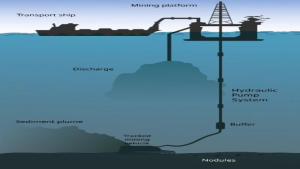 Deep sea mining schematic with independant platform. By G.Mannaerts, CC BY-SA 4.0, Wikipedia
Our F-35 fighter jets are the most advanced and lethal multirole stealth aircraft in the world. However, their avionics, actuators, and radar systems depend on our biggest rival—China, the world’s largest producer of rare-earth elements, without which none of those systems, nor many others vital to the economy, could be built.
Ocean-bed mining might help correct this glaring weakness. President Trump has declared it a national security priority, and an executive order is exploring the possibility of ocean-bed mining beyond national jurisdictions. Federal agencies have been directed to encourage mineral extraction on land and undersea, and with political will, the United States may yet regain a position of strength.
But before we address ocean-bed mining and the international restrictions and hurdles America will have to surmount, some background.
Rare-earth elements are vital inputs for advanced aviation, space, and defense technologies. F-35 fighter jets, for instance, require samarium—a silvery-white metal—and other rare-earth elements for critical hardware, including magnetic components, turbomachinery, and rangefinders.
These elements are also essential for a wide range of high-tech applications, including computers, smartphones, imaging devices, warships, guidance and control systems, electric vehicles, and more. As digital systems take over everyday tasks and become ubiquitous, the need for these elements will rise exponentially.
Rare-earth elements aren’t rare: they are found and mined worldwide. However, over several decades, China has gained and maintained a monopoly on mining and refining them. While Western countries controlled mining to protect the environment, Chinese miners—since the late 1980s—have ravaged the countryside unimpeded, leveraging cheap labor and electricity.
Meanwhile, Chinese researchers focused on cheaper refining technologies. By the 2000s, hundreds of small mining companies and refineries were in operation, chiefly in the southern provinces but also sparsely scattered across the others. They competed with and undercut one another, benefiting international buyers, including the United States.
Soon, recognizing the far-reaching importance of these minerals of the future, the Chinese Communist Party (CCP) stepped in. It consolidated smaller companies into half a dozen state-backed conglomerates—the Big Six. It also restricted exports and set price barriers: domestic users would get the minerals cheaply; export prices would be much higher.
Together, these measures left America and the West dependent on China for everything from scandium for aerospace superalloys to thulium for microwave ovens. China now accounts for 60% of rare-earth mining and nearly 90% of processing and refining, as well as 85% of cobalt, 59% of lithium, and 68% of nickel. The CCP uses this monopoly as a weapon in trade and geopolitics.
America wasn’t always in this disadvantageous position. The Mountain Pass mine in California’s Mojave Desert was once the world’s largest supplier of rare-earth elements. Until the 1990s, it was the only major source. By 2002, however, strict environmental regulations forced it to shut down. It was purchased by a consortium that included a Chinese-owned firm. The operators began extracting rare-earth concentrate (rather than ores) and sending it to China for processing, where environmental laws are lax.
Recently, scientists and policymakers have realized that deep-sea mining could help America break China’s grip and ultimately regain primacy. In April 2025, Trump signed Executive Order 14285—Unleashing America’s Offshore Critical Minerals and Resources—which authorizes deep-sea mining. The order directs the National Oceanic and Atmospheric Administration (NOAA) and the Bureau of Ocean Energy Management (BOEM) to issue permits to expand mineral extraction from the ocean floor.
At depths of 4-6 kilometers, the ocean floor is covered with what appear to be rocks. In fact, they are polymetallic nodules rich in critical minerals, including nickel, cobalt, copper, manganese, and rare earth elements. The Clarion-Clipperton Zone (CCZ), located between Hawaii and Mexico and larger than the European Union, is the largest area on Earth where polymetallic nodules are concentrated.
Inevitably, environmental concerns and international laws must be considered. Proponents argue that the ocean floor has less biomass, so ocean-floor mining is more environmentally friendly and sustainable than land-based mining. Opponents worry that it may have a significant impact on deep-sea ecosystems in ways that are unknown. In addition, there are economic and geopolitical concerns, with the ocean floor becoming, like space, a battlefield for the U.S., China, and Russia.
Ocean bed mining is governed internationally by the United Nations Convention on the Law of the Sea (UNCLOS) of 1982, and the International Seabed Authority (ISA), established under UNCLOS and headquartered in Kingston, Jamaica, is responsible for safeguarding the deep sea. The ISA is an alliance of 172 member-states and over 130 NGOs. While 37 member-states have called for a moratorium on ocean bed mining until the environmental impact is better understood, France wants a complete ban, and countries like Nauru want ocean bed mining expedited.
So far, the ISA has approved 17 exploration contracts, five of which are held by China. The ISA continues deliberations on regulating commercial mining and has yet to sanction commercial exploitation.
The United States is not a signatory to this framework; it has rejected the ISA’s labeling of deep-sea resources as the “common heritage of humanity” as a form of global socialism. Executive Order 14285 could thus conflict with international law, but the State Department has stated that the UNCLOS guidelines do not apply to non-parties like the United States and carry “no weight under customary international law.” The NOAA and the Department of the Interior have moved to streamline permitting, while the BOEM is reviewing lease-sale mining off the coasts of Alaska, Virginia, American Samoa, and the Northern Mariana Islands.
Meanwhile, China, which holds the most ISA contracts and has the world’s largest oceanographic research fleet, has made agreements with the Cook Islands and Kiribati to collaborate on deep-sea research and exploration. A recent CNN investigation found that China is aggressively pursuing its deep-sea interests: Chinese ships, including those linked to its navy, engage in deep-sea mining exploration and stealthily encroach into the strategic waters and exclusive economic zones of other countries.
The battle to dominate ocean-bed exploitation—with the U.S. having to catch up in the field of rare earth elements—has already begun. Encumbrances created by the ISA and UNCLOS cannot be allowed to stand in the way, since China ignores most international conventions anyway when it suits its purpose.
Committed to countering China, the U.S. has proposed Project Vault, a $12 billion investment fund to spur exploration and mining on the ocean floor, bypassing the ISA’s authority to issue permits exclusively. Nine companies are already in negotiations, and auctions and contract awards could occur in months.
Among the leading companies, Important Metals has developed AI-driven vehicles to harvest polymetallic nodules without the environmental damage caused by dredging. The Metals Company has applied for permits to commercially exploit the Clarion-Clipperton Zone, and the NOAA’s environmental impact assessment is likely to be completed in early 2027. Odyssey Marine Exploration has applied for permits to explore and mine heavy mineral sands and phosphorites along the coast of Virginia.
- Deep-sea mining, conducted responsibly and with minimal disruption to marine ecosystems, could help America and the world access reliable sources of minerals that are critical to digital infrastructure, the next generation of clean energy supply, and national security. We need to pursue it so that the American economy—and our defense equipment and fighter jets—are no longer dependent on our biggest rival.


Leave a Reply
You must be logged in to post a comment.