
Peloni: This is long overdue, and even as the E3 has finally triggered the Snapback, it is being done with the most obvious effort to give Iran every chance to evade the consequences which it has earned years ago. Peace thru strength, if applied properly, can be a strong deterrant to bad actors, but such fecklessness as demonstrated by the E3 as they have tolerated and supported the interests of the rogue Iranian state is the very opposite of what has been needed to deter Iran, which is why they are still not deterred even with the announcement of the Snapback mechanism being triggered.
FDD | Aug 29, 2025
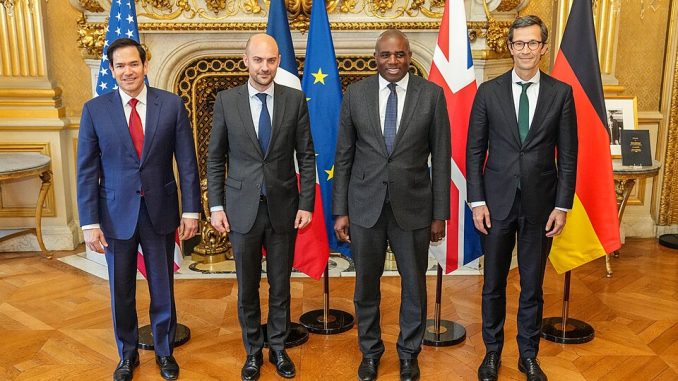 Secretary Marco Rubio participates in a meeting with E3 Foreign Ministers – France Foreign Minister Jean-Noel Barrot, Britain’s Foreign Secretary David Lammy and Germany’s Political Director of the Ministry of Foreign Affairs Günter Sautter at the Quai D’Orsay in Paris, France, April 17, 2025. (U.S. Department of State Photo by Freddie Everett – Flickr, Public Domain, Wikipedia)
Latest Developments
- ‘Snapback’ Process Initiated: The United Kingdom, France, and Germany — collectively known as the E3 — triggered the “snapback” mechanism on August 28 to begin the process of reimposing harsh UN sanctions against Iran over its “significant non-performance” of its nuclear commitments. The trio came to the decision a few days ahead of the deadline to initiate the process after efforts to negotiate with Iran failed and the Islamic Republic continued to block International Atomic Energy Agency inspectors from its nuclear facilities. The “snapback” mechanism enshrined in UN Security Council Resolution 2231 — which endorsed the 2015 Iran nuclear deal — would freeze Iranian assets abroad, halt arms deals, and penalize Iran’s ballistic missile development.
- Letter to UNSC: The E3 wrote a letter to the UN Security Council backing its decision, asserting, “Since 2019 and as of today, Iran has increasingly and deliberately ceased performing its JCPOA commitments. This includes the accumulation of a high enriched uranium stockpile which lacks any credible civilian justification.” The letter added that the E3 has “made exhaustive good faith efforts to resolve the issue of Iran’s non-compliance” but that Tehran “has not returned to compliance with its obligations.” However, the trio did leave room for resolving the issue diplomatically in the 30 days following the “snapback” notification, including the possibility of extending UNSC Resolution 2231.
- U.S. Praises Move: Secretary of State Marco Rubio welcomed the move, stating that Washington “appreciates the leadership of [its] E3 allies in this effort,” adding that “over the coming weeks, [the United States] will work with them and other Members of the UN Security Council to successfully complete the snapback of international sanctions and restrictions on Iran.” Rubio also urged “Iranian leaders to take immediate steps necessary to ensure that their nation will never obtain a nuclear weapon; to walk the path of peace; and to, by extension, advance prosperity for the Iranian people.” Attention now turns to Iran, whose UN Envoy Saeed Iravani threatened in June that Iran would immediately withdraw from the nuclear non-proliferation treaty (NPT) if the “snapback” mechanism were to be triggered.
FDD Expert Response
“The E3 took an overdue and important step toward restoring international restrictions on Iran’s nuclear, missile, and arms programs — including the indefinite demand that Tehran halt enrichment. Washington must lead over the next 30 days to ensure snapback is finalized and that the West ignores Iran’s empty promises of cooperation to obtain an extension.” — Andrea Stricker, Nonproliferation and Biodefense Program Deputy Director and Research Fellow
“The snapback of UN sanctions on Iran is long overdue. Iran remains highly deficient in respect of its commitments under the 2015 nuclear deal, enabling the snapback mechanism to move forward. The E3 has every right, and a moral duty, to trigger snapback. Snapback now means aligning UNSC Resolutions with a global commitment to prevent Iran from engaging in enrichment, reprocessing, and nuclear-capable missile development.” — Richard Golderg, Senior Advisor
“In the wake of the Israeli and U.S. strikes on Iran’s nuclear facilities in June, ‘snapback’ is a vital tool for curbing Iranian nuclear ambitions that will even authorize inspections of Iranian cargo flights and vessels. While snapback is being driven by European allies, the United States plays an important role by backstopping the IAEA’s monitoring mission and working with Europe to counter any stalling tactics on the part of Russia and China.” — Behnam Ben Taleblu, Iran Program Senior Director and Senior Fellow
FDD Background and Analysis
“‘Iran-Linked Individuals’: IAEA Chief Protected by 24/7 Security Detail After Threat From Tehran,” FDD Flash Brief
“Russia Drafts UNSC Resolution To Block Sanctions ‘Snapback’ Against Iran,” FDD Flash Brief
“U.S. Sanctions Extensive Shipping Network in Largest Iran-Related Action Since 2018,” FDD Flash Brief
“Despite war and sanctions, Iran’s oil exports surge,” by Saeed Ghasseminejad and Behnam Ben Taleblu


Leave a Reply
You must be logged in to post a comment.