
PELONI: How similar is the attempt to force people into self censorship on the topic of AI to that surrounding the claim that “the science is settled” or that “shots are safe and effective” or that “Iran can not be defeated”. The Western world has been founded upon the dominance of open debate, respectful argument, and honest assessment of contrary views. These aren’t positions of Democrats, Leftists or Luddites, but of those who want to see democratic principles prevail over autocratic dictates. Governance by the consent of the governed requires open discussions to take place, and on such a topic as will completely remold the definition and qualification of liberty in the west, as will be a consequence of the scope of the AI debate, it is imperative that the people of the West grasp what they are faced with and how it will change the very liberties which define their lives from that of Saudi Arabia, Qatar, Iran or China. Whereas China has an interest in the West being less robust in pursuing AI research, the West must maintain a vigilance over the standards of liberty which must be maintained so as to distinguish themselves from China and its like. Failing to do so will only see the totalitarian principles practice by China come to dominate the West, no matter what the outcome of the AI race might be.
JANET LEVY: Many on the Right are labeling those concerned as “Luddites” financed by Communist China and ignoring real health, environmental, and land use issues to our peril. The globalist project of ubiquitous AI data surveillance systems is a direct threat to our constitutional republic and the freedoms it sustains.
The short-sightedness of allowing development to proceed in the hope that problems can be addressed when they arise will prove dangerous—to the environment and to the health of our citizens.
Janet Levy | Am Thinker | September 16, 2026
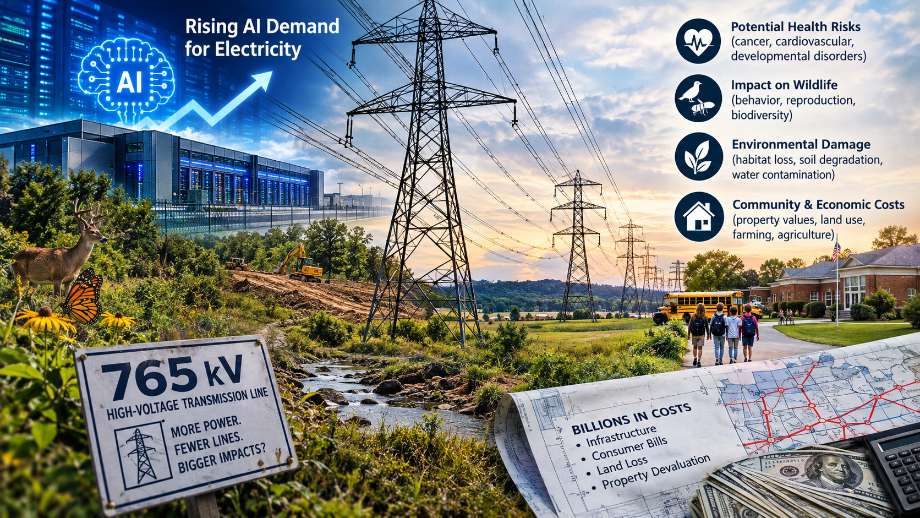 Click to enlarge Image. Image created via AI.
As artificial intelligence (AI) usage escalates, the proliferation of data centers that power AI is fueling a ravenous thirst for electricity. A Department of Energy study estimates that by 2030, data centers alone would need 400 Terawatt-hours (TWh), 10% of America’s end-use in 2023. Expanding power grids to meet this demand will expose people, animals, and the environment to electromagnetic fields (EMFs), whose long-term effects are not sufficiently understood to assert that such exposure is harmless.
Early studies reported increased risks of cancer, cardiovascular disease, and developmental disorders, but these findings were later deemed unsubstantiated. Yet both the National Institute of Environmental Health Sciences (NIEHS) and WHO state that exposure to EMF must be limited, and that further research is needed. A 2008 paper in the British Columbia Medical Journal and other research cited by the National Cancer Institute have linked childhood leukemia to proximity to power lines.
Exposure to EMF can alter behavior, disrupt hormonal systems, and reduce reproduction in livestock, fish, and bees, while degrading biodiversity and accelerating the spread of invasive species. Land clearance for laying lines, building infrastructure, and maintenance leads to habitat destruction and animal displacement. Such work causes erosion, alters soil structure, and reduces aeration and microbial activity, affecting forests and farmland alike. The hum from substations, transformers, and power lines (caused in the latter by corona discharge, which also produces toxic gases) is another nuisance.
There is no comprehensive federal framework to assess risks to human and animal health and to the environment. Nor has a proper appraisal been made of how grid expansion can affect local economies by altering property values, land use, animal husbandry, and agricultural production. Yet the authorities are approving a spate of projects for 765 kV lines—which produce the strongest EMFs encountered in daily life—through forests, farms, and human habitations, even near schools.
The preference for 765 kV stems from its efficiency: more power with fewer lines, half the transmission losses of lower-voltage grids, and a smaller overall footprint. However, experts say the 6X claim—that a single 765 kV line can transmit the same power as three double-circuit 345 kV lines—amounts to hype: the omitted qualification is that this varies with cable configuration and equipment heating limits.
PowerOn Midwest, launched by Great River Energy, ITC Midwest, and Xcel Energy, aims to improve the reliability of the regional grid. It is the first 765 kV project in the Upper Midwest. In Virginia, demand from data centers in the north will be met by a line that crosses nine central counties and integrates supply from renewable and nuclear energy sources. Grid Growth West, a project in western Ohio, includes 190 to 220 miles of new 765 kV and 345 kV lines for data centers and industry.
Opposition to these projects is gaining momentum. No 765 Line, a nonprofit citizens’ coalition, has raised concerns about a 190-mile line—the BECI project—across southern Wisconsin. Its members, who are landowners in the region, are questioning the impact on their property, agriculture, and health. Many of them come from families that have farmed for generations.
In Ohio, beyond issues that affect them directly, such as impacts on farming, patriotic residents have raised concerns that high pylons and cables could endanger low-altitude exercises that military aircraft conduct regularly in the area. Recently, Darke County approved a resolutionopposing the project because it will affect agriculture. The county commissioners have taken up the issue with state and federal officials.
Landowners in Texas are opposing the Hillje-Blue Lacy project, which is directly linked to the Permian Basin plan. Some 2,600 residents, mostly farmers, do not want the high-tension lines and pylons of the 155-mile, 765 kV project to cross their land. A unique concern in the arid and semi-arid parts of Texas is the impact on water resources. The line from Howard to Solstice will cut through 5.5 miles of the Edwards Aquifer Recharge zone, and the 2.5 million people dependent on the aquiferworry that runoff could be contaminated by herbicides used to manage vegetation for the project.
Developers claim the project will achieve economies of scale and deliver significant savings for consumers, but the Texas Public Policy Foundation estimates that the lifetime cost of 765 kV projects in the state would reach $100 billion, increasing consumer bills by 7–8% annually. The nonprofit American Stewards of Liberty says the project will cost residents $8.2 billion in property devaluation and land condemnation.
Given the widespread opposition to the high-voltage grid projects, driven by a range of important concerns, it is imperative that the federal and state governments reassess the risks. Public hearings should not become mere formalities in which genuine concerns are brushed aside. More importantly, our institutes of health and environmental research should commission studies that will bring clarity—either way—on whether the benefits of these projects are worth the risks.
Huge expansion plans—comprising projects worth tens of billions each—have been developed by our planners and businesses. Here is a short roster of some of the investments already made or needed for the power grid, according to the Department of Energy study cited earlier:
- California region: $60 billion needed over the next two decades.
- Texas region: Transmission improvement projects worth $12 billion are expected to be completed by 2030.
- New England: $1.5 billion by 2027 and $4.3 billion by 2030.
- Midwest and Southern U.S.: $10.3 billion by 2030 and 488 new projects totaling $30 billion.
- Pennsylvania-New Jersey-Maryland: 48 new projects totaling $6.6 billion; 93 upgrades totaling $180 million.
- Southeast: 350 projects over the next 10 years, costing about $16.7 billion.
The prospect of immediate profit will incentivize the power industry to see the projects through, heedless of opposition. But the short-sightedness of allowing development to proceed in the hope that problems can be addressed when they arise will prove dangerous—to the environment and to the health of our citizens. The government—and our citizens—cannot afford to let that happen.


Leave a Reply
You must be logged in to post a comment.