
And what this means…
Francisco Gil-White | Management of Reality | Dec 09, 2025
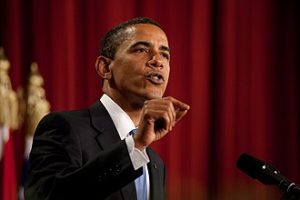 Barack Obama speaks at Cairo University in Cairo, Egypt, Thursday, 4 June 2009. By Chuck Kennedy (Official White House photo) – The Official White House Photostream on Flickr, Public Domain, Wikipedia
The Muslim Brotherhood organization is now all over the Muslim world. It controls vast amounts of resources and has an enormous membership. It is highly disciplined. And tremendously influential.
As The Economist explains:
“The Muslim Brotherhood…, founded in Egypt in 1928, has been an important incubator of Islamist movements, and has survived decades of repression.”
Yes, and one of the “Islamist”—read: jihadi—movements that “the Muslim Brotherhood … has been an important incubator” for is called Hamas, the most astonishingly monstrous terror group of our time, perpetrator of the Grand Guignol massacre of 7 October 2023.
As The Economist also remarks about the Muslim Brotherhood,
“… its highly disciplined youth movement proved crucial to the protests that overthrew [former Egyptian president] Mr [Hosni] Mubarak.”1
Well, but one must give much of the credit to US president Barack Hussein Obama, who pushed very hard to force Egyptian dictator Hosni Mubarak out and to install in his place the Muslim Brotherhood.
But why did he?
Did Obama not understand that the Muslim Brotherhood preaches the extermination of infidels and the destruction of Israel? Or did he understand that only too well?
This piece addresses these questions.
Unpacking diplomatic language
Historian Bernadotte Schmitt once wrote:
“Diplomatic records… never tell the whole story of a diplomatic transaction, as Bismarck long ago avowed, for the motives of the negotiators are seldom declared.”2
But if statesmen and their diplomats, even in their one-on-one dealings, do not reveal what their real intentions are, then their public declarations—speeches, interviews, press briefings, etc.—will be even less transparent. Whoever says, “President Obama’s intention is X because he declared his intention to be X” is not doing political science but propaganda.
If we wish to understand Obama’s—or, more generally, the US bosses’ (plural)—intentions vis-à-vis the Muslim Brotherhood, we must interpret their public statements. In this regard, certain statements from the month of February 2011 are especially useful. But interpretation (naturally) requires context: the context of US policies. I shall provide it.
I begin with Phillip Crowley, Assistant Secretary of State for Public Affairs. In the context of widespread protests against the Egyptian military dictatorship, at a February 2nd press briefing, reporters asked him about the US position on the Muslim Brotherhood, outlawed by the Egyptian regime but clearly a contender to take power if allowed to participate in elections.
MR. CROWLEY: […] If any figure wants to play a role in this [new political] process [in Egypt], they can come forward. If any—if any group—
Q: They could? Does that include the Muslim Brotherhood?
MR. CROWLEY: If any group wants to come forward and play a role in a democratic process, a peaceful process, that is their right as Egyptians. It’s not for us, the United States, to dictate this.3
Let us unpack this.
Consider the words: “It’s not for us, the United States, to dictate…”
Oh really? Anybody who has followed US foreign policy over the years will see the problem. When the US ruling elite does not like something, it makes its wishes known, and then, if necessary, forces the outcome. It dictates. Unhappy with a particular regime, it may bomb (Yugoslavia), invade (Panama, Iraq), or else arrange a coup d’état (Guatemala, Iran).
Or it may do lots of other things. In the 1947 National Security Act, the US Congress gave US Intelligence very broad authority to influence the media and political processes of other countries with so-called “covert actions,” as we have explained here:

THE NATIONAL SECURITY ACT OF 1947 (and what it means…)
Perhaps more to the point, just a few days before the above quoted exchange, former US ambassador to Egypt, Frank G. Wisner, explained the following on TV:
“We [the US ruling elite] have known that the end of the Mubarak period would be with us in some reasonable time frame. We’ve been thinking in these terms. …the situation is not a surprise.”4
But if the US government was already expecting (planning?) a transition to a post-Mubarak Egypt, who was the favorite to replace Egyptian president Hosni Mubarak?
Rewind back to June 2009. Just a few months after installing himself in the White House as the new president of the United States, Barack Obama made a trip to Egypt, to give a speech, to send a message to Muslims. This is very deliberate stuff. Dramatic stuff. (As dramatic and deliberate, perhaps, as Obama giving his first interview as president, just 6 days after assuming office, to Al Arabiya Television.) But if Obama was there to address Muslims in general, was he speaking to (winking at?) anyone in particular? According to a number of reports in the Middle Eastern media, Obama insisted that top representatives of the Muslim Brotherhood be allowed to attend his speech.5
All by itself, this invitation to the Muslim Brotherhood is pregnant with meaning. Egypt is a US client-state, whose military has been built up, tremendously, with US largesse. And the client military government, led at the time by Hosni Mubarak, had been trying to keep the Muslim Brotherhood out of power. So the Muslim Brotherhood representatives, in the context of the dramatic invitation by the president of the World Superpower (Egypt’s Big Boss), were bound to pay close attention to the content of Obama’s speech. And producing such careful attention to content, naturally, was the reason for inviting them. This is how diplomatic language works.
And what did Obama say to the leaders of the Egyptian Muslim Brotherhood, whose mission is to make Islamic Sharia the Law of State in Egypt?
Obama passionately praised the virtues of Islam, and showed that he knows the Quran intimately, for he quoted extensively from it without even glancing at his notes. And he produced the most remarkable interpretation of his job: “I consider it part of my responsibility as President of the United States,” he said pointedly, “to fight against negative stereotypes of Islam wherever they appear.”6
As mentioned, public statements by government officials are usually mired in deceit, subterfuge, and indirectness, but in this case we have relatively clear diplomatic language. Unless the Muslim Brotherhood leaders had fallen into a deep coma they were bound to hear Obama loud and clear: Your turn is up. Get ready.
Now fast forward a year and a half later (in political time, a few seconds) to the 2011 protests. Frank Wisner was sent to Egypt to convey to Mubarak the desires of the US government, which Phillip Crowley, speaking for the State Department, explained in a January 31 briefing:
“President Mubarak pledged a—you know, to undertake political and economic reform. And, as we’ve said ever since, we want to see, you know, concrete actions…”7
The next day Christiane Amanpour explained on ABC News what was going on:
“President Obama dispatched Frank Wisner, a former ambassador to Egypt, to deliver a message directly to Mubarak suggesting he not seek re-election.”8
This is how the Empire dictates the outcome to its client state.
But pressing the Egyptian military government to 1) remove Mubarak, and 2) rush to hold elections, as everybody understood, would give the upper hand to the Muslim Brotherhood, because only the Muslim Brotherhood could organize effectively in such a short period of time.
Not surprisingly, therefore, the next day (February 2), Phillip Crowley was asked by reporters to state the US position on whether the Muslim Brotherhood should play a role in Egyptian politics. To which he replied (as we saw):
“If any group wants to come forward and play a role in a democratic process, a peaceful process, that is their right as Egyptians. It’s not for us, the United States, to dictate this.”
So what did this mean, in context? It meant this:
The US ruling elite WOULD LIKE (very much) for the Muslim Brotherhood to play an active role in Egyptian politics.
Not surprisingly, there were reports that Frank Wisner had met with the Muslim Brotherhood during his trip to Egypt. Reporters asked Crowley about this at the same press briefing, and though initially evasive, he denied it (he seemed a bit nervous).9
On February 14th Secretary of State Hillary Clinton was interviewed by Al Arabiya Television. This is
“an Arabic-language television news channel… partly owned by the Saudi broadcaster Middle East Broadcasting Center (MBC).”10
So Clinton was speaking here directly to the Saudi salafists/wahabbists once allied with the Muslim Brotherhood but now worried that MB’s grassroots power was a threat to their monarchy. Here’s an excerpt from the interview:
MR. MELHEM: […] Is the [Muslim] Brotherhood welcome at the table as President Obama hinted last week?
SEC. CLINTON: That is up to the Egyptian people. […]11
Translation: Yes, you understood President Obama’s hint perfectly.
On February 23rd, Clinton gave an interview to Masrawy.com, an Egyptian website owned, through LINKdotNET, by Orascom Telecom Holding, an Egyptian multinational.12 She was speaking directly to Egyptians. Here is an excerpt:
MR. GHANIM: […] What would be the reaction of the United States if Muslim Brotherhood gained power in Egypt through a true democratic election?
SEC. CLINTON: Well, first, let me say that it’s up to the Egyptian people… any party that is committed to nonviolence, committed to democracy, committed to the rights of all Egyptians, whoever they are, should have the opportunity to compete for Egyptian votes. […]13
Translation: We will all pretend that the Muslim Brotherhood is committed to nonviolence and democracy. Muslim Brotherhood: no problem.
Mubarak resigned under US pressure. Then the US pushed for a lightning quick timetable for a referendum on a new Constitution followed by new elections. According to the Economist,
“the referendum marked a big step towards sending the army… back to barracks… [T]he speedy timetable laid out in the new deal may help the Islamists of the Muslim Brotherhood, among others, to dish secular liberals and other fledgling parties in any early poll.”14
Right. Because only the Muslim Brotherhood had the organizational structure required to produce an effective political party in the “speedy timetable” that Obama forced on Egypt. And that is the reason, as explained by the Economist, that Egyptian liberals had voted against going for a new Constitution and early polls in the referendum (which they lost).
We know what happened: the Muslim Brotherhood won the elections because Obama insisted in immediate elections, which gave the advantage to them. And Mohammed Morsi of the Muslim Brotherhood became the new Egyptian president in June 2012.
But the Muslim Brotherhood won by a mere 51%.
This is obviously what Obama wanted. Is that because he agreed with the Muslim Brotherhood’s goals? Let us first consider what the Muslim Brotherhood wants, and then I will address the issue of whether Obama understood this clearly.
What does the Muslim Brotherhood preach?
Ayaan Hirsi Ali is a widely known Somali author who, in order to escape Islam, took refuge in Holland, where she became a citizen, a political scientist, and a Member of Parliament. She now lives in the United States, after a Muslim stabbed her friend Theo van Gogh to death in the streets of Amsterdam. Pinned between the knife and her friend’s chest was a letter addressed to Hirsi Ali: you are next. The reason for the murder was that van Gogh had made a short film with Hirsi Ali about Islam and its oppression of women.
Hirsi Ali knows the Muslim Brotherhood well. In her autobiography, titled Infidel, she explains the role of this organization in Kenya, where she lived for a number of years as a refugee from the Somali civil wars. In her Nairobi neighborhood, the local Muslim Brotherhood preacher was one Boqol Sawm, whose strategy was to recruit the women first, and then use the women to shame their husbands into becoming good Muslims. If they wanted their wives to obey them again (for wives need not obey husbands who do not accept ‘true Islam’), they would have to follow the Brotherhood.15 It was a powerful inducement. “Boqol Sawm,” explains Hirsi Ali,
“shouted that the men who rejected their wives’ call to Islam would burn. The rich who spent their money on earthly things would burn. The Muslims who abandoned their fellow Muslims—the Palestinians—were not true Muslims, and they would burn, too. Islam was under threat and its enemies—the Jews and the Americans—would burn forever. Those Muslim families who sent their children to universities in the United States, Britain, and other lands of the infidels would burn. Life on earth is temporary, Boqol Sawm yelled; it was meant by Allah to test people. The hypocrites who were too weak to resist the worldly temptations would burn. If you did not break off your friendships with non-Muslims, you would burn.”16
Hirsi Ali tells how one day she went with her Islamic class, led by one Sister Aziza, to a new Muslim Brotherhood mosque built in a poor neighborhood with the money of a Saudi millionaire. The Muslim Brotherhood was converting many poor Kenyans to Islam with the hook of social assistance (highly effective). A recently converted Swahili woman began breastfeeding her child the way she used to prior to her conversion, with her breast in the open.
“All the girls from Sister Aziza’s class shrieked in unison, and we transported this young woman to a hall in the women’s section. An older woman of Swahili origin [another convert to Islam], covered from head to toe in black, started to instruct her in the Islamic way of breast-feeding. First you say Bismillah before you put the nipple into the mouth. As the baby is feeding, beg Allah to protect your child from illness, earthly temptations, and evil ways of the Jews.”17
Is an image worth a thousand words? Perhaps a well-chosen anecdote is worth a thousand explanations: According to the Muslim Brotherhood, it is ‘correct’ for a Muslim child to begin life suckling Jew-hatred from mama’s teat.
Hirsi Ali explains further:
“[The Muslim Brotherhood] taught that, as Muslims, we should oppose the West. Our goal was a global Islamic government, for everyone. How would we fight? Some said the most important goal was preaching: to spread Islam among non-Muslims and to awaken passive Muslims to the call of the true, pure belief. Several young men left the group to go to Egypt, to become members of the original Muslim Brotherhood there. Others received scholarships from various Saudi-funded groups to go to Quran schools in Medina, in Saudi Arabia.”18
There was also much talk of jihad,
“[Jihad is] a word that may have multiple meanings. It may mean that the faith needs financial support, or that an effort should be made to convert new believers. Or it may mean violence; violent jihad is a historical constant in Islam.”19
Hirsi Ali never liked this kind of talk very much. She was attracted to the West:
“For me Britain and America were the countries in my books were there was decency and individual choice. The West to me meant all those ideas…”20
She was hoping that Boqol Sawm was exaggerating. She was hoping that he was distorting the true content of the Quran, for she did not wish her religion to preach death to all those will not convert. So she got the book. She could not read Arabic, so
“I bought my own English edition of the Quran and I read it so I could understand it better. But I found that everything Boqol Sawm had said was in there. Women should obey their husbands. Women were worth half a man. Infidels should be killed.”21
By the time the 9/11 attacks happened Hirsi Ali was living in Holland. There is, of course, a controversy about the authorship of those attacks. But that is not the point here. The point is how they were perceived in the Muslim world, where it was assumed by almost everybody that Osama bin Laden was the mastermind, and where the same people accepted that he had done it in the name of Islam. Dutch TV cameras showed Muslim kids in Holland jubilating in the streets over the deaths of thousands of innocent Americans.
Talking to a friend on her way to the office the next day, Hirsi Ali began a work that would become her lifelong duty: to inform Westerners about what Islam actually preaches, and the danger that her former religion poses to liberty and sanity everywhere. She was provoked to this by her Dutch friends, who, no doubt influenced by the constant apologies for Islam that routinely flood the Western media, didn’t want to believe that this had anything to do with ‘real’ Islam, the alleged “religion of peace.”
“I couldn’t help myself. Just before we reached the office, I blurted out, ‘But it is about Islam. This is based in belief. This is Islam.’ …I walked into the office thinking, ‘I have to wake these people up.’ ”
That’s what Hirsi Ali has been trying to do ever since: wake up Westerners. As she explains about the violence of 9/11,
“This was not just Islam, this was the core of Islam… There were tens of thousands of people, in Africa, the Middle East—even in Holland—who thought this way. Every devout Muslim who aspired to practice genuine Islam—the Muslim Brotherhood Islam, the Islam of the Medina Quran schools—even if they didn’t actively support the attacks, they must at least have approved of them.”22
Some of my readers may be wondering: But then why did Obama support and assist a Muslim Brotherhood takeover of Egypt? Could it be that he didn’t understand what the Muslim Brotherhood stands for?
Was Obama misinformed about Islam and the Muslim Brotherhood?
Lots of people seem to think that objectionable US foreign policy should be explained on the basis of the supposed ignorance or thick-headedness of US leaders. But if US policy appears to contradict what you believe reasonable, there is an obvious alternative to proposing that US leaders are misinformed madmen. The alternative says that US leaders have different values than your own, but they lie in public about their real intentions (so that you will think they do share your values).
This alternative hypothesis has the advantage of being reasonable. It does not force us to say that the most powerful people in the world—in charge of a vast and sophisticated information-gathering system—are stupider, crazier, or less well-informed than the average blogger.
The point is hardly specific to Barack Obama—it is perfectly general. All the same, in the case of Obama and the Muslim Brotherhood we can give a rather sharp demonstration.
I know that some would like to argue—because the words “my Muslim faith” did slide inadvertently from Obama’s lips one time during an ABC News television interview—that he is a closeted Muslim, and therefore must know all about the Muslim Brotherhood.23 I find this a weak argument, because, as others have pointed out, this slip could be an innocent error: Obama meant to say “My alleged Muslim faith” and merely failed to pronounce the word “alleged.” However, a much stronger case exists that Obama has always understood perfectly what the Muslim Brotherhood stands for. This stronger case is built with certain facts from Obama’s upbringing and family background, none of which—unlike the questions of his religious confession and his US citizenship—have ever been in dispute.
President Obama spent his childhood in Indonesia, the largest Muslim country in the world, and for this reason alone one could expect him to be well informed about Islam. If that were not enough, Obama is descended, on his father’s side, from Muslims.24 As mentioned earlier, when he insisted that representatives of the Muslim Brotherhood be present at a speech he gave in Egypt in 2009, Obama went out of his way to praise Islam, repeatedly, and demonstrated that he can quote from the Quran ex tempore. So Obama is not misinformed about Islam. And since he knows the Quran, he knows, as Ayaan Hirsi Ali also does, that the Muslim holy book calls for the slaughter of infidels.
But, in particular, Obama cannot be misinformed about the Muslim Brotherhood. For you see, his own Muslim family is from Nyang’oma Kogelo, in the extreme Western end of Kenya.
So what? Well, Islam is still a minority religion in Kenya (about 10%), and Muslims are mostly on the coast, in the East. In the West, the first Muslim missionaries did not arrive until the very late 19th c. As a consequence, Muslim converts in this area—the area from which Obama’s family hails—are mostly the consequence of Muslim Brotherhood proselytizing, which became especially intense from the 1970s onward. So Obama’s Muslim family, and in particular his father (whom Obama himself explains was “raised a Muslim”25) must be quite familiar with the Muslim Brotherhood message that Ayaan Hirsi Ali (above) witnessed in the very same Kenya: death to all infidels and, especially, death to the Jews.
Also, Obama had to know that the terrorist organization Hamas, in control of the Gaza strip, which has a border with Egypt, and pledged to destroy the Jewish State, is a branch of the Muslim Brotherhood. Why? Because Hamas makes no secret of this, and the information is published in Article 2 of the Hamas Charter, which the Avalon Project at Yale University has made public on the internet:
“ARTICLE 2: The Islamic Resistance Movement is one of the wings of Moslem Brotherhood in Palestine. Moslem Brotherhood Movement is a universal organization which constitutes the largest Islamic movement in modern times. It is characterised by its deep understanding, accurate comprehension and its complete embrace of all Islamic concepts of all aspects of life, culture, creed, politics, economics, education, society, justice and judgment, the spreading of Islam, education, art, information, science of the occult and conversion to Islam.”26
We have discussed Hamas’s ideology and their constitution in greater detail here:

Is Hamas fighting Israeli oppression?
Here, then, are the facts of US foreign policy. After sending billions upon billions of dollars in US armament to the Egyptian military since 1979, Obama—or, more precisely, the US ruling elite—now wanted the Muslim Brotherhood in charge of all that armament. This, Obama—or, more precisely, the US bosses—were doing with a perfect understanding of what the Muslim Brotherhood has always been and what it has always intended to do: destroy Israel in genocide.
How did the Egyptian dictators process this?
Put yourself in the shoes of the Egyptian generals when the US bosses forced Egyptian President Hosni Mubarak to resign in 2011 and moved quickly to install the Muslim Brotherhood by forcing rushed elections.
You are experiencing an existential shock.
For decades, you’ve been a loyal American client—trained, funded, armed, and politically shielded by Washington. You’ve internalized the illusion that, as long as your serve US interests, your power is secure. But now the Americans are not merely withdrawing support—they are actively empowering the Egyptian military’s oldest and most committed domestic enemy: the Muslim Brotherhood. The people who want to destroy you!
- The Egyptian generals realized that the US bosses were managing both sides.
The Brotherhood, supposedly the enemy of Western liberalism, was being elevated by the very superpower that claimed to be fighting Islamic extremism. The Egyptian generals understood, in this moment, that the US Deep State did not merely tolerate the Brotherhood—it was using it. And not just abroad. In Egypt. And now, after spending decades fighting the Brotherhood in the streets and via their intelligence services, the Egyptians were being told by their US patron to surrender, to lower their necks so that the Muslim Brotherhood could sever their heads.
This led to a deeper, more terrifying realization:
- There is no ‘outside’ of the system which the US bosses have created.
The confirmation: Obama supported the Sharia constitution
A clear majority of Egyptians were not amused when they realized that the Muslim Brotherhood was going to impose a new constitution—drafted by an Islamist-majority assembly—that included controversial clauses which embedded a particular interpretation of Sharia into the legal framework. Non-Islamists, Secularists, Coptic Christians, women’s groups, and many legal professionals viewed this as a threat to civil liberties and judicial independence.
Equally troubling was the process: Morsi had granted himself sweeping powers to protect the constitutional assembly, issuing a decree that placed him temporarily above judicial review. This move triggered mass protests in late 2012 and eroded the public’s faith in Morsi’s commitment to pluralism and democratic norms.
The new constitution, and the way it was being rammed through, became a powerful symbol of a broader pattern of governance under Morsi that many perceived as exclusionary, authoritarian, and moreover incompetent.
Under Morsi’s rule, Egypt experienced a worsening economic collapse marked by fuel shortages, electricity blackouts, and rising unemployment. Simultaneously, public security remained precarious, with a perception that Morsi had failed to restore order after the 2011 revolution. His foreign policy gestures, such as cozying up to Hamas and severing ties with the Syrian regime, further alienated nationalist and military-aligned segments of the population. These concerns, amplified by the grassroots Tamarod movement, helped galvanize a broad cross-section of Egyptian society against him.
Perhaps most damaging to Morsi’s legitimacy was his perceived unwillingness to govern inclusively. Many Egyptians—especially revolutionary youth, non-Islamist parties, and civil society actors—felt that the Muslim Brotherhood had hijacked the democratic transition to consolidate its own power. The Sharia-based constitution, in this sense, was not just an ideological problem, but a concrete expression of how the Brotherhood intended to shape Egypt’s political future unilaterally. It confirmed the worst fears of Morsi’s critics and became a rallying point for opposition.
“Claiming executive privilege, Morsi issued a constitutional declaration that had several components, including an executive—and unconstitutional—decision to remove the Prosecutor General and grant extensive presidential immunity.
The response to this declaration was swift and unequivocal. (…) tens of thousands of Egyptians from all walks of life joined to peacefully protest. In the Itihadeya December 5 attacks, protesters were rained upon by supporters of the president (…) Eleven Egyptians were killed that day, and images of torture and abduction committed by the President’s supporters surfaced. Perhaps most shocking was the documentation of those carrying out the attacks marching in sync like militias, chanting pro-Brotherhood slogans. The state police apparatus, noticeably, stood on the sidelines making no real effort to curtail the violence.
Morsi’s response to the Itihadeya attack, accusing protesters of being paid thugs and affirming the actions of his vigilante supporters only empowered his proponents and encouraged more vigilante action, starting a wave of unfair arrests and politically charged prosecutions of [Morsi’s] critics (…) Morsi remained silent as his supporters even laid siege to Egypt’s venerated Supreme Court. With his actions, Morsi effectively lost his claim of being a “president for all Egyptians.”27
The Tamarod grassroots movement collected more signatures for Morsi to step down and allow new elections than the votes Morsi had secured in the election.
And yet, the US ambassador to Egypt expressed support for Morsi’s government and denounced the protesters! In a speech that she delivered at the Ibn Khaldun Center,
“Patterson defended US support of Egypt’s government, emphasizing its ‘elected nature.’ While she expressed an understanding of what she deemed ‘conspiracy theories’ on US support for the Brotherhood, she ultimately dismissed them, noting that ‘Egypt deserves better… citizens with open minds who are unafraid to think for themselves.’ Just one day later, Patterson held a meeting with Khairat al-Shater—a man who holds no government position but is deputy Supreme Guide of the Brotherhood. Indeed, both Patterson’s messaging, reflected in her talk at Ibn Khaldun, and her actions, exemplified by the meeting with al-Shater, lend credence to these same conspiracy theories.
In her speech, Patterson repeated the familiar US government refrain heard throughout the past year: the Morsi government is democratically elected, deriving its legitimacy from a ballot box ‘that met international standards.’ She also derided ‘street action’ in favor of organized political party participation.28
If the generals still harbored doubts about the US position, this would have dissipated them.
The protests gave courage to the generals, who, led by Abdel Fattah el-Sisi, took the opportunity to remove Morsi and reestablish themselves, thus ending Egypt’s brief experiment with Muslim Brotherhood rule.
Obama reacted to that in this manner:
“Obama said on Wednesday he was ‘deeply concerned’ by the military’s move to topple Morsi’s government and suspend Egypt’s constitution. He said he was ordering the US government to assess what the military’s actions meant for US foreign aid to Egypt.
Under US law, the government must suspend foreign aid to any nation whose elected leader is ousted in a coup d’etat. The US provides $1.5bn a year to Egypt in military and economic assistance.
‘I now call on the Egyptian military to move quickly and responsibly to return full authority back to a democratically elected civilian government as soon as possible through an inclusive and transparent process, and to avoid any arbitrary arrests of President Morsi and his supporters,’ Obama said.”29
This is what the Egyptian generals now understood:
- If the US controls both the Islamists and the secular regimes, then there is no one left to appeal to.
The idea of finding a new patron—China, Russia, the Gulf—now seemed naïve. In a system so rigged, the only path to survival was to appease the same force that had just tried to kill you. To demonstrate continued usefulness to the US bosses.
Yes, at home the generals would crush the Brotherhood, lest they themselves be crushed, but they had to show the US bosses that they were still useful.
From this moment on, the generals recalibrated. They moved quickly to crush the Brotherhood domestically, before the US could stop them. But, at the same time, they intensified their collaboration—discreetly—with Hamas, the Brotherhood’s Palestinian wing in Gaza. This wasn’t hypocrisy. It was survival logic. The generals now believed what they had refused to see before:
- The US bosses want Israel destroyed, and the Muslim Brotherhood is one of their chosen tools.
The generals would not surrender Cairo, but they would redouble their efforts to destroy Israel. It was their best chance to stay alive. And this was hardly a departure for them, in one sense, because the Nasserist ideology of their entire military dictatorship had always been the destruction of Israel. Suppressing the Muslim Brotherhood in Egypt while they supported its Hamas wing in Gaza was a contradiction, but one they could live with in order to appease the US bosses and stay in power.
And that is why the Egyptian military dictatorship has been supporting Hamas in Gaza.
And what is Donald Trump’s policy?
The same.
Trump has just given NATO-level protection to Qatar, the main financial supporter of the Muslim Brotherhood in the Muslim world.
And he has stopped Israel from destroying Hamas in Gaza.
The pro-jihadi policy is not Obama’s; it is a consistent policy of the US bosses, over many years.
We have been explaining Trump’s policies in the Middle East here:

A golden opportunity?; Islam and the Arab revolutions; The Economist, April 2, 2011, FRONT BRIEFING, 2162 words.
Schmitt, B. E. (1936). Review: American Neutrality, 1914-1917. The Journal of Modern History, 8(2), 200-211. (p.203)
Federal News Service; February 2, 2011 Wednesday; STATE DEPARTMENT REGULAR BRIEFING; BRIEFER: PHILIP J. (P.J.) CROWLEY, ASSISTANT SECRETARY OF STATE FOR PUBLIC AFFAIRS; LOCATION: STATE DEPARTMENT BRIEFING ROOM, STATE DEPARTMENT, WASHINGTON, D.C.; SECTION: STATE DEPARTMENT BRIEFING; LENGTH: 9136 words
https://2009-2017.state.gov/r/pa/prs/dpb/2011/02/155821.htm
January 28 CNN interview with Frank Wisner:
[Excerpt from CNN transcript]
MORGAN: Frank, let me start with you. It seems everyone is trying to make out this is a huge surprise and yet resentment towards Mubarak has been building for years. President Obama warned him many times, he must do something about this. So, it’s not much of a surprise, is it really?
FRANK WISNER, FMR. U.S. AMBASSADOR TO EGYPT: Well, I think the slow developing situation, even the incidents that have marked this year, the explosion at promise in Alexandria, the beating and killing of a businessman earlier, all these were events that signaled that on top of the disconnect, trouble was brewing. But I don’t think you can ever predict exactly when the crisis will erupt. And, if you will, this crisis with its — the predicate in Tunisia, has come on very quickly. I don’t think anyone, and certainly not the Egyptian government, is completely taken by surprise. We have known that the end of the Mubarak period would be with us in some reasonable time frame. We’ve been thinking in these terms.
So maybe the day, but the situation is not a surprise.
[Excerpt from CNN transcript]
SOURCE: “Crisis in Egypt”; CNN, January 28, 2011 Friday, NEWS; International, 6757 words, Piers Morgan, Ben Wedeman, Nic Robertson, Wolf Blitzer, John King, Amir Ahmed, Fran Townsend, Richard Grenell, Robin Wright, Mohammed Jamjoom, Mark Coatney, Sarah Sirgany
The Atlantic reported:
“…various Middle Eastern news sources report that the administration insisted that at least 10 members of the Muslim Brotherhood, the country’s chief opposition party, be allowed to attend his speech in Cairo on Thursday.”
SOURCE: “Brotherhood” Invited To Obama Speech By U.S.”; The Atlantic; Jun 3 2009; By Marc Ambinder.
https://www.theatlantic.com/politics/archive/2009/06/-brotherhood-invited-to-obama-speech-by-us/18693/
President Obama’s Egypt Speech, 4 June 2009.
STATE DEPARTMENT REGULAR BRIEFING; BRIEFER: PHILIP J. (P.J.) CROWLEY, ASSISTANT SECRETARY OF STATE FOR PUBLIC AFFAIRS; LOCATION: STATE DEPARTMENT BRIEFING ROOM, STATE DEPARTMENT, WASHINGTON, D.C.; Federal News Service, January 31, 2011 Monday, STATE DEPARTMENT BRIEFING, 8733 words
“CRISIS IN EGYPT; ANGRY BURST”; ABC News Transcript, February 1, 2011 Tuesday, 617 words
Federal News Service; February 2, 2011 Wednesday; STATE DEPARTMENT REGULAR BRIEFING; BRIEFER: PHILIP J. (P.J.) CROWLEY, ASSISTANT SECRETARY OF STATE FOR PUBLIC AFFAIRS; LOCATION: STATE DEPARTMENT BRIEFING ROOM, STATE DEPARTMENT, WASHINGTON, D.C.; SECTION: STATE DEPARTMENT BRIEFING; LENGTH: 9136 words
Excerpt:
Q: Can you talk about the Muslim Brotherhood? Can you talk about the Muslim Brotherhood and whether there have been any contacts with them, and whether you think that the Muslim Brotherhood should be part of any political process? You say you’re not going to anoint anybody, but what if a figure from Muslim Brotherhood emerges as the primary candidate to lead the country?
MR. CROWLEY: All right, again —
Q: Specifically on the Muslim Brotherhood.
MR. CROWLEY: We have not met with the Muslim Brotherhood.
Q: Have you spoken with — (off mic)?
(Cross talk.)
Q: Okay, but—no, but what if—should they be part of the political process?
MR. CROWLEY: We have had no contact with the Muslim Brotherhood.
Q: But should they be part of a political process? They obviously have a following in the country.
MR. CROWLEY: Well, again, that is up to them. They are—they are a fact of life in Egypt.
They are highly organized. And if they choose, and if they choose to participate and respect the democratic process, that is a—those are decisions to be made, you know, inside Egypt.
You know, the army obviously will play a role in this transition. There are—there are a broad variety of political figures, political groups, political actors that can participate if they choose. These are decisions to be made inside Egypt.
Q: Have you met with—
Q: P.J.
Q: Have you asked to meet the Muslim Brotherhood?
MR. CROWLEY: No.
Q: Why not?
Q: (Off mic)—that the army—that the—
Q: I mean, you’ve met with other opposition members. Who—can you say who’ve you met with? Ayman Nour. You’ve met with—can you give a—
MR. CROWLEY: I don’t—I don’t have a list here. We are doing an aggressive, active outreach to a broad range of figures. We have always done that. We’re going to continue to do that. We’ve been very active in the last few days.
I can’t detail all the people we have and have not. You asked a specific question. We have not had contact with the Muslim Brotherhood.
Q: Why don’t you meet with the Muslim Brotherhood? What’s the reason not to meet with them?
MR. CROWLEY: I’m—you know, we will meet with figures. If we—if we meet with anyone on those lines, we’ll let you know.
Q: Did you give conditions before you meet the people?
Q: P.J., are you saying that the reports about the meeting with—that Ambassador Wisner has had with the Muslim Brotherhood representatives is false?
MR. CROWLEY: I was in touch with Ambassador Wisner on the airplane as he was coming back. He had two meetings, one with President Mubarak and one with Vice President Suleiman.
Q: Why is—
Q: So is the report false or is it not false?
MR. CROWLEY: I mean, I—I’m just telling you he had two meetings. So if you’re—if you’re saying, did Mr. Wisner meet with the Muslim Brotherhood, the answer is no.
“Al Arabiya” | From Wikipedia, the free encyclopedia
http://en.wikipedia.org/wiki/Al_Arabiya
[Consulted Sunday, May 08, 2011]
Federal News Service; February 14, 2011 Monday; INTERVIEW WITH SECRETARY OF STATE HILLARY RODHAM CLINTON (AS RELEASED BY THE STATE DEPARTMENT) INTERVIEWER: HISHAM MELHEM, AL ARABIYA LOCATION: WASHINGTON, D.C. DATE: MONDAY, FEBRUARY 14, 2011; SECTION: STATE DEPARTMENT BRIEFING; LENGTH: 1512 words
https://2009-2017.state.gov/secretary/20092013clinton/rm/2011/02/156575.htm
Wikipedia articles consulted Sunday, May 08, 2011.
http://en.wikipedia.org/wiki/Masrawy
http://en.wikipedia.org/wiki/LINKdotNET
http://en.wikipedia.org/wiki/Orascom_Telecom_Holding
Federal News Service; February 23, 2011 Wednesday; SOCIAL MEDIA DIALOGUE WITH SECRETARY OF STATE HILLARY RODHAM CLINTON AND AHMED GHANIM OF EGYPT’S MASRAWY.COM (AS RELEASED BY THE STATE DEPARTMENT); LOCATION: DEPARTMENT OF STATE, WASHINGTON, D.C.; SECTION: STATE DEPARTMENT BRIEFING; LENGTH: 4532 words
https://2009-2017.state.gov/secretary/20092013clinton/rm/2011/02/157005.htm
Egypt and Democracy: Yes they can; The Economist; March 26th, 2011; pp.55-56
The Muslim Brotherhood preachers among the Somali exiles in Nairobi, Hirsi Ali explains, first targeted the women. The strategy was to get women to shame the men into being more orthodox Muslims. She focuses on one Boqol Sawm, a preacher she knew well because he preached in her Nairobi neighborhood of Eastleigh.
“As Boqol Sawm’s following grew, his sermons caused a lot of quarrels between spouses. At first, the Somali fathers and husbands were amused and teased their wives, predicting that after a week the silly, bored women would find some other pastime. After a while, however, irritations arose. The living room, usually well furnished, is the domain of the man. Somali men bring their male friends home and sit with them in the living room having men-talk (honor, money, politics, and whether to take a second or third wife) as they drink scented sweet tea and chew qat. The evenings and Friday afternoons are their preferred times, and Boqol Sawm chose to give his lectures especially at those times.
When Boqol Sawm was visiting a house, the men were relegated to the women’s quarters: the kitchen, backyard, and, in some of the bigger houses, the smaller and uglier living rooms usually occupied by the women. And after their wives converted to the True Islam of the Muslim Brotherhood believers, they began saying that chewing qat, smoking, and skipping prayers were forbidden. They actually sent their husbands off, calling them unbelievers. When the men shouted about disobedience, the women replied that in the hierarchy of submission [‘Islam’ literally means ‘submission’ — HIR], we must follow Allah even before husband and father: Allah and the Prophet decreed that wives should obey only husbands who themselves obey Allah.” (p. 105)
In this manner men acquired a powerful incentive to become more orthodox Muslims: to regain control of their households.
“The Muslim Brotherhood believed that there was a pure, original Islam to which we all should return. Traditional ways of practicing Islam had become corrupted, diluted with ancient beliefs that should no longer have currency. The movement was founded in the 1920s in Egypt as an Islamic revivalist movement, then caught on and spread—slowly at first, but much faster in the 1970s, as waves of funding flooded in from the suddenly massively rich Saudis. By 1987 the Muslim Brotherhood’s ideas had reached the Somali housewives of Eastleigh in the gaunt and angry shape of Boqol Sawm.
Within months the first divorces were occurring, and secular Somali men were threatening Boqol Sawm for breaking up their families. Boqol Sawm was chased away by angry husbands from the living room sessions and from the Somali mosques, but copies of his tapes continued to spread even as he was in hiding.
…Boqol Sawm wasn’t the only preacher who had come to our neighborhood to guide the lost back to Allah’s Straight Path after a stint in Medina or Cairo. More and more young men of the Muslim Brotherhood, dressed in ankle-length white robes and red-and-white checked shawls, were striding through the streets. People who converted to their cause started to collect money from family; some women gave their dowries, and all kinds of donations came in. By 1987 the first Muslim Brotherhood mosque was built in Eastleigh, and Boqol Sawm came out of hiding to preach there every Friday, screaming at the top of his lungs through the loudspeakers behind the white minaret topped with a green crescent and a single star.
Boqol Sawm shouted that the men who rejected their wives’ call to Islam would burn…” (pp.105-07)
SOURCE: Hirsi Ali, A. (2007). Infidel. New York: Simon & Shuster.
Hirsi Ali, A. (2007). Infidel. New York: Simon & Shuster. (pp.105-07)
Infidel, op. cit. (p.107)
Infidel, op. cit. (p.109)
Infidel, op. cit. (p.109)
Infidel, op. cit. (p.109)
Infidel, op. cit. (p.104)
Infidel, op. cit. (pp.268-70)
Obama says “my Muslim faith”
PERSONAL HISTORY; Newsday (New York), November 9, 2008 Sunday, NEWS; Pg. W04, 500 words.
Time. (2006, October 16). Barack Obama: My spiritual journey (book excerpt). Time.
https://time.com/archive/6678787/barack-obama-my-spiritual-journey/
Hamas Charter, published by the Avalon Project, Yale University
http://avalon.law.yale.edu/20th_century/hamas.asp
Guirguis,?D. (2013, June 27). In Response to US Ambassador Anne Patterson. MENASource, Atlantic Council.
https://www.atlanticcouncil.org/blogs/menasource/in-response-to-us-ambassador-anne-patterson/
Ibid.
Roberts, D. (2013, July 3). US in bind over Egypt after supporting Morsi but encouraging protesters. The?Guardian.
https://www.theguardian.com/world/2013/jul/03/egypt-obama-us-mohamed-morsi-crisis


After reading this you can only admit: all is lost.