
The impressive post-October 7th achievements of the current government are often overlooked and undervalued.
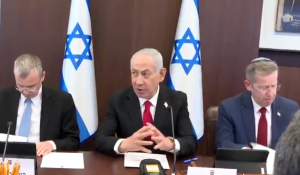 PM Netanyahu offers remarks at Cabinet meeting. Screengrab via X.
One of the most recurring refrains that resonates in the Bibiphobic echo chamber that overhangs much of the political debate in Israel is the allegation that “Bibi has ruined the country.”
Indeed, the incessant repetition of the charge has given it almost axiomatic status for the anti-Netanyahu crowd — as if it were a self-evident truth requiring little substantiation on the part of its purveyors to establish its veracity.
Indeed, a wide-ranging array of achievements runs starkly counter to this grave accusation.
Impressive, if still incomplete, security accomplishments
In the realm of security, many of the facts are largely well established in the public domain, so I will not dwell on them in any great detail.
Virtually all of the pre-October enemy leadership, devoted openly to the destruction of the Jewish state, has been “dispatched into the hereafter”, sending a clear message that following in their footsteps could be a risky path to tread. The array of those no longer with us includes the bloodthirsty Sinwar brothers, the once elusive Mohamed Deif, the hedonistic plutocrat Ismail Haniya, the boastful Hasan Nasrallah, and the brutal theocrat Ayatollah Ali Khamenei, along with a long entourage of cronies and henchmen. And the list gets longer daily.
On the battlefield, sustained IDF action has brought Syria to the brink of disintegration, but most importantly, has decoupled it from Hezbollah and Iran, effectively disrupting the longstanding Shi’a arc linking Iran to Lebanon.
In Lebanon itself, Hezbollah, although still a formidable force, is no longer viewed as the protector of Lebanon, but by many as the enemy of Lebanon.
In Gaza, much of the enclave lies in ruins, with 60-70% of it under the control of the IDF, and with the prospect of large-scale emigration of the inhabitants gaining momentum-albeit sluggishly.
In Iran, much of the infrastructure–physical and human–on which its nuclear program was based, has been eliminated and, at the very least, set back for years.
Emphasis on Economics
But a word of caution is called for here.
Initial operational successes, although necessary, can turn out to be fleeting and ephemeral. Perhaps the starkest example of that is the case of Nasrallah’s predecessor, Abbas al-Musrawi, who was eliminated by the IDF in Lebanon in 1992, a measure that brought the arguably even more murderous Nasrallah to power, as well as resulting in a series of lethal terror attacks on Israeli personnel and installations — particularly in Buenos Aires.
However, for the remainder of the analysis, the focus will be on the economic performance of the country under the Netanyahu government-particularly in the post-October War period-which has received far less media attention than that allotted the security sphere.
Significantly, Israel’s overall economic performance has outstripped virtually all other leading Western economies across a wide range of major indicators.
GDP per capita:
Indeed, while traditional Western European economies have faced prolonged stagnation, Israel maintained a top-tier global position, with its GDP per capita rising to almost $70,000-surpassing major Western economies such as Germany, France, Japan, Canada and the UK-and even the petro-rich UAE.
The exchange rate:
The country’s economic robustness is reflected in the strength of its currency. Indeed, the demand for the shekel has propelled it to be one of the world’s strongest currencies in recent years. Moreover, despite the war and gloomy prospects that abounded in its immediate wake, the shekel has risen dramatically against the US dollar (around 36%) – from a low of just over 4 to under 3 to the dollar! Likewise. It has appreciated substantially against the Euro (over 18%) and Sterling (over 17%)
Direct foreign investment (FDI)
Direct foreign investment in the country has soared since the post-October War. Indeed, Israel has led the world in attracting foreign investments relative to GDP (which of course also contributed to the demand for the shekel and its high rate of exchange)
Moreover, cross-country comparison of FDI as a percentage of gross fixed capital formation shows that international investors see Israel as a distinctly profitable place in which to invest: Thus, in Israel, the rate of FDI in gross fixed capital formation is 13,7% over twice the overall World rate of 5,3% and three times that of the developed economies (4,7%) and of the US (4.4%).
The growth rate of GDP per capita:
In terms of the growth of GDP per capita (as distinct from the absolute levels discussed above), over the last three decades-for most of which Netanyahu was Prime Minister-in Israel this has been +275%, easily surpassing the US (215%) and almost doubling that of the UK and the EU (147% and 147% respectively)
Flawed but successful
Of course, none of this is to suggest that Netanyahu is above all reproach. Indeed, for all his manifest merits, he is a leader with undeniable faults, who has not done many things that he should have, and done many things that he shouldn’t have.
However, whatever those undeniable shortcomings are, they are apparently far fewer than any of his even remotely relevant rivals.
Accordingly, when coming to decide on how to cast one’s ballot in the upcoming elections, it would seem prudent to heed the well-known dictum: If it works, don’t fix it.
Martin Sherman spent seven years in operational capacities in the Israeli defense establishment. He is the founder of the Israel Institute for Strategic Studies (IISS), a member of the Habithonistim-Israel Defense & Security Forum (IDSF) research team, and a participant in the Israel Victory Project.
Israpundit is entirely dependent on readers support. Please help me continue educating people with the truth about what is going on in Israel and around the world.


The attitude of “dreuveni” and similar disregard that the Likud built on a lot of work done by “Mapai Israel” that laid institutional and material foundations from ZILCH.When I first visited as an adult in ’66 and on shnat sherut in 1967 – 68 my relatives and the children of family friends jested frequently about our parental generation’s catch phrase, “She ani bati hyah klum,” When I came there was nothing.
Now on my last visit this Feb’26 past I am astonished at the urban development and the quality of the railways. However there are too many self satisfied Americanised or ex Americans who fail to recognise that the Green Line of the little Israel of 1949 – 67 hangs on the kibbutzim and moshavim of the tower and stockade campaign and that the socialist ethos of those times was a practical implementation of a collective desire to build a nation state when the religious were incapable of doing anything beyond congregational welfare and still do NOT believe in government governing except to featherbed them. Further whatever the achievements of the private sector under the Mandate and first decades of the state there was simply NOT enough of it to support a free market economy. Markets need something to trade and there was nowt in the self governing refugee camp that was Israel in 1949 – 56 before German reparations arrived and after 1967 when the US decided to back a winning horse that could snub the Soviets. As Europe and the Americas besides Israel have shown since, the biggest enterprises in modern economies are public sector schemes even if they use private sector contractors to do the actual work: NASA and space rockets; the Israeli water carriers and the rail, roads and ports.
This is the best rational pitch I have heard for supporting Bibi and the Likud. Even though I personally like Smotrich a lot. He finds a way to achieve things (building in Judea/Samaria). Since he would join Bibi’s coalition and he needs votes to make sure he gets over threshold, voting for the Religious Zionist party would be a good thing!
“The Israeli government expanded the blueprint for the planned city of Mishmar Yehuda on Monday, declaring an additional 91 acres of land in Judea as state property.
The newly designated land, located near Ma’ale Adumim, brings the future city’s total planned footprint to approximately 926 acres. The planned expansion aligns with the initial master plan to construct 3,600 housing units in the area.
Finance Minister Bezalel Smotrich welcomed the move, tweeting in Hebrew, “The attractive and strategic location of the city, near Jerusalem, will provide a tremendous opportunity for young couples to establish their homes there and strengthen the settlement in Judea and Samaria.”
“Arab Media Melts Down Over Smotrich’s 1M-Jew Negev Plan”
Marni Harow
Editor: Marni Harow
The initiative is being promoted under Smotrich’s policy in coordination with the Gush Etzion Regional Council and the government’s Commissioner of Property and Abandoned Lands unit.” –
—-
“Arab media platform Arab i published an alarmist video warning against Finance Minister Bezalel Smotrich’s plan to strengthen Jewish community-building in the Negev and Galilee, claiming it could bring a million Jews and shift the demographic balance.”
https://www.c14news.com/article/1496409
C14 news, yesterday.
Would this be happening under any other possible goverment?
So the left or the opposition expect everybody to ignore these facts and vote them back into power so that they can destroy all that was gained. My guess: most Israelis are sharp enough to see through this scheme.
Just have the humility to recognise that “Mapai Israel” hung the Green Line on its Kibbutzim and Moshavim of the Tower and Stockade campaign and settled a million penniless refugees from the Shoah and the Arab World expulsions when there was precious little in the country – all without letting the sort of sewerless shanty / favella slums develop as in the rest of the post colonial World eg Dacca and Nairobi and many other towns of the not so ex colonial World.
The socialist ethos created the collective will to create a nation state institutions when neither the religious ritual picking could do more than congregational welfare if that and when there was nothing to market to create an entirely market economy. It was the IDF input into tank and aero engineering and cyber that has enabled Israel to seize a niche in the World IT economy.
As is clear from the aero space and IT industries let alone the Dutch dykes and Israeli water carrier besides Israel’s now excellent railways, it is clear that in modern society a lot of public money goes into seeding the big projects of a modern economy and generally Keynesian multiplier to it even if a lot of the detailed work s put out to private sector contractors.