
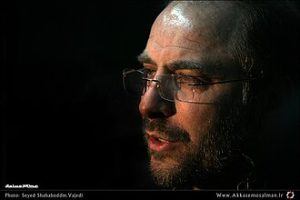
 Mohammad-Baqer Qalibaf. Photo by Seyed Shahabbodin, Vajedi – Akkasemosalman.ir , CC BY 4.0, Wikipedia
The apparent eagerness of Trump to make a deal with Iran, leaving in place the current regime, has left many Iranians feeling deceived and disappointed. They are particularly alarmed that his mediators have been talking to the speaker of Iran’s parliament, Mohammad Bagher Ghalibaf. More on Ghalibaf can be found here: “Iranians feel ‘deceived, abandoned’ as Trump weighs striking deal with Iran’s old guard,” by Omid Habibinia, The Media Line, March 25, 2026:
As US President Donald Trump spoke of talks with a “senior Iranian official,” whom several media outlets identified as parliamentary speaker Mohammad Bagher Ghalibaf, concern spread among many Iranians that the Islamic Republic might ultimately remain in power.
Iranian authorities, however, have publicly insisted they will not fall into what they describe as a “deception operation” aimed at presenting Ghalibaf as Washington’s preferred figure to lead the country. They have also warned that any ground offensive or seizure of Iranian islands in the Persian Gulf would carry severe regional consequences.
Iran’s rulers know that twice before, when the U.S. was engaged in negotiations with Iran, the Americans suddenly broke off the talks and attacked Iran. They fear that his dealing with Ghabilaf is designed to buy time while more American forces can be assembled in the Gulf to take part in a ground war, possibly seizing Kharg Island, or even using American forces to seize the 440 kg of uranium enriched to a level of 60% that is believed to be hidden in Isfahan.
Trump described these developments as tantamount to regime change in Iran, something that deeply distresses many opponents of the Islamic Republic who seek the overthrow of the regime.
Apparently unable so far to effect regime change in Iran, Trump has simply declared that such “regime change” is taking place and expects the world to accept his assertion as true.
His remarks on Monday unsettled part of the opposition, particularly those who had framed Israeli and US military action, echoing Reza Pahlavi, as a form of “humanitarian intervention.”
Many Iranians are disappointed by Trump’s apparent willingness to leave the regime in place, even as he says “regime change” has occurred. He is content, apparently, that dozens of Iranian leaders, both military and civilian, have been removed — that is, killed by the IDF — even though others, no different in kind, remain in power. And especially troubling to Iranians is that Ghabilaf, a hard-liner, is the man with whom Trump has decided to negotiate.
Yet for others, the comments have had the opposite effect, reinforcing calls to intensify domestic efforts to revive a grassroots movement against the regime, regardless of whether Israel and the United States pursue negotiation or escalation with Tehran….
While many Iranians are disappointed with Trump’s readiness to deal with the regime, not to overthrow it, some have not given up hope, and are more determined than ever to foment a rebellion from within, whatever the Americans or Israelis (who are much more insistent on real regime change than the Americans) decide.
On Tuesday, Trump reiterated that his administration is negotiating with Iran, that the Islamic Republic wants to reach a deal, and that it is expected to receive a “gift” in return for such an agreement. He also said that the United States is already the winner of this war and stressed that Washington is negotiating with “wise” people in Iran. He even described this development as tantamount to a “regime change” in Iran….
Since the outset of the conflict, Trump has repeatedly suggested that he has individuals in mind for Iran, drawing comparisons with the Venezuela model.
But the Venezuela model, removing only Nicolás Maduro while leaving the other members of his dictatorial regime in place, including Maduro’s former second-in-command who now leads the country, has not brought either democracy or prosperity to the Venezuelans. So far, her continued rule cannot be considered a victory, as Trump appears to believe.
Notably, lists circulated by US officials naming key Iranian figures whose locations were being sought did not include Ghalibaf, nor, more strikingly, Esmail Qaani, the elusive commander of the Quds Force, prompting speculation that the intended interlocutor could be a senior Islamic Revolutionary Guard Corps (IRGC) figure with political standing, such as the parliamentary speaker.
Trump’s characterization of the person he contacted, namely Ghalibaf, as a “respected” figure stands in sharp contrast to his reputation among many Iranians. Critics portray him as one of the most controversial figures within the political establishment, citing allegations of systemic corruption and his record in security roles.
His tenure as a senior commander in the IRGC and later as police chief coincided with the violent suppression of the 1999 student protests, events witnessed firsthand by me, as I was present at Tehran University dormitories during the crackdown by paramilitary forces, police, Basij units, IRGC personnel, and, ultimately, special security forces linked to the leadership….
The ”moderates” — a relative term in the Iranian context — who include the current president Masoud Pezeshkian, have been pushed aside; hardliners with a history of working in the Islamic Revolutionary Guard Corps are in the ascendant, and among the most prominent is Mohammad Bagher Ghabilaf, the man Trump now considers the most worthy of interlocutors. For anyone hoping that the regime might soften its stance, Ghalibaf’s new prominence — pushed by Trump — is most unwelcome.
So far, if we are to believe Trump’s statements, he is willing to accept the regime’s continued existence, and with a hardliner like Ghalibaf as its new supreme leader. No wonder there is that growing feeling among Iranians of being “deceived and abandoned.”
Trump may be so determined to get the Strait of Hormuz opened again, in order that the energy prices go back down and the stock market goes back up, that he is willing to accept what for the people of Iran will be a defeat, but in Trumpian fashion, he will call it victory.


There won’t be regime change unless the Iranians themselves find the courage and strength to bring it about. Yes, it would be very dangerous, but an outside force could not do what only the Iranians can achieve. Nobody wants another Iraq. Maybe there will be a ground troop invasion by the US, but probably not; in any case, conditions for a revolution in Iran will never be better than now. I only hope they will go for it.