
Ahmad Sharawi
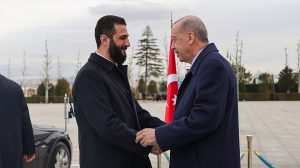 Recep Tayyip Erdogan met with Ahmed al-Sharaa. Photo by Presidency of the Syrian Arab Republic – Presidency of the Syrian Arab Republic, Public Domain, Wikipedia
F1or the first time since March, Israeli jets struck deep inside Syria on August 18, targeting the Abu Duhur airbase in Idlib governorate, roughly 70 kilometers south of the Turkish border. According to official Syrian sources, Israel carried out eight strikes targeting the base’s runway and storage facilities.
The Israeli Prime Minister’s Office said Israel and Syria had previously reached an understanding to preserve the security status quo, which Damascus was allegedly on the verge of breaching by allowing Turkish forces to deploy at the airbase. Syrian officials denied that any such understanding existed and condemned the strikes as a “violation of sovereignty.” Meanwhile, U.S. Special Envoy for Syria and Iraq Thomas Barrack expressed concern that the strikes constituted an “unnecessary escalation that does not advance regional stability.”
Israel has been clear about its red lines and concerns over threats emanating from Syria. Since the fall of the Bashar al-Assad regime in December 2024, Israel has maintained a security zone inside Syrian territory and conducted airstrikes against perceived threats, including military bases that were slated to host Turkish forces, such as the T4 airbase in central Syria, which Israel struck in February 2025.
Syrian Army Capabilities
After Assad’s fall, Syria’s new leadership moved quickly to rebuild their armed forces by combining numerous militias into a more unified military structure. Today, the force reportedly numbers nearly 150,000 personnel and its conventional capabilities remain limited following Israeli strikes in December 2024. A 2026 estimate puts Syria’s inventory at 104 military aircraft, including 52 fighter jets, of which an estimated 21 are operationally ready.
Despite the lack of capabilities, the Syrian Defense Ministry announced the graduation of 1,000 cadets in July, and this month, two Syrian Su-22 fighter jets were flying over northern Syria, the first flight under the new leadership.
Israeli Red Lines
Turkey has made little effort to conceal its determination to maintain a long-term presence in Syria. Turkish Defense Minister Yasar Guler said in February that Ankara has no intention of withdrawing from its bases in northern Syria. Israel worries that Ankara could eventually use its military presence in Syria as a platform to pressure or threaten Israel, and remains wary of the close relationship between Syrian President Ahmad al-Sharaa and the Turkish leadership.
Israel’s concerns, however, extend beyond Turkey itself. Sharaa’s background as a former al-Qaeda leader has made Israeli officials skeptical of his intentions since the earliest days of his rule. Those concerns have been reinforced by his government’s integration of extremists and foreign fighters into the Syrian military, as well as by the massacres targeting minority communities in 2025.
Rhetoric from within the Syrian armed forces has added to these fears. In one video posted on August 16, Syrian army soldiers assembled outside the historic Damascus Citadel were filmed chanting explicitly anti-Israel and antisemitic slogans, including: “I am coming for you, Jew … I will make your blood flow in rivers.”
Washington Should Address Turkey’s Military Entrenchment in Syria
U.S. envoy Thomas Barrack has signaled that he is working on a Turkey-Syria-Israel deconfliction framework aimed at preventing similar incidents in the future. While such an arrangement is important for regional deescalation, it would not provide a long-term solution to the potential threat Turkey could pose to Israel through its military presence in Syria. Washington has also been mediating efforts toward a security agreement between Syria and Israel, an initiative that Sharaa himself has expressed openness to.
Although Turkey’s role was likely discussed during previous negotiations that continued through January, the question of Turkish military entrenchment in Syria should become a central element of any future understanding between Damascus and Jerusalem, who share an interest in weakening Hezbollah and Iranian militias. The United States should also take Israeli concerns about Ankara’s expanding military footprint in Syria more seriously and ensure that any agreement includes mechanisms to prevent Syrian territory from becoming a platform for future Turkish pressure or military threats against Israel.
Ahmad Sharawi?is a senior research analyst at the Foundation for Defense of Democracies (FDD). For more analysis from Ahmad and FDD, please subscribe?HERE. Follow FDD on X?@FDD. Follow Ahmad on X?@AhmadA_Sharawi. FDD is a Washington, DC-based, nonpartisan research institute focusing on national security and foreign policy.


Leave a Reply
You must be logged in to post a comment.