
Peloni: Avi Abelow provides an important context to the Israeli strike on Syria to prevent Turkish expansion southwards towards Israel. Israel established a Red Line regarding Turkey directly expanding and incorporating Syria. Unlike the Red Lines established so often by others in the region, Netanyahu acted to demonstrate that there was in fact absolutely NO flexibility on this Red Line. His comment warning Erdogan “Don’t” served to make this point even more clear, and not just to Turkey. I am honestly impressed with the strength and earnestness with which Netanyahu responded in Syria, and as Abelow explains below, it gives me great hope for the future, as this is the model by which Israel must respond when its stated Red Lines are tested. Erdogan knew full well what he was doing when he made plans to take over the base in Syria, but what he failed to appreciate is that October 7 changed everything, including how Israel might respond when being challenged on stated Red Lines. The fact that Erdogan felt at ease in crossing that Red Line was in no small part due to the American effort by Amb. Tom Barrak and others to embolden Turkey and its Muslim Brotherhood chieftain Erdogan. So a deconfliction mechanism will now be established to prevent similar challenges in the future. It is concerning that such a mechanism was not already considered a necessity by Washington given the raising rhetorical threats coming from Turkey and increasing in tone and significance even in recent weeks. I only hope that when the deconfliction mechanism is soon to be tested that someone more impartial to the advancement of Turkey in the region answers the phone in Washington or things could quickly spiral out of control.
Avi Abelow
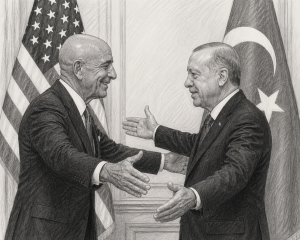 Ambassador Tom Barrack and President Recep Erdogan. Image via AI
Israel just did something in Syria that represents one of the most positive and important changes in Israeli national-security policy since October 7.
Early Tuesday morning, Israeli fighter jets reportedly carried out eight airstrikes against the Abu al-Duhur airbase in northwestern Syria, damaging its runway and storage facilities, and upsetting U.S. envoy Tom Barrack, whose public positions too often seem more focused on advancing the interests of Turkey, Syria and Lebanon than on recognizing the strategic interests of the United States and its ally Israel.
No casualties were reported from the strike.
Why did Israel strike a Syrian airbase so far north, relatively close to Turkey?
Because according to Prime Minister Benjamin Netanyahu’s office, Israel had intelligence that Syria was preparing to allow Turkish forces to deploy at the base.
Israel warned Syria repeatedly not to allow it.
Syria ignored the warnings.
So Israel acted.
The Prime Minister’s Office put it plainly:
“Israel will not tolerate threats to its security.”
Netanyahu himself made the message to Turkey even simpler.
“Don’t.”
This is huge.
Not merely because Israel bombed another military installation in Syria. Israel has done plenty of that.
It is significant because of when Israel acted.
Israel did not wait for Turkey to establish the base.
Israel did not wait for Turkish drones, aircraft, weapons or air-defense systems to become operational there.
Israel did not wait for a Turkish military presence to become an entrenched strategic threat to Israel’s northern frontier.
Israel identified what it believed was a developing threat, warned against it, and then acted preemptively to prevent it from becoming one.
That is the Israel we desperately needed before October 7.
Remember the Hezbollah Tents?
Now compare this to the Israel of before October 7.
In 2023, Hezbollah literally erected armed positions in tents along Israel’s northern frontier, including in territory Israel regarded as being on the Israeli side of the Blue Line, against international law.
Hezbollah was testing us.
And instead of immediately removing the threat, Israel spent months pursuing diplomacy and trying to avoid escalation, fearful of the international outcry if we would act.
Think about the mentality behind that.
Hezbollah, an Iranian-backed jihadist terrorist army dedicated to Israel’s destruction, was establishing facts on the ground right on our border.
And Israel was worried about what might happen if we removed the tents.
What would Hezbollah do?
Would it escalate?
What would Washington say?
What would the international community say?
That mentality was not limited to one tent.
It represented an entire strategic doctrine.
Contain the enemy. Appease the enemy. Avoid escalation. Buy quiet. This dangerous mindset was deeply embedded throughout Israel’s military, intelligence, and political leadership.
And above all:
Don’t do anything that might trigger international condemnation.
October 7 should have buried that doctrine forever.
The New Doctrine: Don’t Wait for the Attack
Now look at what Netanyahu’s government just did.
Israel reportedly identified a possible Turkish military buildup in Syria.
Days before the attack, Mossad director Roman Gofman spoke directly with Syrian Foreign Minister Asaad al-Shaibani. According to Reuters, the conversation dealt extensively with Israel’s concerns over Turkish military activity, including troop deployments, weapons and drones.
Israel warned Syria.
Then, hours after Syrian officials say a Turkish military delegation visited Abu al-Duhur, Israeli jets struck the airfield.
That is an extraordinary contrast.
Before October 7: an enemy establishes a position on our border and we hold back from removing it because we fear international condemnation.
After October 7: Israel sees a potential strategic threat developing hundreds of kilometers away and acts before that threat becomes entrenched.
That is deterrence.
That is how Israel must operate in the Middle East.
Especially because Sunni Turkey is becoming the next major jihadi threat…
The weakening of the Iranian jihadi regime and its Shiite jihadi axis has been an enormous Israeli achievement.
The Shiite Hezbollah in Lebanon has been severely weakened. Iran’s regional infrastructure has suffered devastating blows. Iran’s strategic partner in Syria, Assad, is gone.
But jihad did not disappear.
The strategic landscape is changing.
And under Sunni Muslim Brotherhood leader Recep Tayyip Erdo?an, Turkey is positioning itself as the powerful Sunni Islamist regional power, with longstanding political support for Hamas.
Turkey has become one of the principal patrons of Syria’s new government under ISIS/jihadi leader Al-Jolani, who has a $10 million bounty on his head. Ankara is helping train Syria’s military, supplying equipment and providing political and military support.
That should concern every Israeli and the Trump administration.
Because the danger is that as the Shiite Islamist threat led by Iran weakens, a powerful Sunni Islamist state is filling the vacuum.
And unlike Hamas or Hezbollah, Turkey is not a terrorist organization operating from tunnels.
Turkey is a nation-state.
It possesses NATO’s second-largest military.
It has fighter aircraft, drones, missiles, advanced weapons and an enormous defense industry.
Israel cannot allow that military power to establish itself progressively closer to our northern border and then wake up one morning asking:
How did we let this happen?
We made that mistake with Hezbollah.
We watched them grow from terrorist organization into armies possessing an enormous rocket and missile arsenal.
We made that mistake with Hamas.
We watched Hamas build tunnels, manufacture rockets, train battalions and construct an entire terrorist military infrastructure under Gaza.
And every step of the way there was another excuse for not acting decisively.
Now isn’t the right time.
We don’t want escalation.
The international community won’t support us.
Deterrence is working.
They don’t want a war either.
Then came October 7.
That day should have permanently changed the most fundamental question Israeli leaders ask themselves.
The question can no longer merely be:
What happens if we attack today?
It must also be:
What happens if we don’t, and this threat is ten times more dangerous five years from now?
President Trump’s Syria envoy and ambassador to Turkey, Tom Barrack, criticized Israel’s attack as an “unnecessary escalation” and said Washington believed restraint and engagement were preferable.
This is not the first time Tom Barrack has demonstrated, at best, a troubling misunderstanding of the region, or, more concerningly, taken positions that appear to prioritize the interests of Turkey, Syria and Lebanon over properly protecting the strategic interests of the United States and its ally Israel.
Regardless, Israel’s prime minister has a different responsibility.
His responsibility is to protect Israel.
Israel cannot outsource its security doctrine to Washington.
And certainly not to diplomats whose primary objective is avoiding friction between Turkey, Syria and Israel.
We should coordinate with America.
We should share intelligence.
We should use diplomacy whenever diplomacy can actually remove the threat.
But ultimately, Israel must retain the freedom to defend itself by itself.
Because when an Israeli prime minister has to choose between international criticism today and Israeli funerals tomorrow, there should be no choice at all.
This transformation cannot stop with Netanyahu.
We need an entire generation of Israeli political and military leadership that has internalized October 7.
We need politicians who are not terrified of condemnations.
And we need generals who think like fighters, not diplomats in uniform.
Their instinct when confronting an emerging enemy threat cannot be:
How do we avoid escalation?
It must be:
How do we destroy this threat now so that the enemy understands never to escalate against us?
That does not mean recklessness.
It means understanding deterrence.
Real deterrence is not repeatedly telling an enemy that you don’t want war.
Real deterrence is creating such certainty about the consequences of threatening Israel that the enemy understands that attacking us isn’t worth it.
Western governments can afford to think in terms of diplomatic processes measured in years.
Israel often cannot.
We live in the jihadi Arab Muslim Middle East.
We live surrounded by jihadi enemies that view weakness not as an invitation to compromise, but as an invitation to push harder.
And therefore Israel must never return to the fearful, reactive mentality that dominated so much of our national-security establishment before October 7.
Never again should Israel knowingly allow a military threat to grow because we are afraid of the consequences of eliminating it.
Never again should our leaders confuse restraint with deterrence.
Never again should we wait until our enemies attack us before deciding that the threat has finally become serious enough to destroy.
Israel warned Syria.
Israel saw Turkey moving deeper into the equation.
Israel established a red line.
And when Israel believed that red line was about to be crossed, Israel acted.
Netanyahu summarized Israel’s message in one word:
“Don’t.”
That is a language this region understands.
And it represents something much bigger than one Syrian airbase.
It represents an Israel that is finally learning one of the most painful lessons of October 7:
Preempting a threat may bring international condemnation today. Allowing that threat to grow will definitely bring Israeli funerals tomorrow.
I know which risk I want our leaders to take.
May we never return to the weak, fearful Israel of October 6.
We are still in this wake-up process. We still have many security, intelligence, politicians and legal officials to replace.
And we certainly cannot afford to replace Netanyahu with opposition leaders who would return Israel to the failed pre-October 7 mindset of trusting international powers, appeasing our enemies, and allowing fear of international condemnation to dictate our national-security policy.
But we are winning this war, and we will ultimately win it—despite the serious challenges, both external and internal, that we still must overcome.
Am Yisrael Chai!!!


Leave a Reply
You must be logged in to post a comment.