
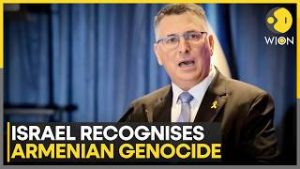
Israeli Govt Unilaterally Votes to Recognise Armenian Genocide | WION News

Peloni:  Meanwhile, Turkey uses its close association with Israel’s Azerbaijani ally to request reconsideration of the recognition of Armenian Genocide.  The full Knesset vote is still pending, so we will see what comes from this request, but the govt has the means to pass this measure without any support from the opposition, which will be hard pressed to vote against it in any event.  The farce of ignoring the ethnic cleansing, which is a better description than genocide, of Armenians and Greeks by the Turks is too comical to ignore.  There was once a geopolitical basis for doing so in the past, but recent events have changed the context for maintaining the charade of ignorance about the events which took place over the course of a decade against these minority populations, more than a century ago.
Video Loads Below

June 29, 2026 | 4 Comments »

Leave a Reply

4 Comments / 4 Comments

  1. “What is lemke’s definition of genocide and is ethnic cleansing different?”
    AI Overview:
    ‘Raphaël Lemkin defined genocide as a coordinated, multi-layered attack aimed at destroying the essential foundations of a national, ethnic, or racial group’s life. He first coined the term in his 1944 book Axis Rule in Occupied Europe, combining the Greek genos (race/tribe) and Latin cide (killing). [1, 2, 3, 4]
    Crucially, ethnic cleansing is distinct under modern international law but was fully included in Lemkin’s original definition of genocide. Over time, political and legal compromises split the two concepts. [1, 2]
    Lemkin’s Original Definition of Genocide
    For Lemkin, genocide did not simply mean mass murder or the immediate physical extermination of a group. Instead, he viewed it as a holistic process designed to wipe out a group’s identity. He outlined eight distinct techniques used by perpetrators to destroy a group’s way of life: [1, 2, 3, 4, 5]
    Political: Abolishing local self-governance and imposing the occupier’s political structures.
    Social: Disrupting the social cohesion and national spirit of the targeted populace.
    Cultural: Banning local languages, closing schools, and destroying historical monuments.
    Economic: Seizing property, wealth, and factories to systematically impoverish the group.
    Biological: Restricting marriages and birth rates within the target group.
    Physical: Imposing starvation, mass deportation, and deadly living conditions.
    Religious: Suppressing local spiritual leadership and criminalizing religious practices.
    Moral: Undermining the group’s dignity and pride through forced humiliation. [1, 2, 3, 4, 5]
    Genocide vs. Ethnic Cleansing
    While Lemkin viewed the forced removal of a group from its land as a primary tool of genocide, modern law separates them based on the perpetrator’s primary intent. [1, 2]
    Feature [1, 2, 3, 4, 5] Genocide Ethnic Cleansing
    Primary Intent Physical destruction of the group in whole or in part. Forced displacement to remove a group from a specific area.
    Legal Status Codified as an independent international crimesince 1948. Not recognized as an independent crime under international law.
    How It Is Charged Charged directly under the UN Genocide Convention. Prosecuted as a war crime or a crime against humanity.
    The Critical Connection
    Despite their legal differences, the lines between ethnic cleansing and genocide are often heavily blurred in practice: [1]
    Acts Overlap: The violent methods used to force a population to flee—such as mass murder, systemic rape, and burning homes—frequently cross the legal threshold into genocide. [1, 2]
    Escalation: Historical atrocities often begin as ethnic cleansing (aiming to move a population) but evolve into outright genocide when the physical destruction of the group becomes the final objective. [1]
    Perpetrator Language: Human rights organizations like the Lemkin Institute for Genocide Preventioncaution that the phrase “ethnic cleansing” was originally popularized by perpetrators to sanitize their actions and minimize the perceived gravity of ongoing genocides. [1]”

    • does natasha hausdorff discuss the difference between genocide and ethnic cleansing?

      Yes, Natasha Hausdorff frequently discusses the legal distinction between genocide and ethnic cleansing, specifically through the lens of international humanitarian law and the ongoing Israeli-Palestinian conflict. As the legal director for UK Lawyers for Israel (UKLFI), she treats both terms as distinct, heavily weaponized legal concepts. [1, 2, 3, 4, 5]
      Her core arguments regarding the differences and definitions include:
      1. The Legal Definition of Genocide
      Intent Requirement: Hausdorff emphasizes that under the 1948 Genocide Convention, genocide requires a strict, proven intent to physically destroy a national, ethnic, racial, or religious group “in whole or in part”. [1, 2]
      Misapplication: She argues that civilian casualties resulting from urban warfare do not legally equate to genocide, as long as an army aims to target combatants rather than eradicate an entire civilian population. [1, 2]
      2. The Distinction of Ethnic Cleansing
      Forced Displacement: In her legal lectures, she addresses ethnic cleansing as the forced removal or displacement of an ethnic group from a specific territory, rather than their physical destruction. [1, 2]
      Evacuation vs. Cleansing: She draws a sharp distinction between illegal ethnic cleansing and lawful, temporary military evacuations. She argues that the IDF’s civilian evacuation directives in Gaza are mandated under the Law of Armed Conflict to minimize civilian casualties, rather than an attempt at permanent displacement. [1, 2]
      3. Historical Inversion
      Jewish History: Hausdorff notes the irony of these terms being utilized against a Jewish state, given that “genocide” was explicitly coined by Raphael Lemkin to describe the Holocaust. [1]
      Arab World Expulsions: To illustrate actual ethnic cleansing, she frequently points to the historical expulsion of roughly 850,000 Jewish people from Arab nations following the 1948 war, noting that those centuries-old communities were entirely erased. [1]
      Summary of Her Perspective
      Ultimately, Hausdorff views both “genocide” and “ethnic cleansing” as modern political libels when applied to Israel. She argues that expanding or conflating these specific legal definitions to encompass standard, high-intensity urban warfare degrades the validity and authority of the international legal order. [1, 2, 3]

    • I’m reminded of:

      “How would you define terrorism?” @ 1:19

      ‘“U.N. Me’ (2009) Official Trailer” 14 years ago

      https://youtu.be/FIzDt5NPYfI?is=77d4jY5yZFbSkOoY

      and:

      “ It is almost universally felt that when we call a country democratic we are praising it; consequently, the defenders of every kind of regime claim that it is a democracy, and fear that they might have to stop using the word if it were tied down to any one meaning.” —George Orwell, “Politics and the English Language” (essay)

      “War is Peace
      Freedom is slavery
      Ignorance is strength”

      – “1984” (novel) – George Orwell

