
Jonathan Feldstein
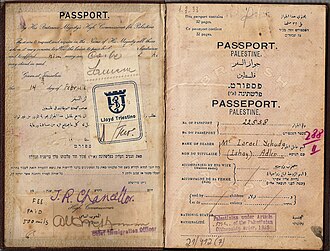 Palestinian Passport issued by British Colonial Office for Israel Yehuda in 1929. Photo by Huddyhuddy – Own work, Public Domain, Wikipedia
On May 15, as has been done for decades, Palestinian Arabs, their supporters and Israel detractors observed the “Nakba” or the catastrophe of Israel’s birth in 1948. In order to understand the veracity of that narrative and how it’s been conflated in modern dialogue and reporting, it’s important to understand what lies behind that. This is Part One of a Six Part series.
A Name with a History
My father was a Palestinian. A Palestinian Jew. He was born in Palestine in 1937, at a time when the only people commonly referred to as “Palestinians” were the Jewish population. The Arabs of Palestine, some of whom were indigenous and many others recent migrants who came to benefit from the prosperity generated by Jewish restoration of their ancestral Land, were referred to simply as Arabs, identified by their respective clans. Arab leaders themselves affirmed this repeatedly over the decades.
These are facts. And here is another: from the day Israel was born in 1948 and my father became an Israeli, until 1964 the year I was born, the term “Palestinian” was essentially in hibernation. It was then repurposed to give an ethnic identity to a people whose main common bonds were their aspiration to annihilate Israel, the war they instigated, and the consequences of losing it.
Rome’s Invention, Repurposed
The term “Palestine” was invented by the Romans in 135 CE, after violently crushing a Jewish rebellion in Judea for the second time in a century. That it was a response to a Jewish uprising underscores the historical fact that Jews were not only present in the Land but indigenous to it. Even if you don’t read the Bible, there is abundant historical and archaeological evidence of this.
Using the name “Palestine” was Rome’s way of erasing the conquered people, and part of their ethnically cleansing most Jews from the Land of Israel. It is an act of historic revisionism to suggest otherwise, or to retroactively apply the term “Palestine” to earlier inhabitants. For instance, those who claim Jesus was a “Palestinian” ignore a basic truth: the term did not exist until more than a century after his crucifixion. He never heard the word. It would have been foreign to him entirely.
The Arch of Titus in Rome, a distinctly non-Jewish edifice, stands as permanent documentation of this truth alongside the historian Josephus and many others. It records Rome’s victory over Judea (the Jews) in the First Century, the looting of the Temple in Jerusalem, and the enslavement of the Jewish people. The common inscription from Rome’s triumph over the Jews reads “Judea Capta,” Judea is captured. There is no mention of Palestine.
From Ottomans to British Mandate
Over the millennia, the land that Rome rebranded as “Palestine” was conquered successively by numerous empires. Among the longest of these was the Ottoman conquest and occupation, from 1516 to 1917, during which Jews and Arabs both inhabited the Land but neither were called Palestinians. Mark Twain, who traveled through the region on pilgrimage, wrote of a land that was desolate, largely empty, and given over to weeds. Throughout his journey and all his observations, he never mentioned “Palestinians,” because there were none in the modern usage.
Following the Ottoman and German loss in World War I, Britain conquered the region and was granted authority for its governance under the League of Nations through what became the British Mandate for Palestine. That Mandate encompassed all of modern Israel, Jerusalem, Gaza, Judea and Samaria (referred to as the West Bank), and all of modern Jordan. After affirming the goal of establishing a Jewish homeland in the 1917 Balfour Declaration, Britain in the 1920s lobbed off 78 percent of Mandatory Palestine and created the Emirate of Transjordan, which later rebranded itself as the Hashemite Kingdom of Jordan.
On November 29, 1947, the United Nations voted to partition the remaining 22 percent of Mandatory Palestine into an Arab state and a Jewish state. The Jewish leadership agreed. The Arab leadership resisted. Violently. Six months later, on May 15, 1948, the British Mandate terminated and the State of Israel was born.
At no point between the Roman conquest and the first half of the twentieth century did an independent state or political entity called Palestine exist. It still hasn’t. So, the idea that there was an independent “Palestine” with an indigenous Arab population known as “Palestinians” fueling the Nakba narrative is false.
The 1964 Invention
The modern Palestinian Arab identity gained sharp definition in the 1960s. The Palestine Liberation Organization (PLO) was founded in 1964, with the stated goal of liberating “Palestine.” Even though they would challenge the Hashemite King Hussein later that decade, their crosshairs were on Israel. Eliminating Israel was their goal. “Armed struggle” was their mandate.
But 1964 was three years before the 1967 Six-Day War and Israel’s capture of the Judea and Samaria (West Bank), Gaza, and Jerusalem. If the goal of liberation of
“Palestine” preceded any Israeli “occupation” of those territories, then it’s clear the target was never the West Bank or Gaza. The target was Israel itself. It’s never been about the lack of a “Palestinian” state, but rather about the existence of the Jewish state.
It is worth noting that the founding father of the PLO and of modern “Palestinian” identity, Yasser Arafat, was born in Egypt. There is hardly another example in history of a leader of a national movement who had no personal connection to the land or people he claimed to lead. Austrian-born Hitler comes to mind as leader of Germany, and is an apt analogy.
It’s also worth noting that if Yasser Arafat was the founding father of the Palestinian Arabs and Palestinian Arab nationalism, its mother of the fraud was the Soviet KGB whose DNA still lingers.
At the height of competing for influence and global hegemony during the Cold War, this tactical identity served Soviet-backed efforts to internationalize the conflict, delegitimize Israel, and undermine US influence in the Middle East. As much as the Soviet Union is now in the dustbin of history, one of its key propaganda tools still lives on.
If the PLO’s covenant rejected Zionism entirely and positioned the “return” of refugees as a demographic weapon to eliminate the Jewish state, the Soviets built the engine and put fuel in the tank. Nakba commemorations reinforce this: the catastrophe is not merely displacement (which occurred in many post-WWII conflicts), but the establishment and existence of Israel as a Jewish homeland. Calls for “right of return” for millions of descendants of those who fled aim at ending Israel’s Jewish majority, not peaceful coexistence.
Before going further, one point deserves emphasis. However modern the construction of “Palestinian” identity may be, today there are millions of people who have genuinely adopted that identity. The historical claims made on its behalf before 1964 are largely baseless, but the human reality that has grown up around the identity since then is real and must be acknowledged. Truth, however, remains the essential starting point for any honest reckoning or future resolution.
Jonathan Feldstein is president of the Genesis 123 Foundation (www,genesis123.co) whose mission is to build bridges between Jews and Christians and Christians with Israel. He was born and educated in the U.S. and immigrated to Israel in 2004. He is married and the father of six, and grandfather of four (so far).
Two sons and a son in law are currently serving in the IDF and have been involved in combat in Gaza and Lebanon since the October 7, 2023 Hamas massacre in Israel.
Jonathan is a leader working with and among Christian supporters of Israel, and shares experiences of living as an Orthodox Jew in Israel through his work, writing, and as host of the Inspiration from Zion podcast. Since the war began, he has authored more than 150 articles, and participated in a similar number of interviews, briefings, prayer events, and more.
Jonathan is working with Christian leaders all over the world to realize a true peace in Gaza, details of which can be found at www.SolutionforPeaceinGaza.com.
In 2023 he published the highly acclaimed book, Israel the Miracle (www.israelthemiracle.com), which makes a great gift for Chanukah and Christmas, and year round.


Israel Getting Thrown Under the Bus for an Iran Deal
https://open.substack.com/pub/lel817/p/israel-getting-thrown-under-the-bus?r=1q2uiq&utm_campaign=post&utm_medium=web&showWelcomeOnShare=true