
PELONI: Israel must maintain its focus on the capabilities of its Arab neighbors, recognizing that treaties are but as tangible as a piece of paper when those capabilities will grant them an edge over that of Israel. Recall the statement of the Jordanian Prime Minister who signed a treaty with Israel…
‘If we ever have military power, will we let them keep Haifa? We’ll take it,’
Egypt is Israel’s powerful southwestern neighbor, a military heavyweight guarding a vital strategic flank, and that demands maximum vigilance without hostility.
By Amine Ayoub | Middle East Forum | Oct 11, 2026
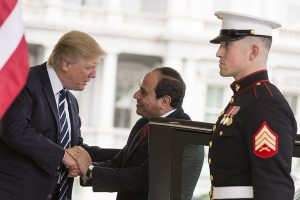 President Donald Trump welcomes Egyptian President Abdel Fattah Al Sisi, Monday, April 3, 2017, at the West Wing entrance of the White House in Washington, D.C. ( Photo by The White House from Washington, DC – Foreign Leader Visits, Public Domain, Wikipedia)
Washington’s decision to override human rights conditions on military aid to Cairo reflects the enduring primacy of strategic interests.
Israel must not mistake diplomatic necessity for long-term security.
When U.S. Secretary of State Marco Rubio authorized a waiver on October 1, bypassing human rights conditions attached to $320 million in military aid to Cairo, the announcement passed with minimal notice inside a public consumed by warfare with Iran and its proxies.
Citing national security interests and Cairo’s helpful role in the conflict with Iran, Washington chose geopolitical continuity over diplomatic leverage.
Such waivers have become routine under both Democratic and Republican administrations, revealing how consistently Cairo’s strategic utility has constrained Washington’s willingness to condition the relationship on political reform.
Yet for Israel, the October 1 waiver illuminates a far deeper dilemma: when an authoritarian neighbor is deemed indispensable to regional stability, how much hidden risk does its internal political fragility create for the state next door?
To be clear, Egypt is not Hamas, and Sinai is not Gaza on the eve of October 7.
The 1979 peace treaty remains a foundational pillar of regional security, and Cairo continues to serve as an essential mediator in Gaza hostage negotiations and crisis management.
However, October 7 shattered the comfortable assumption that a quiet border guaranteed long-term predictability.
For decades, Israeli defense planning operated on the premise that mutual security interests rendered southern frontiers manageable.
Can Israel afford to assume that a regime maintaining order today by suppressing political competition will remain equally predictable tomorrow if regional dynamics shift or popular grievances boil over?
The October 1 waiver is revealing because Washington has not suddenly concluded that President Abdel Fattah el-Sisi’s regime has transformed into a constitutional democracy.
The waiver releases $320 million in Foreign Military Financing—part of Cairo’s $1.3 billion annual U.S. military package—under the explicit justification that these funds counter terrorism, secure borders, and advance American strategic interests.
The underlying bargain is decades old. Egypt is treated in Washington as too large to fail, too strategically located to alienate, and too central to diplomacy to discipline over civil rights concerns.
With its control of the Suez Canal, geographic position along Gaza, formidable army, and diplomatic access, Cairo remains essential to Washington and valuable to Jerusalem.
Yet strategic usefulness must never be confused with strategic transparency.


Leave a Reply
You must be logged in to post a comment.