
Joan Swirsky
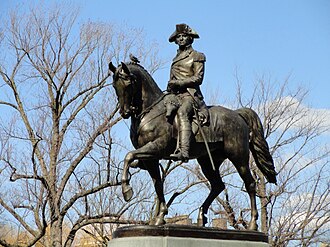 George Washington statue in the Boston Public Garden, Boston, Massachusetts, USA. Sculptor: Thomas Ball. Photoa by Daderot – Own work, CC0, Wikipedia
Today, February 22d, is the anniversary of George Washington’s birth. He was born in 1732, 294 years ago today; the tricentennial of Washington’s birth is but six years away.
In 1971 Congress, in enacting the Uniform Monday Holiday Act, 5 U.S.C. § 6103(a), shifted the annual official observance of Washington’s Birthday from February 22d to the third Monday in February. So we officially celebrated Washington’s birthday last Monday.
The Federal holiday is still officially known as “Washington’s Birthday”. Some States, which also honored other Presidents with additional official holidays on other days (many, for example, honoring Abraham Lincoln on February 12th and Virginia honoring Thomas Jefferson on April 13th), merged those official holidays into the Federal Monday observance of Washington’s Birthday. They thereby reduced the incidence of closures of courts, government offices, banks, and markets, but in some places confusion lead to a corrupted version of the holiday’s name, as “Presidents Day”.
But on this actual anniversary of Washington’s birth, it is appropriate to pause for a moment and take stock of what a difference his person and character made in American and, indeed, human history.
Everything he did as President of the United States a President was doing for the first time.
Perhaps nothing he did was more important for America’s political cultural than the simple fact of his voluntary retirement. That is, after being elected to two terms as President he declined to run for a third term. There can be no doubt that, had he desired it, he could have been President of the United States for life. But he thought it important that power be surrendered, and surrendered visibly and decisively. His return to private life was intentional, thoughtful, and conspicuous. It was meant to send the message that, in a democratic republic, power belongs to the people and not to the government.
Yet he did so much more. I offer just one illustration, and it was a truly signal achievement: By his example he helped establish American traditions of religious freedom, not just as legal abstractions but as cultural realities.
In 1781, as Commander in Chief of the Continental Army, George Washington visited the Touro Synagogue — the Hebrew Congregation in Newport, Rhode Island.
After his election as President he toured the northern States, including Rhode Island, and on August 18, 1790, he addressed the same synagogue with a formal response to the congregation’s address of welcome to him.
When Washington traveled he often entered houses of worship in the cities he visited. Thus it was that the first President of the United States, himself an Anglican (a member of the Protestant Episcopal Church), could be found at various times attending services under the roofs of religious institutions of denominations other than his own, including Catholic (attending Mass, for example, at St. Mary’s Catholic Church in Philadelphia), Lutheran (attending services at the German Lutheran Congregation, also in Philadelphia), Presbyterian, Baptist, and Quaker churches.
This practice was without precedent in the annals of the heads of state of other nations prior to that time. It was part and parcel of the “exceptionalism” that we discern in the American Experiment in ordered liberty.
This is a good moment to re-read the message that President Washington delivered to the Jews of Newport in 1790, a clarion call of religious liberty and a proud moment in American history:
To the Hebrew Congregation in Newport, Rhode Island
Newport, R.I., 18 August 1790
Gentlemen.
While I receive, with much satisfaction, your Address replete with expressions of affection and esteem; I rejoice in the opportunity of assuring you, that I shall always retain a grateful remembrance of the cordial welcome I experienced in my visit to Newport, from all classes of Citizens.
The reflection on the days of difficulty and danger which are past is rendered the more sweet, from a consciousness that they are succeeded by days of uncommon prosperity and security. If we have wisdom to make the best use of the advantages with which we are now favored, we cannot fail, under the just administration of a good Government, to become a great and a happy people.
The Citizens of the United States of America have a right to applaud themselves for having given to mankind examples of an enlarged and liberal policy: a policy worthy of imitation. All possess alike liberty of conscience and immunities of citizenship It is now no more that toleration is spoken of, as if it was by the indulgence of one class of people, that another enjoyed the exercise of their inherent natural rights. For happily the Government of the United States, which gives to bigotry no sanction, to persecution no assistance requires only that they who live under its protection should demean themselves as good citizens, in giving it on all occasions their effectual support.
It would be inconsistent with the frankness of my character not to avow that I am pleased with your favorable opinion of my Administration, and fervent wishes for my felicity. May the Children of the Stock of Abraham, who dwell in this land, continue to merit and enjoy the good will of the other Inhabitants; while every one shall sit in safety under his own vine and figtree, and there shall be none to make him afraid. May the father of all mercies scatter light and not darkness in our paths, and make us all in our several vocations useful here, and in his own due time and way everlastingly happy.


@Peloni Comment disappeared
Indeed, by contrast, Lenin said, Good leaders are not born by the hundred.”