Peloni: Mike Doran and Gadi Taub discuss the Hannukah Massacre, worldwide rise of antisemitism, the use of Jew Hatred to undermine US security interests, and the attempt by Israel’s Deep State to hide the crimes of the top lawyer in the IDF which have recently been exposed.
The word “official” is not neutral; it confers legitimacy, authority and a sense of normalcy—qualities that should never be associated with leaders of a designated terrorist organization.
Moshe Phillips | Dec 16, 2025
Photo by Gerald Shields – Own work, CC BY-SA 4.0, Wikipedia
Recently, CNN labeled a leader of the Hamas terrorist organization “a senior official.” This begs the question: When is a terrorist not a terrorist according to mainstream media?
Peloni: Here is a rather interesting discussion between the former Director General of the Israeli Foreign Ministry, Dr. Alon Liel, and the head of the Israeli Institute of Strategic Studies, Dr. Martin Sherman. It is interesting that, while addressing other topics, Dr. Liel seems to hold that everything that was attempted in the past which failed to bring peace should be pursued over again, as Sherman asserts that the way forward is not thru the failures of past peace processes, but thru Israel’s demonstration and pursuit of strength.
Peloni: How ironic is it that Trump is banning individuals from the PA and Syria from entering the US while requiring that Israel consider that either of these entities are capable or willing peace partners? More than ironic, I would say this is very telling. Perhaps America’s changing regard for individuals originating from these dens of terrorism entering the US will bring with it a sense of regard for Israel’s own reluctance to deem these terror enclaves as peacefully inclined.
White House highlights PA’s ‘weak or nonexistent control’ in West Bank & Gaza
Image by U.S. Department of Homeland Securityvectored by FOX 52 – File:U.S.CBP patch.png, Public Domain, Wikipedia
The White House announced on Tuesday that American passport holders from five additional countries, including Syria, as well as those holding passports issued by the Palestinian Authority (PA), will be added to an existing travel ban.
Peloni: Is Bibi not assertive enough of Israel’s rights among the nations of the world with regards to the US? Is this why the US is at ease demonstrating an arrogance with Israel which it fails to apply to any other nation? I would agree with the former, but not the latter. What do others think?
By Sha’i ben-Tekoa
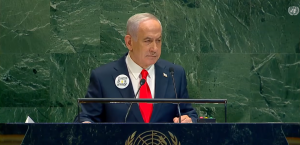
Netanyahu speaks before UN General Assembly. Image via Youtube
If it were possible to design an ultra-sound device to probe the human spirit, and apply it to Israel’s prime minister, the image of his Jewish spine might not register.
Peloni: Never was there a greater need for Jews around the world to be well armed (to the limit of local laws), well trained, and well disciplined, as they provide a secure defense and presence for themselves, their loved ones and the community in which they live. Dependency upon others is not the solution to rampant violence. Instead, self defense is the solution, as it provides not only a deterrence to attacks but a meaningful response for any attack which might arise.
It’s now season on Jews of all stripes, anywhere, any time. Active self help can begin to blunt the wave of attacks.
Douglas Altabef |
Waking up to check the news has become an exercise in the ability to digest the surreal and the truly bizarre.
We are living in times that might have been merely interesting at one point but now are almost predictably jaw dropping.
Peloni: Following a deadly terrorist attack at a Hanukkah celebration at Bondi Beach in Sydney, Americans for a Safe Israel (AFSI) called for stronger action while also echoing statements made by current and former US ambassadors to Israel respectively, Mike Huckabee and David Friedman. The two ambassadors chastised the Australian government’s response and security failures to the recent Hannukah massacre, while also urging leaders to recognize and confront rising antisemitism. AFSI’s chairman, Moshe Phillips, added what should be a universally supported statement, challenging that Jewish holidays should not be marked by mourning, but that of course is the very purpose of carrying out the slaughters of Jews on Jewish Holidays, which is only supported by the feckless responses such as are being supported by the current Australian govt.
A leading pro-Israel organization has come out strongly in support of the remarks made by Ambassador Mike Huckabee and Ambassador David Friedman following the tragic terrorist attack at Bondi Beach in Sydney.
Peloni: Does Trump seriously intend to surround Israel with enemies and those who do not recognize Israel’s right to exist with the most advanced fighter jet in the US arsenal? Doing so will seriously disadvantage Israel in any potential conflict in the future, thus making such a conflict far more likely and the outcome far less certain. Nations led by a Jihadist mentality at a minimum should be barred from access to the F35.
Peloni: There can be no good explanation as to why he US should offer Ukraine Article 5 guarantees, and the result will be disastrous for everyone if they do so.
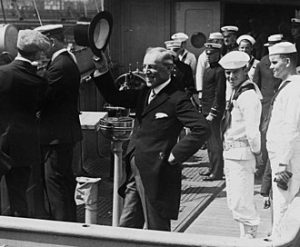
President Woodrow Wilson (center) waves his top hat from the deck of USS George Washington (ID # 3018), as she steamed up New York Harbor upon the President’s return to the U.S. from the World War I peace conference in France, 8 July 1919. Photo by Unknown author – This file is a work of a sailor or employee of the U.S. Navy, taken or made as part of that person’s official duties. As a work of the U.S. federal government, it is in the public domain in the United States., Public Domain, Wikipedia
The idea of offering unilateral US security guarantees to Ukraine is an appalling idea that risks war with Russia. It means the US is willing to go to war to defend Ukraine, and gives the Ukrainians a license to stir up trouble, instigate provocations, and drag America into a confrontation with Russia.
“We are the eternal people…The Chanukah lights must go on all over the world…The Jewish people will continue to bring light all over the world and overcome this terrible darkness.”
So declared President Yitzhak Herzog in a message to the people of Australia, following a horrendous terror attack on Bondi Beach, Sydney, where there was a large gathering in celebration of Chanukah. (More on this below.)
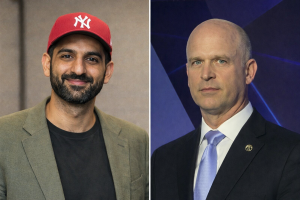
Zohran Mamdani (L), Kevin Roberts (R). Image via AI
The targeting of Jews in the wake of October 7 has been the key subject of COMMENTARY over the course of the past two years. The sight of Israel on the back foot and under attack, with thousands dead at the hands of genocidal maniacs, broke loose a shadowy evil that had been peeking out intermittently from behind the curtain of civilization for the past 80 years. It is roaming freely now. In London and Toronto, Jew-haters are literally demonstrating almost daily under the protection of the police, while those who oppose them are arrested for disturbing the peace.
In a major affirmation of its global economic stature, Israel has been ranked the third strongest economy in the world for 2025, according to The Economist. Surpassing economic powerhouses such as South Korea and the Czech Republic, Israel continues to outperform expectations especially amid regional challenges and ongoing conflict.
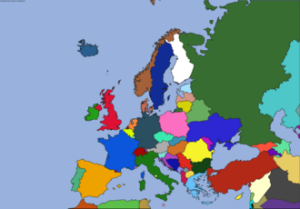
Peloni: Europe’s decay has been an ongoing tragedy made ever more evident and irreversible by the injection of unvetted Arab migrants into their societies in numbers which dwarfed and overwhelmed many communities in Europe, communities which are still in the death throws of being entirely consumed by the Arabic society which has shifted the Overton window of values, ideology and culture which once defined Europe as being European. With this in mind, it is important to recognize that the European countries which have come to recognize a Palestinian state have done so even as no such state exist, nor does any form of infrastructure which might support such an imagined nightmare. Indeed, the European nations which have endorsed this phantom state far from their own lands serves little purpose beyond the act of submitting to the dominance of Islam over the West, the subjugation of European values to those of Islamists, and the capitulation of their role in opposing the barbarians which are focused, not solely on the conquest of Israel, but that of Europe, the US and the West as well. The war of civilization over barbarism, if it is to be won, will do so without the support of the Eastern Europeans who have traditionally been the armrest of democratic civilization in Europe, leaving the Western nations of Europe to be the line from which, as Alexander explains, the reconquest of Europe will succeed or fail.
The indigenous population is aging and leaving, while the barbarians are young and passionate.
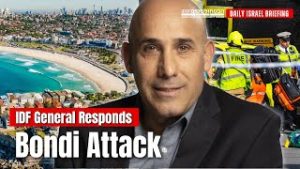
Peloni: Gen. Avivi discusses the increasingly important role which Israel needs to play in helping to protect Jews in the Diaspora. This would be largely due to the efforts of the Mossad and gathering and sharing intelligence to prevent attacks such as took place in Australia. He also argues that Jews should consider investing themselves in the state of Israel, while it is difficult it is possible and it is important.
The Islamic terrorist attack at Bondi Beach is a stark reminder that there is zero difference between anti-Zionism and antisemitism.
The horrific shooting attack on the Chanukah party has generated a variety of responses and recommendations, from tolerance education and self-defense to increasing synagogue attendance as a show of defiance by holding larger public Chanukah celebrations.
Peloni: It is highly troublesome to hear the FBI representative repeatedly referring to the group involve here as a “radical Left Wing Group” if in fact it is an Islamic terrorist group. Radical Islam is a very real threat and the blinders employed to pretend that it can be wished away as ‘Left wing radicals’ only serves to provide cover for a very real intent which is concerted around the subjugation of the US by the adherents of the Muslim Brotherhood and others.


 Photo by Gerald Shields – Own work, CC BY-SA 4.0,