Robert Spencer’s new masterpiece unveils how the Byzantines saved civilization.
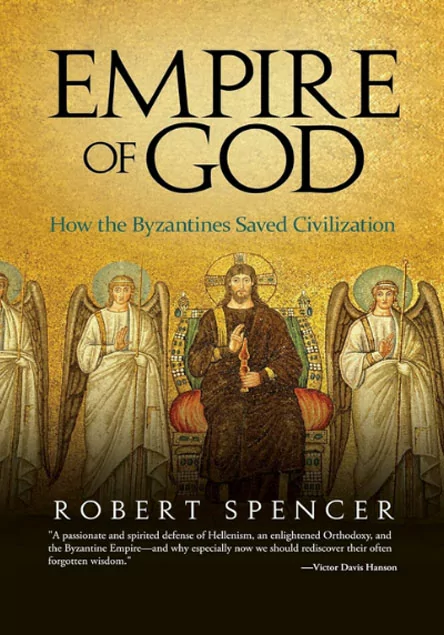 Founded as a kingdom in 753 B.C., Rome became a republic in 509 B.C. and an empire in 27 B.C By the fourth century A.D., the empire was so huge – extending from present-day Scotland to the Persian Gulf – that it was decided to divide it, for administrative purposes, in half, with one capital (and one emperor) at Rome and another at Constantinople. Most reasonably educated people in the Western world today are aware that our civilization began with Rome, and had its antecedents in Athens and Jerusalem. If we went to decent schools, we acquired at least some awareness of Rome; some of us read Virgil’s Aeneid, Shakespeare’s Antony and Cleopatra and Julius Caesar, Shaw’s Caesar and Cleopatra, and Robert Graves’s I, Claudius; those of us with a fondness for old movies have seen Roman epics like Spartacus and The Robe and Quo Vadis? We know that while the Greeks were big on philosophy and drama and art, the Romans were more practically inclined, constructing massive arenas and aqueducts, not to mention a number of roads that are still used to this day. No, we’re not experts on Rome, but it’s a part of our consciousness. Indeed, a series of postings on social media that were widely shared just a few weeks ago suggested that a not inconsiderable percentage of American men think about the Roman Empire several times a day.
Read more…