
Ambassador (ret.) Yoram Ettinger | “Second Thought: a US-Israel Initiative” | March 29, 2026
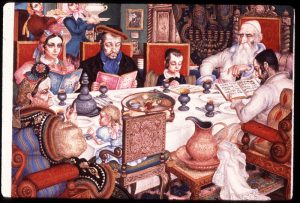 “Passover” by Arthur Szyk. Image by Center for Jewish History, NYC – Flickr, No restrictions, Wikipedia
*Passover (April 1-8, 2026) is a Jewish national liberation holiday, which features Moses and the Exodus. The legacy of Passover deeply impacted the Early Pilgrims and the Founding Fathers, and was essential in shaping of the US culture, in general, and the structure of the US political discourse and political system (e.g., the 3 branches of government and the separation of power), in particular. Contemporaries called George Washington an “American Moses,” while John Adams was referred to as an “American Joshua.”
*The Early Pilgrims explicitly considered themselves as the “Modern Day Chosen People” fleeing the “Modern Day Egypt” – drawing parallels between Pharaoh and King James I – experiencing the “Modern Day Exodus” and the “Modern Day Parting of the Sea,” sailing to the “New Israel,” “New Canaan” and the “Modern Day Promised Land.” In 1776, John Adams wrote to Abigail, his wife and closest advisor, about a sermon that drew a “parallel between the Case of Israel and that of America, and between the conduct of Pharaoh and that of King George III.
*The Early Pilgrims and the Founding Fathers were inspired by British and French philosophers, as well as by the Passover concept of Liberty; hence, the 1751 engraving on the Liberty Bell (“Proclaim Liberty throughout all the land unto all the inhabitants thereof,” Leviticus 25:10, the essence of the Jubilee, which is the Mosaic role model of liberty) and the 1787 US Constitution and the 1789 Bill of Rights. The Bible was cited more frequently than any European philosopher in founding-era political literature. The Book of Deuteronomy was especially prominent.
*The term “Federalism” – based on foedus, the Latin word for “The Covenant” – was coined by the Founding Fathers, who considered themselves as “the Modern-Day People of the Covenant.”
*Benjamin Franklin, explicitly invoked Exodus when discussing civic leadership and public order. During the Constitutional Convention, Franklin referred to Jethro’s counsel to Moses in Exodus 18:21, which laid down the foundation for the Mosaic 3-branch-government, separation of powers and the authority of the 12 Tribal Presidents/Governors. Moses was the Executive, Aharon was the Judiciary and the 70 Elders were the Legislature.
*In 1776, Benjamin Franklin and Thomas Jefferson proposed Exodus-based designs for the Great Seal of the USA: Moses with his rod and the Egyptian chariots drowning in the sea, with the Israelites led through the wilderness by the pillars of cloud and fire.? Their proposed inscription was: “Rebellion to Tyrants is Obedience to G-d.”
*According to Max Dimont’s Jews God and History: “The Mosaic Code … was the first truly judicial, written code… its passion for justice, its love of democracy…. The Mosaic Code laid down the first principles for a separation of church and state…. The Mosaic law established the principle that the Jews could do anything not specifically denied to them [by the Constitution]….”
*The principles of due process — procedural fairness and equality before the law, explicitly guaranteed in the Fifth and Fourteenth Amendments — are found throughout the Laws of Moses, most especially in Exodus 23:1–9, which has for centuries been called the “Ten Commandments of Due Process.”
*Thomas Paine argued in his 47-page-“Common Sense,” which was referred to as “The Cement of the Revolution,” that the Hebrew Bible was an argument against monarchy.?
*The Abolitionist movement, as a whole, and Abraham Lincoln and Frederick Douglass, in particular, drew much inspiration from Passover’s Exodus and the Mosaic legacy. Harriet Tubman of the “Underground Railroad” (1822-1913) was highlighted as Mama Moses. Martin Luther King’s leading theme was “Let my People Go,” which was reverberated earlier by Paul Robson and Louis Armstrong.
*Moses became a paradigmatic lawgiver and liberator in the US political discourse, seen as a precedent for combining moral law, covenantal consent, and resistance to tyranny.
*The Chamber of the US House of Representatives, the Chambers of the US Supreme Court and the main reading room in the Library of Congress feature statues and engravings of Moses and the Ten Commandments.
*On June 28, 2005, in Van Orden v. Perry, Chief Justice William Rehnquist acknowledged the Ten Commandments as having historical significance in American culture and legal system, allowing their display on state grounds. He noted they have an “undeniable historical meaning” beyond just a religious one: “Since 1935, Moses has stood, holding two tablets that reveal portions of the Ten Commandments, written in Hebrew, among other lawgivers in the [Supreme Court’s] south frieze…. Moses sits on the exterior east façade, holding the Ten Commandments… Since 1897, a large statue of Moses holding the Ten Commandments, alongside a statue of the Apostle Paul, has overlooked the rotunda of the Library of Congress’ Jefferson Building. A two tablets medallion depicting the Ten Commandments decorates the floor of the National Archives…. In the Justice Department, a statue entitled ‘The Spirit of Law’ has two tablets representing the Ten Commandments. In front of the Ronald Reagan Building stands a sculpture that includes a depiction of the Ten Commandments. A 24-foot-tall sculpture, outside the Federal Courthouse, depicting the Ten Commandments and a cross. Moses is prominently featured in the Chamber of the US House of Representatives…. Moses was a lawgiver and a religious leader, and the Ten Commandments have undeniable historical meaning….”
More: Jewish Holidays Guide for the Perplexed – Amazon, Smashwords
400th Anniversary of US-Israel Kinship: 1620-2020 – Amazon, Smashwords


Leave a Reply
You must be logged in to post a comment.