
Peloni: Aynaz Anni Cyrus provides and important look into how power in Iran is both harnessed and implemented to support and protect the regime by looking at the personality and history of Ali Larijani.
Inside the career of Ali Larijani
Aynaz Anni Cyrus | Mar 17, 2026
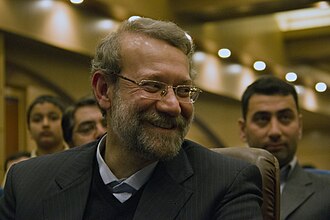 Ali Larijani. Photo by Mostafameraji – Own work, CC BY-SA 4.0, Wikipedia
I have been telling you for years, with evidence, documentation, and a consistent pattern of behavior, that the Islamic Republic is not sustained by ideology alone but by individuals placed at critical points of control. These are not symbolic figures. These are men whose decisions translate directly into policy, enforcement, and consequences for millions.
Ali Larijani was one of those men.
To understand his role, you cannot read his résumé the way Western media presents it, as a sequence of political titles suggesting administrative responsibility. You have to understand what those positions require inside the Islamic Republic. Every role he held placed him closer to the operational core of power, where information is controlled, dissent is assessed as a threat, and responses are coordinated across security, intelligence, and political channels.
Larijani served as head of state broadcasting, a position that in Iran is not about media in the Western sense but about narrative control. This role determines what the public is allowed to see, what is suppressed, and how events are framed to maintain stability. That level of control is not passive. It requires alignment with the regime’s priorities and the discipline to enforce them consistently.
He later became Secretary of the Supreme National Security Council, where his responsibilities shifted directly to managing unrest and state response. This is where protests are evaluated, threats are defined, and decisions are made about surveillance, arrests, and force deployment. These are not abstract discussions. They result in action carried out across intelligence units, security forces, and enforcement structures.
Larijani was not observing these processes. He was positioned inside them.
As Speaker of Parliament, he became more visible, but visibility should not be mistaken for distance from power. In the Islamic Republic, legislative authority does not function independently from security enforcement. It operates within boundaries set from above and reinforced through the same structures that carry out suppression. His role at that level required continuity with the system, not separation from it.


Leave a Reply
You must be logged in to post a comment.