
Peloni: Doha’s media empire includes the fabrication of fake news, the platform of promoting that fake news and the fact checking outlet which it uses to confirms the fake news as factual. Employing Western influencers to sell the confirmed fake news as evident simply acts to seal the deal with its target audience in the West which remains oblivious to the fact that the Qatari media empire is honed to specifically corrupt and bring the West to its ruin.
Ari Ben Am & Natalie Ecanow | June 9, 2026
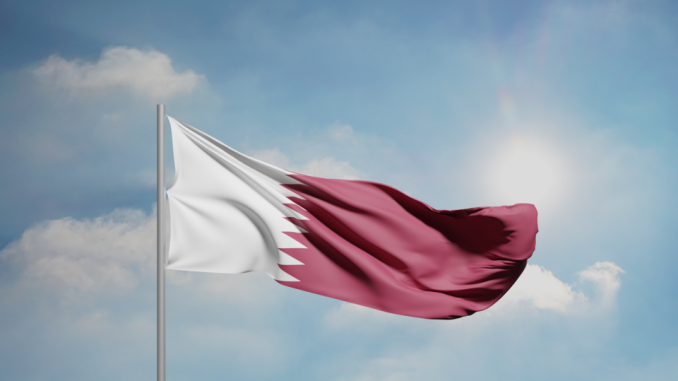 By Aerra Carnicom – This image includes elements that have been taken or adapted from this file:, CC BY-SA 4.0, Wikipedia
For years, Qatar has positioned itself in Washington as a trusted American partner: a host to major U.S. military assets, a mediator in hostage negotiations, and a wealthy Gulf state capable of talking to nearly everyone in a turbulent region. At the same time, Doha has earned a reputation for exerting influence by illicit means, such as the bribes that secured it the right to host soccer’s 2022 World Cup. Less recognized is the Qatari regime’s employment of an artificial media platform that poses as an independent news organization while promoting Doha’s agenda.
To complement Al Jazeera, its global media powerhouse, Doha created Eekad, an Arabic-language media platform that presents itself as an independent fact-checking and open-source investigative outlet. In actuality, Eekad is part of an opaque digital ecosystem with links to Qatari government ministries and contracted PR firms that consistently pushes narratives aligned with Qatar’s geopolitical interests, while attacking many of Doha’s regional rivals.
Eekad produces polished content that mimics serious investigations by using satellite imagery, network analysis graphs, and short-form videos designed for mass consumption across the Arabic-speaking world. It has built a strong audience online but obfuscates who funds, operates, and controls the platform. What is clear, however, is that multiple Eekad employees simultaneously worked at Al Jazeera, Qatari ministries, and state-affiliated organizations.
Eekad’s messaging follows a remarkable pattern. It regularly criticizes Israel, Saudi Arabia, and the United Arab Emirates while defending Hamas and dismissing criticism of Qatar. For example, after Hamas’s October 7, 2023 massacre in Israel, the platform questioned reports of atrocities committed against Israeli civilians while portraying criticism of Hamas as part of coordinated foreign influence campaigns. This jibes with Qatar’s position of holding Israel “solely responsible” for the October 7 massacre.
Eekad has also repeatedly defended Qatar’s reputation by attempting to debunk criticism of Doha. The platform worked to discredit allegations of labor abuses tied to the 2022 World Cup despite FIFA finding that “severe human rights impacts did ultimately occur in Qatar.”
These are the same narratives and talking points that Qatar has peddled outside the shadows of social media. Documents submitted to the U.S. Department of Justice pursuant to the Foreign Agents Registration Act show how Qatar has spent over $235 million dollars employing dozens of American lobbying and public relations firms to polish Qatar’s reputation and promote its relationship with the United States.
In some cases, Doha has employed U.S. firms specifically for outreach to traditional media. Tucker Carlson’s viral 2025 interview with Qatar’s prime minister is a product of these efforts. Qatar has invested in a significant U.S. media campaign in recent months, hiring a former CNN producer to serve as a registered agent in the United States, and encouraging Qatar-based academics to “examine strategies of sectarian hate speech and propaganda on social media in the Gulf region.”
The patterns hinting at direct Qatari government control of Eekad are difficult to dismiss. Washington tends to think about foreign influence through the lens of Russian troll farms or Chinese espionage, but Qatar is working to earn itself a place on that list.
Today’s influence campaigns increasingly operate through decentralized digital ecosystems: “independent” brands, influencers, and social media networks that can maintain plausible deniability while still advancing state interests. This is no secret to Qatar, which brought a group of conservative influencers to Doha over Thanksgiving 2025 on a luxury trip that resembled a sophisticated foreign influence campaign rather than an educational endeavor. One influencer, a veteran with nearly half-a-million followers on X, said he had an “eye-opening few days” learning about “the unique and mutually beneficial military and financial partnerships that we share with Qatar.” Months later, another online personality said that Qatar had invited him on the influencer trip but then told him that “they ran out of money for ticket allocation” after he posted a video “questioning Qatar’s influence in America.”
Platforms like Eekad are effective because they do not resemble traditional state propaganda outlets. Their content adopts the aesthetics of scrappy open-source intelligence and online fact-checking outlets, helping the material to appear credible to ordinary viewers. It is a suitable approach for countries like Qatar, which seek to maintain close military and diplomatic ties with Washington while promoting narratives directly harmful to American interests.
When meeting with Qatari counterparts, senior U.S. leaders should make clear they aware of Qatar’s underhanded methods and that Washington will strip Doha of the privileges of being ally if behaves like an adversary.
Ari Ben Am is an adjunct fellow at FDD’s Center on Cyber and Technology Innovation. His research focuses on emerging threats, influence and information operations, cyber operations, and hybrid warfare. Natalie Ecanow is a senior research analyst at the Foundation for Defense of Democracies (FDD) focusing on the Middle East and the Gulf.


Yet Americans won’t treat qatar as horribly as Israel is treated. Qatar won’t be held in disdain like Israel is.
More and more I become anti-Christian.
More and more I become emotionally detached from America while feeling closer to Israel.
@Laura
This is an unfair burden to place on Christians, as if Trump’s support of the Muslim Brotherhood leadership in Qatar and Turkey is due in some bizarre way to Christian doctrine or teachings. It isn’t. It is a political choice being made by Trump which has NOTHING at all to do with religion in general or with Christians in particular.
You linking these together raises many questions, but not for the Christians in America, many of who comprise the greatest friends Israel has in the WORLD.
Please do not denigrate Christians like this. They have not earned your scorn for Trump’s actions with Qatar, any more than Bibi did when he used Qatar to pay Hamas to leverage them against Fatah in the PA. These are political choices with geopolitical consequences, and are not related to religious teachings in Christianity, Judaism or Islam.
My criticism of Christians has nothing to do with Trump and qatar. Go on X and see all the Israel and Jew-hatred coming from Christians. And they are hating Jews in the name of Christianity.
Actually, it IS related to islamic teachings.
SOME Christians still support us, many have turned against us. My criticism stands.
@Laura
Those supporting the premise of replacement theology are those that are earning your anger on Twitter. Stating your animosity as being for Christians in general is neither balanced, fair nor honest, and by doing so, you threaten the support of the only friends we have in America.
“…and that Washington will strip Doha of the privileges of being ally if behaves like an adversary…”
How much of this nonsense will be tolerated before this “stripping” takes place… and how is Qatar being regarded at this very moment, or should I say, from Oct 2023 until now?
@keelie
As is true of many of the Gulf states, Qatar is tightly associated with China, and this is something which Trump has been working to offset. Washington’s efforts to dominate the region is in no small part why Trump is still active in Iran, which is China’s closest and most important regional partner.