
By: Yigal Carmon | MEMRI | July 2, 2026
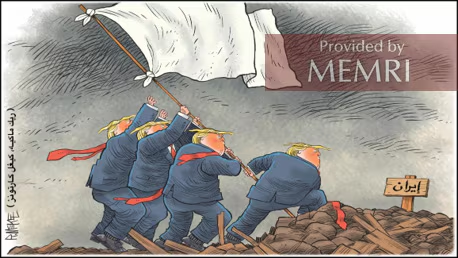 Cartoon in Qatari daily: Trump raises white flag in Iran (Al-Arabi Al-Jadid, London, June 25, 2026). Image via MEMRI.org
Amid criticism across the Arab world—particularly in the Gulf states—of the memorandum of understanding (MOU) recently signed by the U.S. and Iran to end the war,[1] and against the backdrop of concerns over potential Iranian control of the Strait of Hormuz,[2] Qatar, which played a role in drafting the MOU, is expressing satisfaction with the agreement and portraying it as a clear victory for Iran and defeat and humiliation for the U.S.
Despite Qatar’s status as a close U.S. ally, journalists, intellectuals, and clerics identified with the Qatari establishment praised Iran in press articles and X posts, arguing that it has emerged from the war with significant gains while the U.S. has been forced to make far-reaching concessions, indicating that it is a “declining superpower.” Some writers even compared President Trump’s signing of the MOU at France’s Palace of Versailles to Germany’s signing of its surrender agreement at the same location at the end of the First World War, claiming that Iran has succeeded in imposing its terms on the U.S. without being required to make concessions of its own. One writer argued that the MOU signed by the U.S. marks the end of Western hegemony in the Arab and Muslim world, while another called on the countries of the region to draw lessons from Iran’s victory and strengthen their ties with Tehran in preparation for the next confrontation with Israel.[3]
This pro-Iranian line is consistent with Qatar’s policy both before and during the war, which was characterized by maintaining close ties with Iran. Qatar’s alignment with Iran in the leadup to the war was manifested in intensive diplomatic contacts and reciprocal visits, alongside public expressions of support for the Iranian regime from senior figures closely associated with the Qatari leadership. The latter embraced the Iranian narrative and criticized the Trump administration’s policy toward Iran.[4]
According to media reports, Qatar continued this policy during the war. It reportedly offered to facilitate the release of frozen Iranian assets in an attempt to prevent Iranian attacks on its territory, and also offered to halt gas production in order to drive up global energy prices and thereby increase economic pressure on the U.S. to end the war.[5] Although Qatar denied these reports, it seems that Iran indeed took care to limit the harm to Qatari interests. According to the Lebanese daily Al-Akhbar, which is affiliated with Hizbullah, senior Qatari officials acknowledged that the Iranian strikes on Qatari territory had indeed targeted only U.S. and British sites and interests, and that any damage to Qatari interests had been incidental.[6] In addition, Qatar was the first Gulf state to announce, on March 23, 2026, a return to normalcy, apparently after receiving assurances from Iran that it would not be attacked, even as Iran continued its drone and ballistic missile attacks against the other Gulf states.[7]
Moreover, the purchase over the last decade of advanced American aerial technologies by Qatar, as well as a security cooperation agreement signed by Qatar and Iran in 2010, have raised suspicions of a possible leakage of advanced U.S. military technologies to Iran. During the recent war, Iran succeeded in shooting down several advanced U.S. fighter jets of a type that was sold to Qatar despite concerns expressed at the time by the U.S. Department of Defense that such technologies could ultimately find their way into the hands of hostile actors.[8]
Despite its clear pro-Iranian inclination, Qatar continues to present itself as a neutral mediator between the U.S. and Iran and views this role as a source of soft power that serves its broader strategic objectives. [9] In this context, it is worth noting that the Bürgenstock Resort in Switzerland, which hosted the first round of U.S.-Iran talks following the signing of the MOU, is Qatari-owned. Qatar’s Minister of State and Deputy Prime Minister Hamad Al-Kawari boasted of this fact in an article in the state daily Al-Sharq,[10] and the matter was also prominently highlighted in the Qatari media.[11]
This report reviews reactions in Qatar to the MOU recently signed by the U.S. and Iran.
Editor Of Qatari Daily: The MOU Is An Iranian Victory And A U.S. Defeat
Ma’an Al-Bayari, editor of the London-based Qatari daily Al-Arabi Al-Jadid, wrote in his column on June 22, 2026: “Donald Trump can say whatever he wishes about the MOU with Iran in his endless stream of tiresome daily statements and posts proclaiming it a victory for the U.S… We don’t need to take his words at face value or treat them as serious. Anyone who examines the MOU even briefly can see the clear Iranian gains and an unmistakable American defeat, without going so far as to describe it as an Iranian victory and a defeat for Washington.”[12]
Qatari Intellectuals: Iran Forced the U.S. to Accept Its Terms Without Making Concessions
Mariam Aal Sa’ad, Director General of the Katara Public Diplomacy Center in Qatar, wrote on her X account following the opening of the June 21-22 round of U.S.-Iran talks in Switzerland: “Iran – a single country, hated by its neighbors, boycotted by the world, and besieged within its own borders – has succeeded, through force, in compelling [the U.S.] to respect it and acknowledge its weight and capabilities. It is the only country that has managed to restrain Trump… Despite suffering losses and despite the assassination of its leaders and scientists, it forced the U.S. to sit down with it [at the negotiating table] and to accept its demands without [Iran itself] having to make any concessions.”[13]
A similar view was expressed by Liqaa Maki, a researcher at the Al-Jazeera Centre for Studies and a commentator on the Al-Jazeera channel, who wrote on his X account: “…The outcome of this war favors Iran, because it obtained a higher price than it would have received in the Geneva negotiations before the war, in exchange for the same concessions on the nuclear issue…”[14]
Journalists In Qatar: Trump’s Signing Of The MOU Is Like Germany’s Signing Of The Treaty Of Versailles After WWI
Several journalists compared President Trump’s signing of the MOU with Iran at the Palace of Versailles to Germany’s signing, at the same palace, of the peace treaty with the Allied Powers at the end of World War I – a treaty widely regarded as one of humiliation and surrender. For example, Al–Jazeera presenter Hayat Al-Yamani shared on her X account a video of President Trump’s signing of the MOU with Iran, and wrote: “Trump signed the agreement to end the war with Iran at the Palace of Versailles. The first thing that came to my mind was that the most famous agreement ever signed at Versailles was the humiliating treaty signed by Germany that brought World War I to an end.”[15]
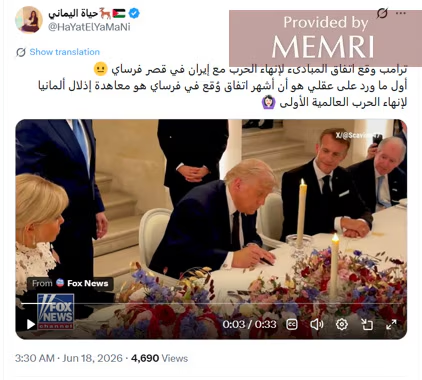
Mohamad Ghamloush, a news presenter at Qatar’s Al-Araby TV, wrote in a similar vein, “Historically, what is the Palace of Versailles famous for?” – also hinting at the Treaty of Versailles. [16]
Qatari Economist: America’s Signing Of The MOU Marks The End Of Western Hegemony In The Region
In a June 23 article titled “The last War” in the Qatari state daily Al-Sharq, Qatari economist Abdullah Al-Khater argued that America’s signing of the MOU with Iran marked the end of Western hegemony in the region. He wrote: “The weakening of Western influence enabled the Al-Aqsa Flood [i.e., Hamas’s October 7, 2023 attack on Israel] to accelerate the advent of the next international order. After a thousand years of wars in the region, the MOU [between the U.S. and Iran] has now been signed. Indeed, wars in the region have not ceased since the First Crusade… After the West adopted the concept of secularism, these campaigns came to be called imperialism and colonialism… The significance of signing the MOU, continuing the negotiations, and America’s insistence on pursuing the negotiating track is that it marks the end of wars and of [Western] hegemony over the Arab and Islamic region… This agreement will curb the colonialist offensive now that the West has been exhausted and is no longer capable of fulfilling the role of the hegemon…”[17]
IUMS Member: The U.S. Is In Decline
On June 21, Abd Al-Razzaq Al-Maqri, a member of the International Union of Muslim Scholars (IUMS), one of the Qatari regime’s principal vehicles for promoting a radical Islamist, anti-Western ideology, published an article on his X account discussing the outcome of the war. He wrote: “The U.S. and its allies have suffered significant losses that will have a profound impact on shaping the geopolitical landscape of the region and the world’s future geostrategic order. These losses include:
— The loss of America’s prestige and its leading position in the world, further reinforcing its image as a declining power in the eyes of all…
— The collapse of the image of the U.S. military as a force capable of operating anywhere in the world…
— The collapse of [America’s] credibility in the eyes of its allies as a power capable of protecting them, prompting them to recognize the need to revise their defense strategies…
— The collapse of the role of the U.S. military bases in the region, rendering them useless and turning them into a burden on the countries hosting them and easy targets in any [future] conflict involving the U.S…”[18]
Article In Qatari Daily: Iran Has Won, Therefore The Arab States Should Renew Their Relations With It In Preparation For The Next Confrontation With Israel
An article by Egyptian columnist Hassan Nafi’ in the Qatari daily Al-Arabi Al-Jadid under the headline “An Iranian Victory in the Memorandum of Understanding” argued that the Arab states should internalize that Iran has won, put aside their differences with it, and strengthen their relations with it in preparation for the next confrontation with Israel. He wrote: “It can be said, without any exaggeration, that the current MOU constitutes a clear-cut Iranian victory… Given that America’s commitment to the terms of the MOU will undoubtedly lead to increased regional influence for Iran and greater cohesion within the resistance axis… the Arab and Islamic states of the region, including Iran, should set aside their differences and rebuild their relations on firmer foundations in preparation for the next round of confrontation with the entity [i.e., Israel].”[19]
For sources see:


Leave a Reply
You must be logged in to post a comment.