
By Dmitriy Shapiro & Keti Korkiya | January 28, 2026
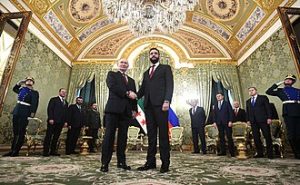 Putin meets with President of the Syrian Arab Republic Ahmed al-Sharaa. Photo by Kremlin.ru, CC BY 4.0, Wikipedia
Syrian President Ahmed al Sharaa made his second visit to Moscow in four months on January 28, even as Russia is withdrawing its forces from the city of Qamishli in northeastern Syria. Moscow may hope that its withdrawal will help ensure Damascus grants Russia continued access to key bases in western Syria.
The Russian pullback from Qamishli comes as Syrian government forces seized vast swaths of territory earlier this month from the Kurdish-led Syrian Democratic Forces (SDF). Forces loyal to Sharaa have been fighting the SDF as part of an effort to bring all Syrian territory under the control of the government in Damascus.
A January 20 ceasefire between pro-government forces and the SDF gave Damascus control of Syria’s Deir-ez-Zor and Raqqa Governorates. The status of Al Hasakah Governorate, which includes Qamishli, was left for later negotiations. However, a government takeover there seems inevitable.
The Russian withdrawal from Qamishli appears to have begun last week. A video shared by the Kurdish Rudaw Media Network on January 22 showed a Russian Il-76 military transport aircraft landing at the airport. Subsequent footage aired on January 26 showed Russian military equipment being loaded onto an Il-76. The same day, Al-Monitor posted footage from inside a makeshift Russian barracks that had reportedly been abandoned two days earlier.
Some of the Russian forces withdrawn from Qamishli are expected to redeploy to the Russian-controlled Hmeimim air base in western Syria, while others will return to Russia, a Syrian source told Reuters on January 26. Another source said that Russia had transported military vehicles and heavy weaponry to Hmeimim over the previous two days.
The pullback came after the Russian daily Kommersant, citing an unnamed Syrian source familiar with the situation, reported on January 21 that the Syrian government may ask Russian troops to vacate Qamishli as part of the negotiations for Hasakah.
“I think the Russians will be asked to leave Qamishli completely,” the source told Kommersant. “They have no business there now.” The American military also appears to be headed for a full withdrawal from northeastern Syria, where US forces had partnered with the SDF to fight the Islamic State.
Russia, which backed deposed Syrian President Bashar al Assad in the 13-year Syrian Civil War, had used the Qamishli airport to support joint patrols with Turkey as part of a 2019 agreement to ensure the removal of Kurdish forces from the Turkey-Syria border and monitor a ceasefire between Kurdish and Turkish forces. Still, the Russian military presence in Qamishli had been relatively small.
Russia’s most important assets are Hmeimim Air Base and the Tartus naval logistics center in western Syria. These facilities not only helped Moscow support Assad’s regime but also gave the Russian military a gateway to pursue its interests in the Middle East, the Mediterranean, and Africa. When rebel forces led by Sharaa’s Hayat Tahrir al Sham (HTS) ousted Assad in December 2024, it threw Russia’s continued presence in Syria into question.
There is no love lost between Moscow and Syria’s new rulers after being on opposite sides of the Syrian Civil War. Russia helped slaughter many thousands of civilians, including in airstrikes on hospitals, markets, schools, and refugee camps, while supporting Assad. Many of these atrocities were committed in Idlib province, the stronghold of HTS, a former affiliate of Al Qaeda. The Russians, for their part, remain wary of extremist elements in the new regime.
Nevertheless, both sides have opted for pragmatism. Although the Kremlin granted asylum to Assad, it quickly recognized Syria’s new government and engaged diplomatically to ensure continued access to its military facilities.
Sharaa has called on Russia to extradite Assad back to Syria so that he can stand trial, a move which Moscow has refused. Damascus also terminated a contract under which a Russian company managed and operated the commercial side of the Tartus port. At the same time, Sharaa has calculated that Syria is better off preserving cordial ties with Russia, including with defense cooperation.
On October 15, Sharaa met with Russian President Vladimir Putin in Moscow. The Syrian leader promised to “respect all agreements” made between Russia and Syria, apparently referring to the military facilities, while “working on redefining the nature of relations with Russia.”
A Syrian foreign ministry official told Reuters that Damascus, which resented Russia’s presence in Qamishli and ties to the Kurds, interprets the Russian withdrawal as a gesture intended to build goodwill and reassure Sharaa that Moscow will not interfere in his struggle with the SDF. When they met on January 28, Putin congratulated Sharaa on the “growing momentum” in his “efforts to restore Syria’s territorial integrity.”
Sharaa and Putin reportedly discussed the future of the Hmeimim and Tartus facilities during the meeting, along with regional and economic issues, according to Syrian and Russian officials. “Sharaa was also seeking greater Russian engagement in future security arrangements in southern Syria, including a military police presence in Quneitra, in the Golan Heights, to serve as a buffer against Israeli incursions,” Reuters reported, citing the Syrian foreign ministry source.
A number of Russian officials attended the meeting, including Dmitry Shugaev, director of the Federal Service for Military-Technical Cooperation. Shugaev’s presence suggests a potential discussion of arms sales to Syria, as Sharaa looks to rebuild his country’s military capabilities.
So far, Syria and Russia appear willing to let bygones be bygones and move forward in their bilateral economic and security relationships. However, time will tell how long the Syrian government will be willing to allow Russia to use its territory as a base for its global ambitions.

We need to know more about how Israel is involved in helping the minorities in Syria. The Kurds declared friendship with Israel and hoped for some hands-on aid but so far, they seem to have been abandoned.