
Peloni: As I have stated previously: “Fake famines and fake genocides in Gaza earned instantaneous support and outrage from across the West, while real famines and real genocides are ignored by these same sources of outrage. There is a foul sickness in the West which supports such nonsense charges against Israel, while ignoring the ongoing slaughter across Africa. It is called antisemitism, the old hatred, which must be understood to stand uniquely apart from other forms of hatred, as clearly depicted by the cruel use of selective rage against Israel for a given charge of atrocities, even when it is obviously false from the outset.
Focus of international outrage must be made to deal with real atrocities, and in the process save what remains of the Christian communities across Africa which have been abandoned to suffer the cruel fate, which is only imagined in Gaza to suit an antisemitic agenda.”
Michael Derfler
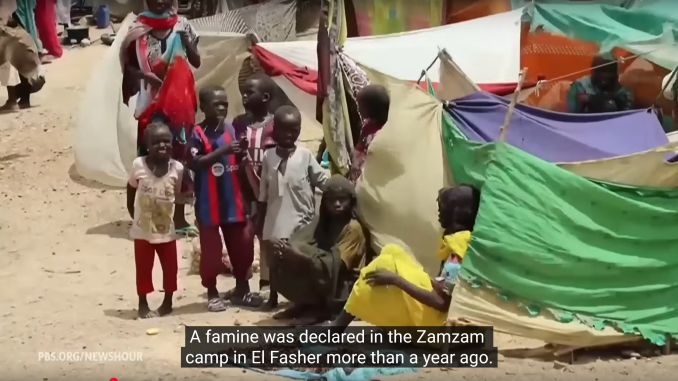 Famine declareed in South Sudan over one year ago. Screengrab via Youtube
I. Introduction
Human suffering should command moral clarity. Famine, war, and displacement ought to provoke a universal outcry, regardless of geography, politics, or identity. Yet in today’s international discourse, outrage is applied unevenly—most vocally when one country, Israel, is involved. This essay explores the famine declared in Gaza in 2025 and contrasts it with the far more extensive but largely ignored hunger catastrophe in Sudan, among other countries. It argues that the disproportionate response toward Israel reflects not just political double standards, but often the repackaging of centuries-old antisemitic patterns into the language of human rights and humanitarianism.
—
Section II. The Gaza Famine Declaration: Media and Political Reactions
On August 22, 2025, the UN-backed Integrated Food Security Phase Classification (IPC) made a historic decision: it declared parts of Gaza—specifically Gaza City and northern Gaza—as meeting the conditions for famine (IPC Phase 5). It was the first time the IPC declared a famine outside of Africa. The declaration followed months of deteriorating humanitarian conditions amidst ongoing conflict between Israel and Hamas. The IPC report stated, “As this famine is entirely man-made, it can be halted and reversed,” emphasizing the urgency of the situation.
However, most, if not all, of the data driving the Gaza famine narrative is filtered through Hamas, a party with strong political motivations, and which uses the slogan “we love death more than you love life.” This creates a situation where international agencies and media may base severe condemnations on information that cannot be independently verified and may be intentionally biased. This raises questions about the accuracy and impartiality of the data underpinning the famine declaration.
The international reaction was immediate and intense. Headlines in The Guardian, Vox, Reuters, and AP dominated global news cycles. UN officials condemned Israel’s blockade, and Pope Francis publicly demanded an end to what he called “starvation as a weapon.” Across NGOs and human rights bodies, the finger pointed overwhelmingly at Israel, portrayed as the primary—and at times sole—agent responsible for the crisis.
Following the IPC’s famine declaration in Gaza, some reports, including those from JNS, Israel Behind the News, and the Washington Free Beacon, questioned the classification’s basis. These outlets highlighted the IPC’s use of mid-upper arm circumference (MUAC) as the primary indicator for acute malnutrition, noting it as a departure from the standard weight-for-height (WHZ) measurements. They also pointed out the lower 15% MUAC threshold used for the declaration, which they compared to the 30% threshold for WHZ, raising concerns about a selective application of humanitarian standards.
However, the IPC has stated that the use of MUAC is not a new change but an established part of their methodology for situations where WHZ data is unavailable. The IPC’s logic dictates that while WHZ is a broader measure of wasting, a lower percentage of the population meeting the MUAC criteria (15%) can signal an equally dire crisis because MUAC is a stronger predictor of mortality. Therefore, the 15% MUAC threshold is a valid alternative to the 30% WHZ threshold, as they are different benchmarks on different measurement scales that both indicate a severe humanitarian crisis. While the U.S. State Department acknowledged it was reviewing reports of a definition change, most major news outlets did not cover the shift, and the IPC stands by its findings.
Section III: The Role of Hamas in Gaza’s Crisis
Any serious analysis of Gaza’s suffering must address Hamas’s central and deliberate role in creating it. Since 2007, Hamas has functioned not only as a de facto government but as an authoritarian regime that has repeatedly diverted humanitarian aid, used civilian infrastructure for military operations, and embedded itself within hospitals, schools, and densely populated neighborhoods—intentionally weaponizing its own population.
This strategy was most starkly visible during the war that preceded the 2025 famine declaration, which began with Hamas’s October 7, 2023 massacre of over 1,200 Israeli civilians and the taking of more than 250 hostages. In the ensuing conflict, Hamas further entrenched itself within civilian areas—turning hospitals, refugee camps, and UN facilities into bases of operation. This not only endangered the population it claims to protect but also made humanitarian response efforts nearly impossible, all while maximizing the visibility of civilian suffering for political gain.
Hamas’s willingness to sacrifice its own people is not new, nor is its grip on Gaza purely coercive. In the 2006 Palestinian legislative elections—the last held under anything resembling democratic conditions—Hamas won a clear majority. This victory was not the result of deception. Voters were fully aware of Hamas’s charter, which explicitly calls for Israel’s destruction and embraces armed resistance. While some later regretted that choice and dissent has since been brutally suppressed, the fact remains: Hamas was not merely imposed on Gaza; it was chosen by a significant segment of the population.
This context matters. International humanitarian law rightly protects civilians regardless of who governs them—but narratives that paint Gaza’s people as wholly passive victims erase critical facts. Hamas’s decisions—and the electoral support it once enjoyed—must be included in any honest moral calculus.
And yet, despite these realities, international condemnations have overwhelmingly focused on Israel. Reports, statistics, and humanitarian data are frequently funneled through Hamas-controlled channels, yet still form the basis of sweeping global accusations. The central role Hamas has played in precipitating and prolonging the crisis is often ignored entirely.
Section IV. Egypt’s Blockade and Historical Responsibility
One of the most glaring omissions in this international outrage is the near-total absence of criticism of Egypt, despite its blockade of Gaza. Egypt strictly controls the Rafah border crossing, often sealing it entirely—citing national security and the threat of Hamas-linked extremism. Yet international headlines rarely mention Egypt when reporting on aid restrictions in Gaza.
This silence is particularly puzzling given the deep Egyptian cultural and historical ties to Gaza. Many Gazans carry family names such as Masri (“Egyptian”) or Masrawi, reflecting either recent lineage or roots dating back to periods when Gaza was under Egyptian control. Figures within Hamas, including senior leader Fathi Hammad, have explicitly appealed to Egyptians as “brothers,” invoking a shared identity to demand support and solidarity.
Historically, Egypt ruled Gaza from 1948–1967 without granting autonomy or promoting Palestinian independence. Even earlier, in the 1830’s, Egypt under Muhammad Ali made efforts at colonizing Palestine as part of broader imperial ambitions. Despite these deep ties and Egypt’s decisive role in limiting Gaza’s access to the outside world, the global humanitarian narrative focuses almost exclusively on Israel—a selective framing that distorts responsibility.
Section V. Sudan: A More Severe Crisis with Less Outrage
While the world focuses on Gaza, a massive and underreported humanitarian catastrophe is unfolding in Sudan. As of mid-2025, over 25 million Sudanese people – more than ten times the population of Gaza – face extreme food insecurity. The IPC has declared famine in Zamzam Camp in Darfur, and projections suggest that conditions will worsen in additional regions.
This famine is not a byproduct of war but rather a deliberate strategy. Both the Sudanese Armed Forces (SAF) and the Rapid Support Forces (RSF) have intentionally blocked aid, targeted humanitarian workers, and used starvation as a weapon. The UN has described the situation as the “largest hunger crisis on Earth.”
And yet, the international response has been muted:
• Minimal media coverage.
• Rare public statements from global leaders.
• Sparse UN Security Council action.
• Humanitarian appeals remain underfunded.
The contrast is staggering. In Gaza, a few hundred thousand facing starvation garners global headlines. In Sudan, tens of millions suffer in near silence. This disparity cannot be explained by objective humanitarian concern.
Section VI. Other regions experiencing severe food insecurity with limited international attention:
Democratic Republic of the Congo (DRC): Escalating conflict and economic shocks have driven 27.7 million people into high levels of acute food insecurity.
Somalia: An updated projection shows 4.6 million people likely to face high levels of acute food insecurity, with 1.8 million children likely to suffer acute malnutrition.
South Sudan: Over 6.3 million people are experiencing high levels of acute food insecurity, with 2.1 million children likely to suffer from acute malnutrition.
Central African Republic: Armed violence and high food prices have left nearly 2 million people in high levels of acute food insecurity.
Haiti: Relentless gang violence and economic collapse have left one in two Haitians in high levels of acute food insecurity.
Section VII: A Pattern of Disproportionate Blame on Israel
The treatment of Gaza and Sudan (among others) illustrates a pattern: when Israel is involved, moral outrage surges, even if the scale of suffering is smaller or the causes are complex. When worse humanitarian crises involve non-Western or non-Jewish actors, silence often prevails.
Even among human rights organizations, Israel is repeatedly singled out for condemnation, often without comparable critique of authoritarian states or militant actors. This is not to suggest that Israel is above reproach, especially in light of the fact that Israel abandoned its military presence in Gaza in 2005. But to suggest that it bears unique or total responsibility, especially in the face of multilateral causes and contested data, is analytically shallow and morally biased.
VIII. Antisemitism: Historical and Modern Context
To understand why Israel receives this kind of disproportionate scrutiny, we must revisit a deeper historical context: antisemitism.
For over 2,000 years, Jews have been scapegoated for plagues, wars, economic downturns, and social unrest. The blood libel—accusing Jews of murdering children for ritual purposes—was used to incite mass violence. Jews were blamed for poisoning wells during the Black Death and cast as disloyal or corrupt in every society they entered.
Today, many of these same narratives have simply shifted targets—from Jews as individuals to the Jewish state. In this modern form:
• Israel is accused of deliberately killing children.
• Accusations of “genocide” and “ethnic cleansing” are made without evidence or legal basis.
• Israel is presented as uniquely malevolent, regardless of its actual conduct or the behavior of its enemies.
Antisemitism often hides behind the language of human rights, anti-colonialism, or justice. But the emotional intensity, disproportionate focus, and double standards applied to Israel echo centuries of anti-Jewish hatred.
Since 2023, antisemitic incidents have skyrocketed globally. Jews in London, Paris, New York, and Sydney have been attacked for actions taken by the Israeli government. College campuses have seen rising harassment of Jewish students. Online spaces are filled with conspiratorial, dehumanizing narratives.
Section IX. Conclusion
The famine in Gaza is a tragedy. But the international response to it—when viewed alongside the silence on Sudan and the demonization of Israel—reveals a disturbing truth: humanitarian concern is often not universal. It is selective, politicized, and deeply entangled with bias.
The world’s disproportionate condemnation of Israel, its erasure of other actors like Egypt and Hamas, and its near-total neglect of crises like Sudan suggest that many cries of outrage are not truly about saving lives—but about assigning blame. And too often, that blame lands, once again, on Israel—and, by extension, on Jews worldwide.
If we care about human dignity, we must be willing to hold all actors accountable equally. That means condemning starvation wherever it occurs, whoever causes it. Anything less is not compassion. It is hatred masquerading as principle.


The target has not shifted at all. Jews, wherever they reside, are still the “easy” target to divert current aches and pains away from those causing them.
My guess is that Jews everywhere are being encouraged by the Eternal to return to the land of their fathers. Actually, it is not only Jews who are in the Eternal’s sights. All sons of Jacob are on the line but most of them haven’t recognized that yet. Apparently, the Jews are first, to be followed by the other tribes of Israel.