
Peloni: As Europe moves further from the US with a reckless lack of awareness of their own capabilities or Trump’s patience(see below), the US Congress demonstrates a continued commitment to the keeping the graft going in Ukraine even in the continued light of US dollars being siphoned for Zelensky’s govt members as the Ukrainian war effort continues to falter. For more on this see “Swamp Moves To Hand $400 Million To Ukraine As Zelenskyy Gov’t Faces Corruption Scandal”
Thanks to Starmer, Macron and Merz, NATO is on the rocks
Stephen Bryen | Weapons & Strategy | Dec 9, 2025
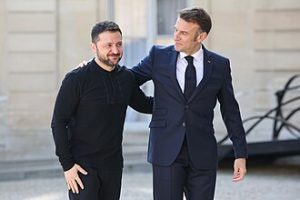 Volodymyr Zelenskyy, President of Ukraine, welcomed by Emmanuel Macron, President of the French Republic, to participate in the meeting on peace and security for Ukraine hosted by the French president in Paris. Photo by © European Union, 2025, CC BY 4.0, Wikipedia
Ukrainian President Volodymyr Zelensky visited London on Monday, December 8 where he met with Keir Starmer, Prime Minister of the United Kingdom, Emmanuel Macron, President of France and Friedrich Merz, Chancellor of Germany. Two things happened: Zelensky made it clear (and expanded on the subject on his way to Brussels after the meeting) that Ukraine would not cede any territory to Russia. At the same time, the three leaders strongly supported using seized Russian assets ($245 billion) to fund Ukraine’s war. Keir Starmer claimed that in the meeting with Zelensky they “discussed positive progress made to use immobilized Russian sovereign assets to support Ukraine’s reconstruction.” Actually, there is strong opposition in Europe to the use of Russia’s assets, led by Belgium, Italy, Hungary and Slovakia, with serious doubts expressed in France and Germany (despite seemingly acceding to Starmer). The US also is strongly opposed.
The three European leaders, all of whom are deeply unpopular and face hostile electorates, may think they are saving Zelensky from a predatory Putin and from Donald Trump, the hated American president, but actually they have freed the Trump administration from any need to forge a compromise on Ukraine. By backing Zelensky and undermining Trump’s efforts, Trump can now focus on US geopolitical priorities. Along with China, Russia is critical for American policy. The 2025 National Security Strategy makes it clear the US wants to “reestablish strategic stability with Russia.”
What does “strategic stability with Russia” mean? It means a return to a more balanced relationship between the two superpowers. Part of the restoration obviously means ending NATO expansion and keeping Ukraine out of NATO. The new National Security Strategy follows this approach. It means a considerable rethinking of the NATO alliance. NATO cannot be opposed to US geopolitical leadership if the alliance will continue. Thanks to Starmer, Macron and Merz, NATO is on the rocks.
The 2025 National Security Strategy openly worries about Europe’s industrial, social and political decline, and the loss of freedoms not only on the periphery (Romania, for example) but at the core in France, Germany and the UK (where even some local elections have been delayed at least for the next two years and where the UK government has tried to intimidate and suppress the opposition).
In a stunning statement about Europe, the National Security Strategy declares “Should present trends continue, the continent will be unrecognizable in 20 years or less. As such, it is far from obvious whether certain European countries will have economies and militaries strong enough to remain reliable allies.”
The US is not going to openly break with NATO, but it is shifting the burden of responsibility onto Europe, declaring the US won’t continue “unfairly” paying for European security. While the Europeans are now trying to increase their investment in defense (up to 5% pf GDP), it will be years before any real change takes place in Europe’s armed forces. Young people in Europe on the whole don’t want to serve in the army, and the alarm is great enough that France is initiating a limited form of military service and the Germans are instituting a form of a voluntary lottery system, seen as a first step to conscription. Britain’s army is crumbling and finding recruits is difficult, as the armed forces continue to shrink. The lack of funds in the UK makes reconstitution nearly impossible. Elsewhere, in Poland, Polish Prime Minister Donald Tusk announced a plan to make all Polish men undergo compulsory military training.
Thus there is a massive gap between intentions and reality when it comes to European rearmament or any ability to replace the United States to assure stability in Europe. Under these circumstances, the decision by the “big three” plus Zelensky to undermine the US initiatives on Ukraine and Russia looks suicidal, and it is.
It may be that some sort of Ukraine negotiations stumble forward, but unless Kiev’s government changes hands (Trump is calling for elections) and changes its policy, the chance for any negotiations is slim to none. The administration will try and pursue improved ties to Russia, notwithstanding the Europeans, and look to lower the nuclear threshold with arms agreements, if it can and if the Russians are willing. In parallel, Washington could start lifting sanctions or agree to waivers on certain sanctions, allowing for US business deals and investments in Russia. Moving this way generates its own momentum and leads to changes in the geopolitical landscape, as Washington refocuses on its core interests.


https://www.newsweek.com/trump-may-walk-away-from-ukraine-says-donald-trump-jr-11169847
Hi, Sebastien
If I read it right, President Trump correctly labels the Europeans in general not having enough sense to govern themselves. If this is true, he is correct: They are in a headlong move to become “Greater Palestine. That’s nobody’s fault but their own.
This past year or so, I’ve been watching pro-Ukrainian bloggers and propaganda outlets denigrate Donald Trump; and even more, denigrate the MAGA movement. If they decide to part with the US, I certainly won’t try to stop them.
Soembody, please explain this to me. It reads as though Donald Trump is opposing Donald Trump. Huh?
Those three are losers in their own countries. Have they suddenly become more powerful than NATO?
Clear? Say what? When did we have strategic stability with Russia? Under Yeltsin? Gorbachev? Brezhnev? Krushchev? If the author means “under Putin”, he’s out of his gourd! Somebody, please tell me how we have ever had “strategic stability” with Russia (Yes, obviously we did under Stalin. I mean since then.), and what, exactly, that “stability” consists of. Try to keep it to 25 words or less. OK. 50 words.
@Michael
The reference here is to the Europeans backing Zelensky. I think this is clear when reading the article, to me it was, in any event.
Those three make up the majority of European leaderiship. There move to once again obstruct US policy has lead to Trump leaving them to deal with the mess with Russia which they are determined to not diffuse.
The US had strategic stability with Russia under Trump’s first term, or at least far more so than exists today or is even possible while Europe is determined to pursue more aggressive measures with Russia.
Peloni, thanks for responding.
I notice that Zelenskyy has agreed to elections. What now?
https://youtu.be/8YPrJvHK4tk
@Michael
Well in any real democracy, the answer would be that the people will decide. Ukraine should be understood to be far less than a democracy, and I would argue that they have yet to have an election which was not decided regardless of the public’s preferences.
While Zel is accepting the elections being forced on him, he is simultaneously requiring US and EU ‘support’ for him to do so. No doubt this means more money, but also feet on the ground of US and EU reps, which will in turn require a ceasefire. So things are not as decided as they look, IMO.
When elections do come, it is likely that Valerie Zhaluzhney will will win. He will likely have support of the radical Right, with whom he has been well associated, as well as the support of not being Zelensky, who I believe will be revealed to be less popular in Ukraine than he is with his corrupt globalist allies. Notably, Zhaluzhney has been outside of the decision making in Ukraine for a notable period of time and is personally popular and trusted by many in Ukraine. Looking back to Zel’s own election victory, the choice of a popular outsider is how Poroshenko’s removal was explained.
Of course. This reminds me of Vietnam in the 1960s, when Thieu was elected in the thick of combat. Zelenskyy’s response to his critics was a ridiculous response to a ridiculous demand.
I notice that the propaganda on both sides has ramped up to “FULL LUDICROUS”. Europe has just issued a 48-hour ultimatum against Russia, which Russia will certainlly refuse and Europe can’t follow through on anyway.
BTW, I suppose you know that the Russian people will NEVER rise up against the government because of life getting uncomfortable; but the Europeans will back down, if they have to turn up their thermostats to keep warm.
Donald Trump may be the only one holding any cards. Hey! Maybe the Europeans will cede Greenland to the US, and pay us to take it — in exchange for our helping Ukraine. What’s not to like about it?
@Michael
Quite true.
Yes, Peloni: The Russian people will not rise up because of personal suffering (They romanticize suffering). What will likely topple him (deservedly) is a coup.
https://www.youtube.com/watch?v=i0Gk7htU41s and
https://www.youtube.com/watch?v=SICF0bwAdr0
Trump forces Zelensky to go to late elections. Finally.
My comment: 😀
AI Overview
https://en.wikipedia.org/wiki/Servant_of_the_People_(2015_TV_series)
AI Overview
I saw the first season years ago on Netflix. Hilarious. He plays a chaplinesque character. The music is great.
Ironic.
Zelinsky’s hard line? You mean he actually has the audacity to insist on his country’s sovereignty and oppose being swallowed up by Russia?
@Laura
Let us be honest. Ukraine has no sovereignty. It is run by oligarchs who steal from the funds donated by foreigners to support Ukraine’s war effort, and the Ukrainians are not even interested enough in their own victory to stop stealing as their forces face serial setbacks.
Beyond this, Zel has no chance of victory, and the US has no interest in continuing to back his effort to soak the American budget as he tries. Also Ukrainian deficits in munitions, men and morale have been further complicated by a lack of strategies which don’t make these deficiencies worse. As Europe is being Europe, they are opposing the US call for a reality check in this war, leaving the US giving them all notice that they are soon to be on their own, leaving them and Ukraine to fend for themselves and to pay for it as well.
It isn’t about sovereignty. It is about victory, which Zelensky can not achieve with US support which he is soon to lose. This is what was meant by Hard Line.