
Iranian Kurdish parties form a historic coalition to coordinate efforts and safeguard Kurdish interests amid regional unrest.
By SETH J. FRANTZMAN | MARCH 5, 2026
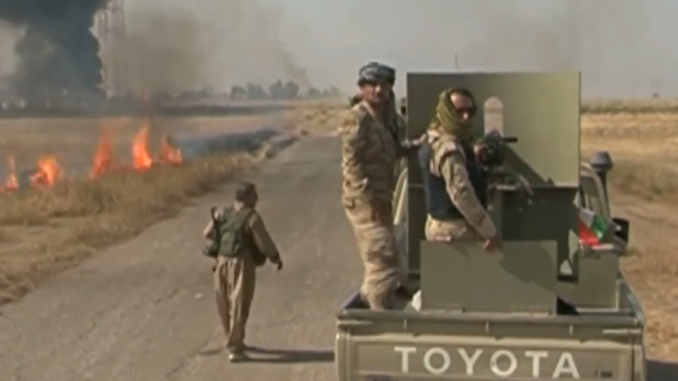 Kurdish Peshmerga forces engaging militants in Iraq. Screengrab via Youtube
Komala Party of Iranian Kurdistan’s political bureau announced its decision to join the Coalition of Political Forces of Iranian Kurdistan, Rojhelat Info, a news site that covers Kurdish Iranian issues, reported.
On Wednesday, Komala said it had “had intensive and productive participation” in recent months of dialogue surrounding the coalition, Kurdistan Region-based news channel Rudaw Media Network reported. The party said it had “insisted on further clarification” of “practical mechanisms” for managing “the unified Peshmerga force of Kurdistan” and “the joint administration of Kurdistan in the transitional phase.”
On Wednesday, Mohtadi wrote: “This is very good news for the people of Kurdistan, who need to close ranks more than ever, and encouraging news for all those working toward the great cause of political unity and democracy-seeking in Iran.”
It also reduces the chances that one group might be exploited or do something that leads to controversy among the other groups.
In the past, some of these groups have not been on the same page about what type of activism and struggle should take place in the Kurdish regions of Iran. The Kurdish regions of Iran are called Rojhelat in Kurdish, meaning Eastern Kurdistan.
Kurdish alliance positions itself for possible support
The unity of the Kurdish Iranian groups will also enable them to discuss what kind of support they might want amid the war in Iran. This is important because Kurds find themselves between a rock and a hard place in Iran.
Kurdish areas are being hit with airstrikes that target regime bases. Many of the Kurdish groups, however, have leaders who are in the Kurdistan Region of Northern Iraq. The Kurdistan Regional Government (KRG) in northern Iraq has said it does not want to be dragged into a conflict with Iran.
For instance, the KRG on Thursday said: “Reports that speak about the role of the Kurdistan Region and the allegations claiming that we are part of a plan to arm and send Kurdish opposition parties into Iranian territory are completely unfounded. We categorically deny them and affirm that they are being published deliberately and maliciously.”
The KRG emphasized that it was not “part of any campaign to expand the war and tensions in the region.”

Leave a Reply
You must be logged in to post a comment.