
Harry Liberman
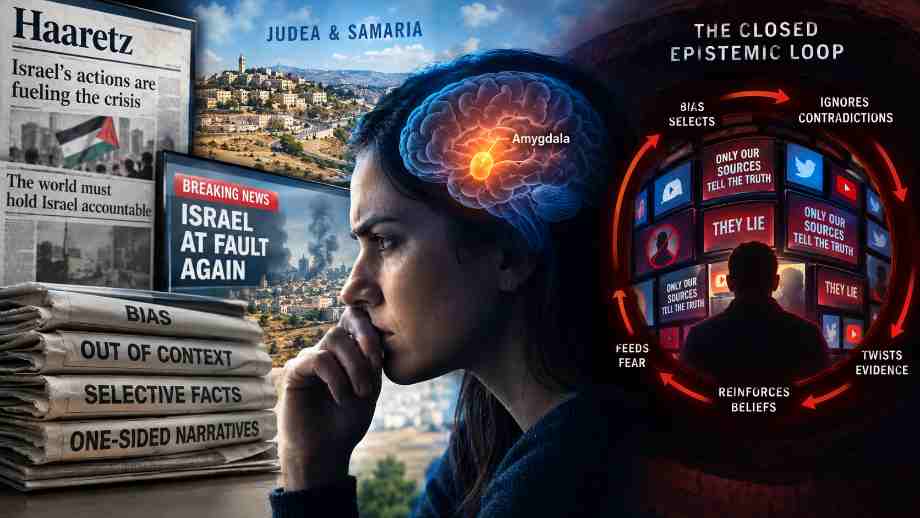 Click Image to Enlarge. Image created via AI.
The amygdala is a small, almond-shaped cluster of nuclei located deep within the brain’s temporal lobe that functions as the body’s primary threat-detector and emotional processing center. As a core component of the primitive limbic system, it acts like an internal alarm system, constantly scanning your environment for danger and dictating how you react to emotional stimuli.
A closed epistemic loop is a psychological and social phenomenon where an individual or group becomes entirely insulated from reality because their biases dictate what they see, and what they see protects their biases.
The term comes from epistemology, the branch of philosophy concerned with the theory of knowledge—specifically, how we know what we know. When a system or mind falls into a closed epistemic loop, it functions through a three-stage self-reinforcing cycle where a deep foundational bias dictates that only trusted tribal sources tell the truth while outsiders are malicious or deceptive, leading to an aggregate blindness where the individual filters out, ignores, or hyper-scrutinizes any data that contradicts the tribe, ultimately creating an immunized worldview where contradictory evidence is twisted into proof that the enemy is trying to trick them via the psychological mechanism known as the backfire effect.
In modern society, physical predators are rare, but ideological predators are perceived by this primitive biology as identical threats to survival.
When an insular or biased media consumer encounters a sharp contradiction to their worldview, the brain interprets this structural challenge to their community, moral identity, or personal safety as a literal attack. The evolutionary “low road” circuitry fires, the amygdala hijacks cognitive resources, and the prefrontal cortex is overridden to execute a protective “fight or flight” response—either aggressively attacking the source of contradiction or retreating further into the insulated tribal safety of the echo chamber.
The intersection of neurobiology and communication reveals why biased media outlets so frequently violate the foundational canons of journalism. When a news organization shifts its primary objective from an open-ended search for objective truth to a defensive ideological stance, it creates an environment that triggers the defense systems of its audience and creators, directly contradicting the core tenets of balanced reporting.
In order to understand how agenda-driven media works, by examining contemporary examples such as the publication Haaretz, it is well worth your time to study cognitive psychology and how all forms of tribalism work in primitive echo chambers. This specific intersection reveals why outlets violate foundational reporting metrics. When an organization swaps its search for objective truth for a rigid stance, it triggers a defensive loop that runs counter to the baseline ethics of international reporting.
Under this analytical framework, reporting can become inherently agenda-driven, tribal, and primitive. It ceases to function as a fluid tracker of events and instead hardens into a protective filter. This shift highlights how institutional bias mirrors individual defensive psychology, prioritizing narrative preservation over new data.
No legitimate media or objective individual can operate healthily with a completely singular, unyielding worldview.
On its face, it is logical that even if an outlet reporting on complex environments like Israel and the broader Middle East reports accurately half the time, the remaining half must, by virtue of tribal mentality, align with their agenda-driven ideology. For someone deeply embedded within a closed ideological system, an uncovered mistake [Israel is not Apartheid , Genocidal, Colonial it is the ancestral land of the Jews ] is not treated as a tactical oversight; it is rejected as an existential threat.
This phenomenon is plain and obvious during normal, one-on-one conversations between individuals, particularly when those who react with immediate anger as opposed to curiosity are unaware that they formulated their opinions based on secondary narratives rather than thorough, firsthand exploration of data. Their anger acts as a psychological shield, successfully protecting them from the discomfort of a more rational and objective opinion.
When these core beliefs are challenged, neuroimaging shows the brain activates the amygdala—the same region responsible for the primitive survival response. Contradictory facts are perceived not as alternative viewpoints, but as personal attacks. To accept the fact would mean dismantling their sense of self, community, and moral framework, prompting individuals to unconsciously deploy cognitive defense mechanisms like confirmation bias, putting vastly more energy into scrutinizing or dismissing evidence that contradicts their view than evidence that supports it.
If real evidence does not exist to support an ideological claim, the subconscious mind easily rationalizes the use of misleading statistics, out-of-context quotes, or biased framing.
In the minds of the faithful, the “greater truth” of the ideology justifies the flawed data. Presenting ironclad evidence to a deeply entrenched individual can cause them to double down on their original belief, viewing the contradiction as proof that the establishment is trying to deceive them, trading truth for tribal instincts as their cognitive mindset shifts from accuracy goals to directional goals.
Ultimately, this pattern creates a closed epistemic loop where the bias feeds the blindness, and the blindness protects the bias, leaving the individual entirely insulated from reality. Breaking this loop requires recognizing the psychological traps that dictate narrative selection over real-world data.
To truly understand the mechanics of agenda-driven media, one must step away from political theory and look instead toward cognitive psychology.
The operational framework of outlets like Haaretz offers a stark case study in how modern media institutions can devolve into tribal echo chambers, entirely deaf and blind to any external contradictions that threaten their core worldview. When an organization transitions from a fact-driven mission to an agenda-driven ideology, reporting ceases to be journalism; it becomes a mechanism for tribal survival.
Logically, no objective person or legitimate media outlet possesses a singular, unyielding worldview.
Human reality is far too complex for any one ideological framework—in this case, an anti-Israel stance—to hold a monopoly on truth. Even if an agenda-driven outlet reports accurately half the time, the remaining half must, by virtue of tribal necessity, be bent to align with their ideological goals. For those deeply embedded within such a framework, a factual mistake or a counter-narrative is not perceived as a mere tactical error. It is treated as an existential threat to the collective framework.This primitive biology of the amygdala works in direct tandem with the primitive ideology of collectivism.
Ideological systems like Socialism, Nazism, Marxism, Islamism, and progressive Leftism are all foundational forms of collectivism.
This collectivist worldview leaves absolutely no room for the robust, independent individualism and moral agency rooted in the Torah, which demands that an individual pause, stop, think, and analyze facts for themselves before jumping to conclusions. Collectivism demands compliance over independent analysis, utilizing the body’s baseline “fight-or-flight” impulses to crush critical thought and enforce absolute conformity to the group.
This collectivist, amygdala-driven dynamic becomes highly apparent when evaluating the selective application of anti-colonial rhetoric.
If Israel were truly a “colonial” entity—as anti-Zionist and antisemitic commentators suggest—logical consistency would require these ideologues to target every single historical and contemporary global empire that has conquered, subjugated, and physically stood upon the indigenous peoples of the world.
Instead, they point their primitive, defensive fingers exclusively at the Jewish people and the State of Israel, who are undeniably the historical victims of colonization rather than its perpetrators.
This structural exclusion of facts is most apparent when examining the historical, legal, and archaeological data that directly challenge the conventional narrative. To maintain a rigid editorial line, an agenda-driven outlet must systematically filter out foundational realities. For instance, the deep indigenous roots of the Jewish people—verified through archaeological discoveries across the region and physical monuments like the Arch of Titus on YouTube commemorating Roman colonization and enslavement—are minimized to preserve a specific narrative of modern settlement.
Similarly, the tribal lens often obscures complex legal histories, such as the original parameters of Mandatory Palestine, the separation of Transjordan from the mandate territory in 1921, and its formal independence as Jordan in 1946. To sustain a singular worldview, reporting frequently minimizes the historical reality that ancient communities in Judea and Samaria were ethnically cleansed of their Jewish populations by forces like the British-led Arab Legion during the 1948 war.
By reframing the Nakba—a term originally coined by Syrian intellectual Constantin Zureiq in his seminal book Ma’na an-Nakba to describe the political embarrassment and tactical failures of Arab military forces—as a story of purely unilateral external aggression, the media can bypass uncomfortable historical truths. This paradigm avoids addressing how pre-1967 territories were held by Arab states for nearly two decades without the establishment of a Palestinian state, or how hundreds of thousands of Jews were simultaneously displaced via systemic persecution and expulsion from Arab states.
Israpundit is entirely dependent on readers support. Please help me continue educating people with the truth about what is going on in Israel and around the world.


Leave a Reply
You must be logged in to post a comment.