
By Jalal Tagreeb
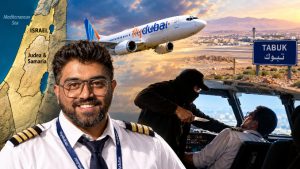 Image created via AI
On 30 September 2026, flydubai Flight FZ1073 left Dubai for Tel Aviv with 174 people aboard, including 27 children according to Israeli media. About two and a half hours into the flight, the Boeing 737 MAX 8 began to fall. Flight-tracking data show it dropping from nearly 34,000 feet to under 17,000 feet in about a minute.
In the cockpit, the first officer allegedly stabbed the captain. The captain fought him off long enough to unlock the cockpit door. Passengers then overpowered the attacker, and two off-duty pilots on board took control and landed the aircraft in Tabuk, Saudi Arabia. Saudi Arabia’s preliminary findings, reached with a UAE security team, confirmed that the co-pilot assaulted the captain and that both men were injured. They gave no motive.
The suspect is reported to be an Omani national, and Saudi Arabia has handed him to the UAE. His motive is still unknown.
The hero, and the people beside him
The captain, identified in reports as Smit Machchhar, did the decisive thing. Post-9/11 cockpit doors are built so that nobody can force entry, and the locking system treats the flight deck as the safest place on the aircraft. A stabbed man, losing blood, had to overrule that system himself. Security analysts called his ability to signal an emergency and unlock the door while under attack “beyond heroic.” He also had to open the door without knowing who would come through.
He didn’t save the plane alone. An Israeli official said two off-duty airline pilots travelling as passengers, one South African and one from New Zealand, entered the cockpit with cabin crew and passengers and pinned the attacker.
Israeli passengers entered the cockpit and subdued him, and the relief pilots then took control and landed the plane.
Flydubai describes them as on-duty crew travelling on the flight. One passenger told NPR he saw three passengers throw themselves on the co-pilot and capture him. The rescue was collective, and it began with one man’s decision.
A skeptical reading, tested against the evidence
An Arabic news websites, argued that the incident arrived with suspicious timing and that Israeli officials framed it in ways that served Netanyahu. The news is cautious in places. It explicitly separates propaganda effect from a deliberate division of roles between Netanyahu and his defense minister. But the tone, and the closing line about a director who is “in no hurry,” invite readers to suspect something staged. Here are some main claims, sorted into what is verified, what is plausible but unproven, and what the evidence contradicts or doesn’t support.
Verified
The timeline of political isolation. Netanyahu addressed the UN on 24 September as many delegations walked out. That happened. Reuters reported that dozens of delegates left as he began speaking, and Anadolu counted roughly 70 countries that walked out or stayed away. Another outlet put the figure at least 77. The “80 countries” is a little above the mentioned counts. It is the right order of magnitude, but the exact number varies by source. NPR reported that Netanyahu called the departing delegates “moral cowards.”
The Abu Dhabi visit. Netanyahu visited Mohamed bin Zayed on 27 September with security officials, including the Mossad chief. The UAE and Israeli governments both confirmed the trip, and Netanyahu’s office said he was accompanied by senior security figures including Mossad representatives.
The pre-incident warning. On 29 September Netanyahu warned of attempts to attack Israel before the election, and that the opposition doubted his motives. That is accurate. His video warned of “indications” that enemies would try to attack before the elections, and his opponents dismissed it as unevidenced fearmongering. Yair Lapid said the plane incident was not mentioned in the security briefing Netanyahu gave that Tuesday.
The six-day, three-day and one-day arithmetic. The counting of days between the UN speech, the visit, the warning and the incident is correct.
Katz moved faster than Netanyahu. Defense Minister Israel Katz called the incident an attempted jihadist terrorist attack, while the airline said the motive was unknown. Netanyahu’s first words were broader.
The links to earlier warnings. Katz referred back to the earlier intelligence-based warnings after the incident. The political packaging the literature describes is real.
Early confusion over who was who. Accounts did shift. Some reports gave the captain a different nationality; Swiss reporting described the captain as Saudi, while most reporting identifies Smit Machchhar, an Indian national. The best-supported picture is an Indian captain and an Omani co-pilot, the latter confirmed to CBS by an Omani official although Oman hasn’t publicly confirmed it. The confusion reflected a confused first day of reporting.
The aircraft briefly entered Jordanian airspace. Flightradar24 shows it briefly entered Jordanian airspace, turned back 180 degrees, and headed southwest to Tabuk. Emergency squawk codes were transmitted while it was over Jordan.
Plausible but unproven
Why two extra pilots were aboard. This is the sharpest point. Short flights don’t normally carry relief crew. The flight was scheduled for about three hours and fifteen minutes, so “short” is generous, but the instinct isn’t baseless. A CNN safety analyst called extra on-duty pilots fairly unusual unless they are being repositioned for other flights, in which case they are often off-duty. That is an ordinary explanation, and it fits the “positioning crew” picture. But I have not seen flydubai publicly explain why these particular pilots were aboard, and the investigation should answer it. The fact that they existed is documented. The coincidence the literature finds suspicious has a mundane explanation that nobody has yet confirmed.
Why Tabuk and not a Jordanian airport. Whether Tabuk was simply the nearest option, and offers alternatives: that Jordan’s investigators are too good, or that Jordan wouldn’t cooperate with a fabricated story. Those alternatives have no evidence behind them. The simplest explanation is that the relief crew chose a suitable runway in the direction the aircraft was already heading after turning back. But the reason isn’t documented, and the question is fair. The investigation should say who made the decision and why.
Why Netanyahu went to Abu Dhabi. The literature points to reports that he asked Mohamed bin Zayed to deny a pre-October 7 warning. The AP reported that Netanyahu asked the UAE president to deny that he had warned of a Hamas attack, citing anonymous sources. Emirati authorities didn’t confirm the request. Netanyahu’s office called the AP report “fake news” and said the visit focused on strengthening relations and regional challenges. Ynet reported a Mossad-arranged meeting after a Saudi request for help against the Houthis. That’s anonymous sourcing against an official denial. It may be true, but it isn’t established.
That the incident benefits Netanyahu. On this the literature is on solid ground. Al Jazeera’s analysis said the incident arguably bolsters his narrative ahead of the election, though it noted doubts about whether it will ultimately help him. Avigdor Lieberman accused officials of trying to manufacture spin from it. But benefit is not cause. An event can help someone politically without having been arranged by them, and any politician will use a crisis.
Contradicted, or unsupported
The suggestion that the event was staged or scripted. The column’s closing lines imply it. The evidence runs against it. The injuries are real: a passenger who spoke to CNN said the captain suffered massive blood loss, and CNN verified video of the wounded pilot. Saudi authorities, with a UAE security team, confirmed an assault and injuries to both men. The UAE, the airline’s home state, opened its own criminal investigation. A staged event would require a pilot willing to risk death, Saudi and Emirati investigators, an airline, and 174 passengers to cooperate in a fiction that damages Dubai’s carrier and flights to Israel. flydubai has suspended all flights to and from Israel, a costly consequence for a state-owned airline. And false-flag claims have appeared in Iranian outlets, where Fars presented no evidence, and no independent evidence for that allegation has emerged.
The idea that Netanyahu deliberately held back “jihadist” language. The point about differing wording is accurate for the first hours. But the “good cop, bad cop” reading weakens with time. By Thursday Netanyahu himself said it had been established that the co-pilot had undergone “Islamist radical indoctrination.” That claim is unverified. The literature allows that the difference may reflect different information or different caution, and the later facts fit that reading at least as well as a planned split.
Some of the smaller claims I couldn’t verify. I found no confirmation that early reports described the passengers as mostly soldiers, or of “songs of joy” on the relief flight. The passenger count of 174 is consistent across sources. The 180 figure I found came from Itamar Ben-Gvir, not Katz. And the 27 children the literature treats with suspicion are documented by Israeli media, so they were not invented for sympathy.
Summary
|
Claims |
Status |
|
UN walkout, 24 Sept |
Verified (counts vary, 70 to 77+) |
|
Abu Dhabi visit with Mossad, 27 Sept |
Verified |
|
Pre-election attack warning, 29 Sept |
Verified |
|
Katz faster and harder than Netanyahu |
Verified; narrowed since by Netanyahu’s own statements |
|
Confusion about nationalities |
Verified as early confusion |
|
Briefly in Jordanian airspace |
Verified |
|
Extra pilots a suspicious coincidence |
Unusual; ordinary explanation plausible, unconfirmed |
|
Why Tabuk |
Fair question, no evidence for the alternatives |
|
Netanyahu asked MBZ to deny a warning |
Reported by AP and Haaretz; denied; unconfirmed |
|
Incident benefits Netanyahu |
Plausible and widely argued; not proof of cause |
|
Staging |
Not supported; contradicted by independent confirmation |
Inside the cockpit, the captain, was fighting for his life. CNN’s analysts noted that he managed to signal an emergency and unlock the door while being attacked. The captain suffered massive blood loss and was severely wounded, according to a passenger who spoke to CNN.
Help arrived quickly. An Israeli official said two off-duty airline pilots travelling as passengers, one South African and one from New Zealand, entered the cockpit with cabin crew and passengers and pinned the attacker down. One passenger told NPR he saw three passengers throw themselves on the co-pilot and capture him. flydubai said the aircraft was secured by on-duty flydubai crew travelling on the flight, who diverted and landed it safely at Tabuk.
The word is overused, so it helps to say exactly what he did. Cockpit doors have been hardened since 9/11 so that no one can force their way in. Locking mechanisms were designed so that nobody, even a pilot, can enter if someone inside actively denies access. The system treats the cockpit as the safest place on the aircraft.
A pilot who has been stabbed, is losing blood, and is being attacked by the person beside him must do several things at once. He must recognize that the system’s logic has failed. He must reach the unlock control and overrule the very protocol meant to protect him. And he must accept that opening the door lets in strangers when he cannot know who will come through. One security analyst called the act “beyond heroic,” and another said that without it the outcome could have had geopolitical consequences.
He wasn’t alone. The off-duty pilots who flew an unfamiliar, crippled aircraft to a landing, the passengers who ran toward danger, and the cabin crew who opened the way all share the credit. Heroism here was collective, and it started with one man deciding to open a door.
Most security measures prevent passengers from reaching the cockpit, and very little prevents a pilot from taking over the plane. A reinforced door cannot, by itself, stop an incident involving a person already authorized to be inside. Germanwings 9525 showed the same weakness. French investigators found the first officer kept the door locked during the fatal descent despite requests for entry. FZ1073 shows the problem is not unique to one carrier or one decade.
No regulation required qualified pilots to be aboard, and without the deadheading crew, no trained personnel could have flown the plane after both pilots were incapacitated. A system that depends on fortunate seating arrangements is not a safety system.
The aircraft was flying toward Israel during a tense regional period, so any attack carried risk beyond the passengers. Israel’s prime minister said the co-pilot apparently tried to crash the plane, while President Trump said the co-pilot was perhaps a terrorist or perhaps a “whack job.” That disagreement matters. The incident will be read through political lenses, which is why verified facts must come before narratives.
Pressure is growing for the co-pilot to face justice in Israel, with some arguing he should spend the rest of his life there. The proposal deserves a serious answer, not a slogan.
Israeli citizens were the passengers and the intended victims, and the destination was Israeli soil. Israel has said it will investigate alongside its Emirati partners. Supporters argue a prosecution there would give victims a voice, signal that attacks on civilian aircraft will carry the gravest consequences, and reassure travelers. Under international aviation conventions, several states can have a claim to jurisdiction, including the destination state.
Custody is currently elsewhere. The UAE says its courts have jurisdiction because the aircraft is UAE-registered and flies under the UAE flag. Saudi Arabia transferred the co-pilot to the UAE. Any move to Israel would need a legal basis, the UAE’s consent and a formal request. None of that is in public view, and it isn’t something outside commentators can decree.
He is a suspect, not a convict. His motive is unknown, and the radicalization allegations are not yet established findings. If he is found to have acted alone out of suicidal despair, as one Israeli account suggests, a prosecution should reflect that. A trial in the country where the aircraft was registered, where the suspect lived and worked, may also better support a thorough investigation of how a weapon reached the cockpit and what the airline missed. The strongest guarantee of a life sentence, if the evidence warrants one, is a trial that no one can later dismiss as political.
My view is that the venue matters less than three conditions. The evidence should be tested in open court. The trial should result in accountability proportionate to the crime. And Israeli investigators should have meaningful access, which the UAE has already signaled it will allow. If those conditions are met, a lifetime sentence, if guilt is proven, can be served wherever the court decides.
FZ1073 will probably be studied for years. Its lessons are practical: doors that protect against outsiders but not insiders, a safety margin that depended on off-duty pilots being aboard, and a debate over who should try the accused. Its human lesson is simpler. When the system failed, a wounded captain used his last strength to let others save the aircraft. The industry owes him more than praise. It owes him a fix.
————————————————————————————————————————
The captain speaks
On 2 October, Captain Smit Machchhar described the attack in a video call with India’s prime minister, Narendra Modi, from his hospital bed. He said he knew the aircraft was going down, that he had fallen to the ground, and that he told himself the door was right there and managed to open it so people could enter. He has flown for 17 years and been a captain for 11. He said he was lying injured on the floor and made “one last push” to open the door from inside. He added that others who entered also played a role, and that while he was fighting for his own life he knew he would not let others die. Modi praised his presence of mind and said it saved lives and the reputation of Indian pilots. The captain described his injuries as a journey rather than a wound, saying that viewing it as a wound would make recovery harder. CNN reported that he was out of danger after surgery and that his parents had travelled to Dubai to be with him. ‘I was not going to let others die’: Flydubai pilot recounts opening cockpit door with ‘one last push’ +3
His account matches the one from Netanyahu’s office. A spokesperson told Reuters the captain was covered in blood and on the floor when he opened the cockpit door. The door was opened from the inside by a wounded man, not forced by those outside. timesofisrael
What the cabin footage shows
Channel 12 aired new footage on 1 October, filmed from a seat near the cockpit, in which people shout in English and Hebrew, one saying the co-pilot tried to crash the plane. Calls for a doctor are heard, and an Israeli dentist, Dr. Shota Musayev, rushes forward to give treatment. The captain, bloodied on the floor, says the co-pilot hit him many times and that he can no longer squeeze his hand shut. The attacker, also bloodied, is on his knees with his hands bound behind his back, surrounded by crew. A flydubai steward says in English that this is a terrorist and that police are needed. timesofisraeltimesofisrael
Three cautions apply. It isn’t clear when the camera was first turned on. The steward’s remark was a reaction in the moment, not an investigative finding. And the clip does not show the stabbing or the struggle in the cockpit. timesofisrael
The passenger accounts clarify who did what. Yaniv Hayun, an Israeli plumber, helped storm the cockpit and subdue the co-pilot, then stabilized the plane after its nosedive, which allowed a second pair of flydubai pilots on board to take control and land it. Passengers described the captain opening the door, the struggle with the co-pilot, and a descent so sharp that the jet’s rudder was ripped off. The sequence, then, is that the captain opened the door, Israeli passengers entered first, and the relief pilots flew the aircraft afterward. The Sun says passengers with flight experience helped land the aircraft, which differs slightly from the Reuters and Times of Israel account of a second pair of flydubai pilots. timesofisraelAl Jazeera
One passenger claim needs care. Hayun said the co-pilot shouted “Kill me” in English after being tied up, and interpreted this to mean he had failed in his mission and preferred to die. Netanyahu repeated the quote. That is a passenger’s interpretation. The words could fit an ideological account or a suicidal one, and they don’t settle which. timesofisrael
The investigation and the claims about the co-pilot
The UAE attorney general formed a team of prosecutors to examine the circumstances and motives and whether the incident was linked to terrorist activity or intent, or involved prior planning or direction. He said UAE courts have jurisdiction because the aircraft is registered in the UAE and flies under its flag. The co-pilot was transferred on Thursday from Saudi custody to the UAE. Netanyahu said the UAE president agreed that Israel would join the interrogation. His spokesman said Israel can now join the UAE investigation team to learn the motives and who may have been behind the co-pilot. UAE investigates possible ‘terrorist’ link in attack on flight to Israel +3
On motive, Netanyahu told Fox News that the co-pilot underwent Islamist radical indoctrination, based on personal information Israel is gathering, and that it looks very likely he intended to down the plane. He added that he does not make final conclusions yet. He also said it is too early to say whether Iran was involved. An Israeli official told The Times of Israel that the co-pilot’s social media accounts show he was radicalized into jihadist ideology and that he posted content about killing Jewish people. Netanyahu has also said the initial investigation suggests the co-pilot was suicidal. UAE investigates possible ‘terrorist’ link in attack on flight to Israel +2
These claims are unverified. The full social-media record has not been publicly authenticated, and the allegations are not yet established as findings of the UAE-led investigation. The evidence so far fits two readings, an ideologically driven attack or a suicidal act, and the two could overlap. eturbonews
The Sun also relays a third-hand claim, from an Israeli television anchor who says he spoke to a colleague, that the suspect refused to shake hands with women and prayed several times a day. I would not weigh this. It comes from no one who knew the man, and these are common religious practices, not evidence of extremism or intent. The Sun also notes that Israel and Oman have no diplomatic relations and that foreign crew normally face tight checks before flying into Israel, and that Israel is investigating how a knife reached the aircraft. How a weapon reached the cockpit remains unanswered in everything I have seen.
Where the sources differ
-
Passenger count: Al Jazeera puts the number aboard at 174. The Times of Israel and The Sun say 180. The gap may reflect crew. Al Jazeera
-
Captain’s location: The Sun says he spoke from a hospital in Saudi Arabia. Reuters, via The Times of Israel, places him in a hospital in Abu Dhabi. timesofisrael
-
Speed of the dive: The Sun cites a 700 mph nosedive. I found no support for that figure. The tracking data used in the opening section show a descent from nearly 34,000 feet to under 17,000 feet in about a minute.
Sources
-
The Sun, “Captain stabbed by pilot on ‘hijacked’ flight says ‘I wasn’t going to let others die’ as he breaks silence from hospital” (text supplied by you; I could not open the page myself): https://www.the-sun.com/news/17087342/captain-stabbed-hijacked-flight-breaks-silence/
-
The Times of Israel, “The wounded captain, the bound attacker, shouts for a doctor and a pilot: New video shows chaos on flydubai flight,” 1 October 2026: https://www.timesofisrael.com/is-there-a-doctor-or-pilot-new-video-shows-chaos-on-flydubai-flight-after-attack-thwarted/
-
The Times of Israel liveblog (Reuters, citing the BBC), “‘I was not going to let others die’: Flydubai pilot recounts opening cockpit door with ‘one last push’,” 2 October 2026: https://www.timesofisrael.com/liveblog_entry/i-was-not-going-to-let-others-die-flydubai-pilot-recounts-opening-cockpit-door-with-one-last-push/
-
Al Jazeera (with AP and Reuters), “UAE investigates possible ‘terrorist’ link in attack on flight to Israel,” 1 October 2026: https://www.aljazeera.com/news/2026/10/1/uae-investigates-possible-terrorist-link-in-attack-on-flight-to-israel
-
ANI, “Omani co-pilot in flydubai attack discussed ‘killing jews’ on social media: Israeli official,” 1 October 2026: https://www.aninews.in/news/world/middle-east/omani-co-pilot-in-flydubai-attack-discussed-killing-jews-on-social-media-israeli-official20261001222013/
Jalal Tagreeb is an East Jordanian freelance researcher and translator who works in the United Kingdom and abroad, specializing in Islamic Studies and History. Formerly rooted in conservative Sunni Islam, he was once an active Muslim apologist who frequently debated secularists. Following a series of decisive intellectual defeats, he undertook a profound re-evaluation of his beliefs, ultimately culminating in his public renunciation of Islam.
He now focuses on analyzing cultural and ideological contrasts between the West and the Middle East. Through his writings and translations, he aims to foster meaningful dialogue, encourage critical engagement with Islamic tradition, and promote intellectual honesty. His writings, debates, and a selection of his previously refuted Islamic arguments can be found here: Jalal Tagreeb, Author at The Freethinker.
He can be contacted at servantjiff@gmail.com.


Leave a Reply
You must be logged in to post a comment.