
Peloni: We were supposed to have the one page MOU published today, but that did not happen. Instead, the Iranians are demanding that there be no linkage between concessions on the nuclear file and the billions of dollars in sanctions relief. Meanwhile we are hearing concerns about the deal falling apart in place of the ‘coming soon’ proclamations made yesterday. Ultimately, it comes down to the question of whether the Iranians are ultimately willing to capitulate to Trump’s demands, and publicly at least, there has never been any indication that this would be forthcoming, and this has still not changed. Hence the publicly released message by Trump via Truth Social in the picture below…
Avi Abelow | Meta | Ma 24, 2026
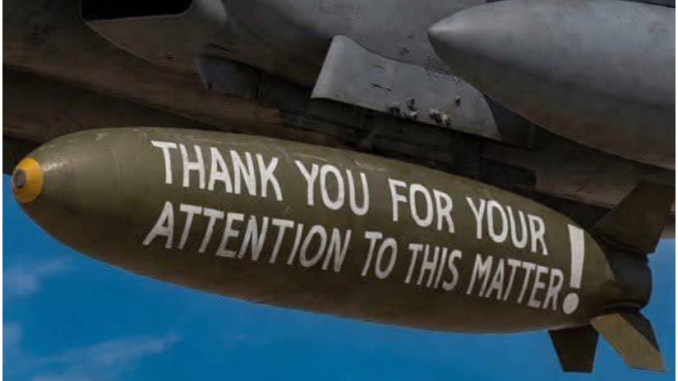 Most recent picture posted by Trump, with the implied warning that war is still a possible solution to the current situation in Iran. Screengrab via X.
The emerging reports about this proposed agreement with Iran should concern anyone who actually understands the Middle East, not through the naïve lens of Western diplomacy, but through the reality of Islamic jihadist ideology and regional power politics.
If the reports are accurate, this looks like a very bad deal.
But at the same time, it is important to emphasize: this is still not a finalized agreement, and this war may not be over at all.
Unlike the weak appeasement policies of previous Western administrations, President Trump is still keeping massive armed forces positioned throughout the Middle East, and this has been the best policy vis a vis Iran from any Western government. That matters. It means President Trump still has leverage and military options on the table if/when Iran refuses to comply or continues playing games.
And let us be honest: Iran is already signaling that it has no intention of truly surrendering its enriched uranium.
Iranian state media is openly denying key elements reportedly included in the framework discussions.
As reported by an official Iranian news agency:
– We did not agree to remove nuclear materials from the country, nor will we agree to any reference to this in the framework agreement.
– The claim that we agreed to halt nuclear activity for 20 years is false.
– The lifting of the blockade on Hormuz depends on the implementation of American commitments. It is not automatic, and it can also be reversed.
That alone should tell everyone how fragile and potentially meaningless this entire deal may become.
The Strait of Hormuz will also be a major test. If Iran does not remove the naval mines or if international shipping companies still refuse to safely pass through the strait because of Iranian mines, threats, intimidation, or instability, then this “agreement” becomes little more than political theater. It will be very interesting to see how Trump reacts if global commerce remains paralyzed despite the headlines declaring “peace.”
At the same time, we must understand something the Western mindset consistently fails to grasp: in the Islamist world, survival itself is viewed as victory.
The Islamic jihadi regime of Iran can now proclaim to the Arab and Muslim world that it survived Israel and America and lived to continue the jihad another day.
Even if Iran suffered devastating blows militarily and strategically, simply remaining standing allows the regime to frame this as a win internally and regionally.
That is a mindset too many in the West simply do not understand. Hence, they don’t understand the importance of actual victory over jihadist Muslims.
For Israel, the situation is far from ideal. But let us not ignore reality either. Israel today is still in a much stronger strategic position than before this war against Iran began.
Iran’s military infrastructure, prestige, deterrence, regional positioning, and exposure have all been significantly damaged. The illusion of Iranian invincibility has been shattered.
There is also a much bigger geopolitical layer to this entire war that many people are missing.
This conflict is not only about Iran, uranium, missiles, or even Israel. It is also deeply connected to the global economic order that Trump is trying to impact, China, European weakness that allowed a nuclear Iran, energy dependency, shipping routes, and the future balance of world power.
China depends heavily on Middle Eastern energy flowing through the Strait of Hormuz.
Europe is already economically fragile after years of failed energy policies and dependence on unstable global supply chains. The disruption of oil, gas, shipping, insurance, and trade routes caused by this war is putting enormous pressure not only on Iran, but on China, Europe, and the entire global economic/trade system, which has been bad for America manufacturing, Americans, and their personal bank accounts.
That is why it is possible that these ongoing negotiations and temporary agreements by Trump are serving a larger strategic purpose beyond simply “making peace” with Iran. It could be that prolonging this uncertainty continues weakening China economically, exposing Europe’s vulnerability, reshaping global trade realities, and pressuring the international system in ways beneficial to American strategic interests before eventually returning to fully dismantle the jihadist Islamic regime in Iran militarily.
Whether that is the actual strategy or not, one thing is clear: this war is already reshaping the global order far beyond the Middle East itself.
And Israel is emerging from this war as a regional superpower, with Trump giving Israel far greater backing and operational freedom to do what is necessary to defend itself on every front.
Just think about how dramatically reality has changed.
Before October 7th, the IDF leadership was hesitant to even remove a single Hezbollah tent illegally set up in no man’s land in violation of internationally signed agreements and the international Blue Line understandings.
Yet look where we are today: Israel openly striking Hezbollah deep inside Lebanon, with IDF positions in Southern Lebanon, dismantling Hamas infrastructure throughout Gaza, with over 60% of Gaza under Israeli rule, and targeting strategic assets of the Islamic regime inside Iran itself. The entire regional equation has shifted. What once seemed “too dangerous diplomatically” or “too escalatory” before October 7th has now become the new norm in the Middle East, understood as necessary for Israel’s survival and long-term security.
The real question is not only where Israel stands today, but whether Israel will still be able to operate with this same level of freedom and determination in a post-Trump world.
And personally, I still do not believe Trump will truly end this war if Iran refuses to give up its enriched uranium in a verifiable way. Trump may want a deal, but he also understands strength, leverage, and appearances. Allowing Iran to openly cheat while pretending peace has been achieved would ultimately project weakness, and Trump understands that better than most Western leaders.
But whether this deal moves forward or collapses, the most important lesson remains exactly the same.
Our future does not depend on Trump. It does not depend on Netanyahu. And it does not depend on any human leader.
Our future depends on Hashem.And on us.
On our faith. On our strength. On our unity. And on whether we have the courage to stand proudly as Jews, defend our homeland, and fulfill our national destiny, no matter what the nations of the world decide to do.
Am Yisrael Chai!!!


No deal with Iran can work. They will simply lie to get what they want which is sanctions relief, release of funds, stop of blockade and stop of war.
They will continue to build missiles, fund terrorism and work to create nuclear weapons.
The IRGC must be destroyed.
@Rafi
Agreed
Yes, absolutely. There can be no agreement that the IRGC would honour, unless it suited them. Therefore, they have to go.