
Peloni: Is this hypothesis about why the US has failed to open the Strait of Hormuz proving accurate? Well, if Trump is about to declare victory after having not achieved victory, John Konrad’s analysis offer us some insight as to why he would choose such a course.
John Konrad | March 18, 2026
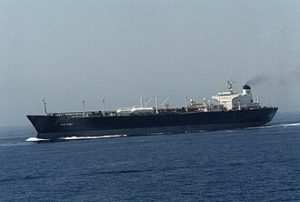 A port view of the reflagged Kuwaiti supertanker GAS KING underway. Photo by Department of Defense. American Forces Information Service. Defense Visual Information Center. 1994 -Public Domain, Wikipedia
By Captain John Konrad (Opinion) – The Strait of Hormuz is twenty-one miles wide. Two shipping channels, each two miles across, separated by a two-mile buffer. There is no alternative. Saudi Arabia’s East-West Pipeline to Yanbu and the UAE’s pipeline to Fujairah can handle maybe five million barrels combined. The math doesn’t work. The bottleneck is not political. It is geological and hydrographic.
Every TV analyst in America is talking about minesweepers and carrier strike groups. They are asking the wrong questions. The binding constraint on Hormuz was never a minefield or insurance. It is the US Navy’s willingness and ability to reopen it.
Every talking point suggests the White House and Navy are working hard to reopen the strait but progress is slow. A new posts on Truth Social suggests we may have to considet a new hypothesis.
“I wonder what would happen if we “finished off” what’s left of the Iranian Terror State, and let the Countries that use it, we don’t, be responsible for the so called Strait?” wrote President Trump in a psot this morning. “That would get some of our non-responsive “Allies” in gear, and fast!!!”
Let's unpack this..
What if the White House has no intention of reopening the Strait of Hormuz?
What if this war is really about ships & tariffs?
I had a long discussion with senior DOE official yesterday on background. I can’t share any details but it’s clear everyone’s… https://t.co/DCP0uw7C4E
— John ? Konrad V (@johnkonrad) March 18, 2026
Which leads to a question, White House may have no intention of reopening the Strait of Hormuz?
The Insurance Kill Switch
When the seven P&I clubs belonging to the International Group issued 72-hour cancellation notices for war risk coverage in the Persian Gulf on March 5, they did not just raise costs. They made transit impossible.
P&I clubs insure roughly 90 percent of the world’s ocean-going tonnage. Without their coverage, ships cannot sail. Port authorities will not let them dock. Banks will not finance the cargo. Charterers will not book the vessel. The entire system, from loading berth to discharge terminal, is underwritten by a chain of contracts that begins with a club in London, Oslo, or Tokyo. When the clubs pulled war risk extensions, that chain broke. Not for a few ships. For the global fleet.


I don’t understand this explanation. Could someone please simplify?
Also I wondered – what is the so hard about preventing Iran from stopping free passage? I didn’t undsrstand why the US can’t prevent this blocade.