
Peloni: This is an important report.
Steven Stalinsky, R. Sosnow, Rachel Legow | MEMRI | Mar 20, 2026
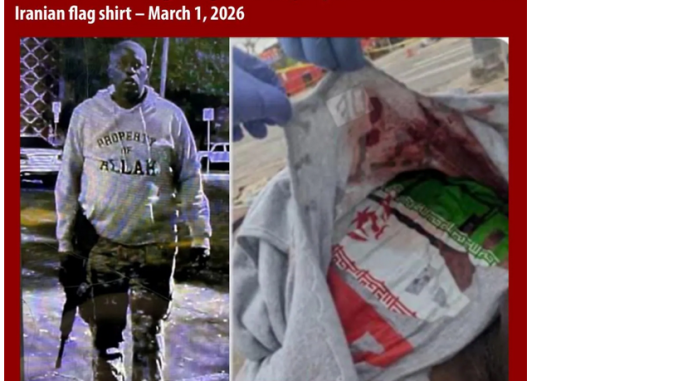 Image via MEMRI.org
Background: U.S. Government Warnings
Iran’s calls of “Death to America” over the past 47 years of its Islamic regime have never been mere rhetoric. U.S. intelligence agencies have long warned that Tehran’s ideological messaging and covert networks could inspire or enable attacks inside the U.S.
The threat has only grown in recent years, as more operatives have been dispatched to the U.S. to scope out targets and even set up educational and religious institutions to spread Iran’s Islamic revolutionary ideology. Outreach to student groups has been ramped up, as have efforts to influence U.S. domestic policy.
Now, as the regime faces the biggest threat in its history, and its top armed forces spokesman Gen. Abolfazl Shekarchi warns that “parks, recreational areas, and tourist destinations” will not be safe for Iran’s enemies anywhere, the Iranian regime’s loyalists across the U.S. are publicly displaying their support for the regime, its leaders, and its ideology. This includes memorials for slain Supreme Leader Ali Khamenei held at Islamic centers that Iran help to create and through its disinformation campaign all across social media.
According to the 2026 Annual Threat Assessment of the U.S. Intelligence Community, released March 18, “the most likely terrorist attack scenario in the Homeland involves U.S.-based lone offenders” – and that Iran has “proven capable of developing lethal operations against Americans at home and abroad and probably will attempt to pursue such efforts again if the current [Iranian] government remains in power and is able to rebuild.”
On March 11, President Trump said that he had been briefed on Iranian sleeper cells and that “we know where most of them are, we’ve got our eye on all of them.” This follows a U.S. Department of Homeland Security (DHS) intelligence assessment dated March 1, 2026, that Iran and/or its proxies could carry out retaliatory attacks against the U.S. for the killing of Supreme Leader Khamenei. It also warned that Iranian networks and affiliated cyber actors could pursue targeted violence or cyber retaliation.
A DHS National Terrorism Advisory System (NTAS) bulletin published in June 2025 addressed a “heightened threat environment” due to U.S. military activity against Iran. Warning about possible “low-level cyber attacks against U.S. networks by pro-Iranian hacktivists” and that “cyber actors affiliated with the Iranian government may conduct attacks against U.S. networks,” it went on to underline Iran’s “long-standing commitment” to target U.S. government officials it views as responsible for the 2020 killing of Qassem Soleimani, the commander of the IRGC’s elite Qods Force that operates outside the borders of Iran.
The Annual Threat Assessment released in March 2025 warned that Iran remains a primary state adversary that will “continue to directly threaten U.S. persons globally and remains committed to its decade-long effort to develop surrogate networks inside the United States.” It too stressed that Iran still “seeks to target former and current U.S. officials it believes were involved” in Soleimani’s killing.
These threats goes back years; the February 2018 and January 2019 Worldwide Threat Assessments noted the increase of hostile Iranian elements in the U.S. The 2018 assessment stated, “Iran will continue working to penetrate [the] U.S.” and “cultivating a network of operatives across the globe as a contingency to enable potential terrorist attacks. It added that Iran will almost certainly further develop and maintain terrorist capabilities. These were likely already used in the foiled mid-2018 plot to bomb an Iranian opposition event in Paris attended by prominent European and U.S. figures. The 2019 assessment said that Iran “continues to present a cyber espionage and attack threat” and persists in seeking political, economic and military advantage over the U.S.
In The U.S.: Iran-Linked Terror Activity, Iranian Loyalists’ Subversive Activity, And Arrests Over The Past Decade
Since the current war began, there have already been terror incidents on U.S. soil. The FBI is also warning police departments in California about Iran’s intention to attack the state by launching drones at the West Coast of the U.S.
The day after the U.S.-Israeli strikes on Iran began on March 1, a naturalized U.S. citizen from Senegal, Ndiaga Diagne, opened fire in downtown Austin, Texas, killing three and wounding over a dozen; he was shot and killed by police at the scene. Diagne wore a hooded sweatshirt that read “Property of Allah” over a shirt with the Iranian flag on it, and an Iranian flag and images of Iranian leaders were found in his home. Authorities are investigating a potential connection with Iran.
In its first public statement after the killing of Khamenei, on March 2, the IRGC Qods Force vowed to “open the gates of fire” upon the enemy and not to rest until its complete defeat. “The enemy should know that their days of happiness are over, and no place in the world, including their own homes, will offer them safety.”
For years, Iran has invested significant effort in cultivating networks of sympathizers, agents, and operatives abroad, including in the U.S., through propaganda, covert influence, and recruitment. The Iranian religious and government establishments openly boast in their official Farsi media that there is support inside the U.S. to do Iran’s bidding. Iranian Supreme Council for Cultural Revolution member Hassan Rahimpour Azghadi said on Iranian TV in December 2018 that Iran’s influence is worldwide, that it “has forces that are willing to sacrifice their lives” and “has bases from North Africa to East Asia… [and] supporters inside America and Europe.”
 Image via MEMRI.org
Supporters inside the U.S. such the ones Azghadi is boasting about have been arrested for offenses including espionage, cyber crime targeting individuals, groups, and companies, and violating U.S. sanctions on Iran. Earlier this month on March 6, 2026, a U.S. federal jury convicted Pakistani national Asif Merchant in a plot to assassinate him and other U.S. political figures in a murder-for-hire scheme prosecutors said was linked to Iran and motivated by retaliation for the 2020 killing of Soleimani. Merchant had attempted to recruit individuals he believed were hitmen – actually undercover FBI informants.
Other IRGC-related convictions in the U.S. in the past few years include the January 2026 conviction of a man hired by the Iranian regime to assassinate Iranian-American journalist Masih Alinejad in New York City; the October 2025 conviction of two Russian mob leaders also hired by the regime in the plot to assassinate her; the November 2024 conviction of an Iranian asset who employed multiple associates in the New York City area to surveil and murder a U.S. citizen of Iranian origin who publicly opposed the regime; and the August 2022 conviction of an Iranian national and IRGC member who attempted to arrange the murder of former national security advisor John Bolton.
One of the most disturbing and telling cases was in August 2020, when two Iranians – one a dual Iran-U.S. citizen and one a U.S. resident – were arrested and charged with allegedly conducting covert surveillance on behalf of Iran of Israeli and Jewish facilities in the U.S., including a Chabad House in Chicago, as well as for collecting identifying information about U.S. citizens and nationals who are members of the group Mujahedin-e Khalq. This, said a Department of Justice official, “demonstrates a continued interest in targeting the United States, as well as potential opposition groups located in the United States.”
Additionally, over a decade and a half ago, in October 2011, the U.S. accused Iranian regime elements, including Soleimani, of plotting to assassinate Saudi Ambassador to Washington Adel Al-Jubeir, a key advisor to Saudi King Abdullah, at a restaurant in the U.S.
PressTV, which was designated by the U.S. in 2013 and whose parent company is the U.S. Treasury-designated Islamic Republic of Iran Broadcasting organization, has been used by Iranian intelligence services to recruit sensitive assets, including people in the U.S. It is one of the channels MEMRI monitors.
MEMRI has been closely monitoring PressTV’s broadcasts covering protests from all over Washington, D.C. including in front of the White House, from Times Square in New York City, from Chicago City Hall, and from Jewish and other sensitive areas around the country including in front of politicians’ homes. It maintains correspondents in cities across the U.S. This vital security issue has been allowed to fester. In January 2019, PressTV made headlines in the U.S. with the FBI’s 2019 arrest in St Louis of the outlet’s American-born anchor Marzieh Hashemi, who has worked for Iran’s state broadcaster for three decades. Over the years, PressTV has hosted dozens of events in C-Span’s video library; since Khamenei’s death, C-Span has aired hours of its programing – doing the Iranian regime a direct favor by allowing it to spread its official anti-U.S. propaganda, including against the U.S. government and military, as our troops are battling Iran – without any disclaimer. Further evidence of the outlet’s ongoing activity in the U.S. was its coverage of the Minnesota immigration unrest in February 2026 just before the war on Iran began.
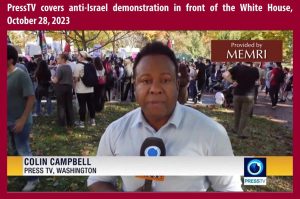 Image via MEMRI.org
For Years, The Iranian Regime Has Threatened To Attack The U.S., Assassinate Officials – Up To And Including President Trump
Since the beginning of 2026, in the run-up to the war, the constant stream of Iranian regime threats against the U.S. has intensified, including threats to assassinate President Trump and other U.S. officials, past and present.
A February 25, 2026 post on the official website of Supreme Leader Ali Khamenei warned that if Iran were to be attacked, American interests and citizens “will not be safe anywhere in the world” – which could include inside the U.S. Additionally, Iran-aligned militias have also hinted at attacks inside the U.S.: On February 1, 2026, senior Houthi official Hezam Al-Asad wrote on X that Tehran should respond to a U.S. attack by striking the U.S. “home front.” This, it said, would be an opportunity for Iran to cooperate with other actors against the U.S. Other supporters of the regime have also said Iran may attack the U.S. homeland, including Lebanese political analyst Ismail Al-Najjar warned in a February 6, 2026 interview on Lebanon On TV that Washington, D.C. “is not sacred” and could be targeted.
The MEMRI Iran Media Studies Project, which maintains the largest archives of translated Farsi content from the past three decades, has documented the open threats by Iran’s ayatollahs and military figures to attack U.S. interests. These threats, issued in Iranian religious, political, academic, and media venues, have come from top regime officials, including Supreme Leader Ali Khamenei himself, as well as from IRGC and army leaders, Majlis members, and members of regime institutions such as the Assembly of Experts. These officials have not just threatened to attack the U.S. – they claim that they have support within the U.S. to carry out attacks inside it. They are calling for and orchestrating simulations of attacks on the U.S.; their rhetoric, infused with the language of annihilation and genocide, is broadcast live on state television, used in military drills, in Majlis sessions, and in sermons.
Regarding President Trump, the threats have included an animated video of his assassination at a Mar-a-Lago golf course posted on Khamenei’s website and an open declaration by a regime mouthpiece that “Iran has planned, and is planning to assassinate Trump.” The regime religious establishment even issued a fatwa declaring jihad against him and calls for his assassination, and a regime-affiliated movement claimed to have raised over $40 million for this.


Leave a Reply
You must be logged in to post a comment.