
Peloni: Zineb Riboua makes an important case arguing that the IRGC is facing a choice of what sacrifices it must make to survive, and how far it might be capable of stretching its resources to maintain the fascade of strength as the effects of Economic D-Day increasingly mount by the day. Keep in mind that the US midterms are just two months away, and the balance of power in the US Congress between allies of Trump and those of Iran will be decided in that coming contest. To be certain Iran is keeping this in mind, and yet, all the same, two months would seem to be an eternity when the value of Iranian currency dropped about 10% in just one week.
Iran’s Strength Was Always Conditional
Zineb Riboua | Aug 31, 2026
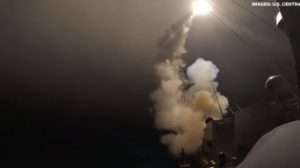 Iranian missiles launched against US bases in Jordan on Sept 1, 2026. Screengrab via Youtube.
or months, I have made the same argument: the IRGC is weak and will lose. The numbers have taken longer to surface than the strategic reality, but they are now increasingly difficult to dismiss. More interesting is why recognition took so long. Part of the answer lies in the effectiveness of the Islamic Republic’s propaganda. Another part lies in assumptions about Iran and the Middle East that have remained remarkably resistant to evidence.
Three assumptions in particular have distorted much of the debate about Iranian power.
The first is the role of the proxies. IRGC power has never just been about missiles, drones, or the nuclear program. Tehran’s real competitive advantage lay in force multiplication across multiple theaters. Hezbollah threatened Israel from Lebanon, Hamas from Gaza, Iraqi militias targeted U.S. forces, the Houthis menaced shipping and Gulf states, and Assad’s Syria provided the logistical corridor to the Levant. That network gave the IRGC strategic depth, distributed deterrence, and an economy-of-force model that allowed Tehran to impose multi-theater pressure while limiting Iran’s direct exposure and forcing its adversaries to disperse assets, attention, and operational capacity.
Since October 7, almost the reverse of what Tehran wanted has happened. Assad fell. Hamas is fragmented. Hezbollah is confused and has lost much of the leadership structure that made it such a powerful partner to the IRGC. By September 2024, Israel eliminated Hezbollah’s top commanders, and Syria, which for years gave Tehran geography, logistics, and access to Lebanon, is no longer available in the same way. The regional system Iran spent decades building has taken one blow after another.
That change is central to understanding IRGC power. Tehran’s strength came from force multiplication. Iranian missiles were far more threatening when combined with militias, logistical corridors, political allies, and pressure across several theaters. Iran still has serious military capabilities, but many of the mechanisms that once amplified them are weaker, less coordinated, or gone. The U.S. campaign may look slow from the outside, but much of its effect comes from compounding those losses.
Continue Reading Article
Israpundit is entirely dependent on readers support. Please help me continue educating people with the truth about what is going on in Israel and around the world.


Leave a Reply
You must be logged in to post a comment.