
By Jalal Tagreeb
 Video Loads at Bottom
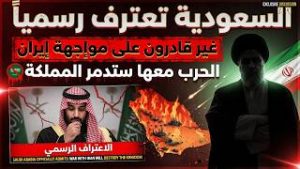
In a recent video that has been circulating widely across Arabic-speaking platforms, Egyptian commentator Khaled Hassan delivered what can only be described as a devastating — and unwitting — vindication of Israel’s strategic position in the Middle East. Hassan’s analysis, sharp and unapologetic, was aimed squarely at the Kingdom of Saudi Arabia and its contradictory, fear-driven posture toward Iran. But in laying bare Riyadh’s paralysis, Hassan inadvertently stripped away the last fig leaf covering a truth that pro-Israel observers have long argued: Iran is the existential menace in this region, and Israel, far from being the aggressor, is the rational actor that much of the Arab world secretly wishes it could emulate.
Hassan opens his video by expressing what he calls “astonishment” at the Saudi leadership’s behavior in the days surrounding May 9–11, 2026. He draws attention to a remarkable article published in Al-Sharq Al-Awsat by none other than Prince Turki Al-Faisal — former director of Saudi intelligence for over two decades — in which the prince warned that had Israel succeeded in “igniting war” between Saudi Arabia and Iran, the region would have plunged into ruin, with thousands of Saudi sons and daughters killed. The prince’s framing, tellingly, casts Israel as the instigator of a hypothetical catastrophe. But Hassan, to his credit, tears straight through this scapegoating. His central question is not about Israel at all. It is about Saudi Arabia’s inability to confront, name, or face Iran.
And here is where the essay must begin — not with praise for Hassan’s courage, though it deserves acknowledgment, but with a clear-eyed reading of what his analysis reveals about the broader regional reality.
The Confession Behind the Blame
When Prince Turki Al-Faisal wrote that a Saudi-Iranian war would bring “destruction, ruin, and the loss of thousands of our sons and daughters in a battle that has nothing to do with us,” he framed it as a warning against an Israeli plot. But Hassan rightly points out the more alarming truth buried within that framing: a senior former intelligence chief of the most oil-wealthy Arab state just admitted publicly that Iran — a country under severe international sanctions, with an air force so outdated it cannot acquire a single modern fighter jet from any Western nation — could devastate Saudi Arabia.
Let that sink in. Saudi Arabia, which has spent hundreds of billions of dollars on the most sophisticated American weaponry, which has signed contracts for F-35 aircraft, which boasts the most advanced air defense systems money can buy, is afraid. Afraid enough that its former intelligence chief will not frame a war with Iran as something Saudi Arabia could win — but as something that would bring mass death to the Kingdom.
This is not a minor rhetorical inconsistency. This is a fundamental admission of strategic impotence dressed up as a plea for peace. And it stands in glaring contradiction to what Crown Prince Mohammed bin Salman himself declared eight years ago in an interview with American television — that Iran represents no real threat to the Kingdom, that it is a lesser state incapable of challenging Saudi power. Khaled Hassan presses this contradiction with visible frustration: which Saudi Arabia should the world believe? The one that calls itself a regional superpower, or the one whose former intelligence chief trembles at the prospect of Iranian drones?
The answer, of course, is that both statements cannot be true simultaneously. And that is precisely the problem.
The Double Standard That Says Everything
Perhaps the most revealing portion of Hassan’s video — and the most directly relevant to Israel’s standing in this conflict — is his comparison of how Saudi Arabia speaks about Israel versus how it speaks, or refuses to speak, about Iran.
On May 10, 2026, the Saudi Foreign Ministry issued a statement condemning Iranian attacks on UAE, Kuwait, and Qatar. It condemned the strikes in vivid language. What it did not do — what it conspicuously, almost pathologically refused to do — was name Iran. Not once. A sovereign state was struck by a hostile regional power, and the self-declared guardian of Gulf security could not bring itself to print the name of the aggressor.
Yet Hassan contrasts this with Saudi statements from December 2024 and February 2026, in which the Saudi Foreign Ministry named Israel explicitly, boldly, and repeatedly — condemning its actions in Syria and Gaza with muscular, unambiguous language. No hedging, no circumlocutions, no omissions.
The pattern Hassan exposes is as simple as it is damning: Saudi Arabia names Israel because it knows Israel will not retaliate. It refuses to name Iran because it genuinely fears what Iran might do. As Hassan puts it with characteristic bluntness, the Kingdom is brave only in front of those it knows will not strike it. This is not diplomacy. It is appeasement masquerading as principle.
For those of us who defend Israel’s right to exist and act in its own defense, this double standard is not merely frustrating — it is clarifying. The Arab world’s loudest rhetorical volleys against Israel have always been safe theater. Israel, a democracy governed by laws, international norms, and democratic accountability, does not bomb foreign ministries for issuing press releases. Iran, on the other hand, arms militias, strikes civilian infrastructure, launches ballistic missiles and drones across international borders, and funds proxy warfare from Lebanon to Yemen to Iraq. And yet it is Israel that gets named in every condemnation, while Iran gets protected by silence.
Khaled Hassan has, in his righteous anger at Saudi Arabia’s cowardice, revealed the foundational hypocrisy of the region’s anti-Israel posture. It was never really about justice. It was always about which enemy was safe to denounce.
The UAE and the Lesson of Deterrence
Hassan also raises a comparison that deserves serious attention. He points to a Wall Street Journal report from May 11, 2026, indicating that the UAE had been conducting covert strikes on Iranian targets, including what appears to have been an April attack on oil facilities on Lavan Island. Crucially, the UAE did not deny these reports — and in the language of statecraft, silence is effectively acknowledgment.
Hassan holds the UAE up as the more courageous actor: a smaller country, far less populous than Saudi Arabia, that chose to act rather than to appease. This is precisely the logic of deterrence that Israel has practiced and refined over decades. When you are surrounded by actors who celebrate your destruction, the choice between confrontation and capitulation is not abstract — it is existential. The UAE appears to have absorbed this lesson. Saudi Arabia, for all its wealth and military hardware, has not.
Israel has long understood that genuine regional security cannot be built on silence or accommodation of Iranian aggression. Every Iron Dome battery, every covert operation, every precision strike on Iranian weapons transfers to Hezbollah represents the same underlying conviction: that Iran must be confronted, not appeased. The UAE, in these covert strikes, is beginning to think like Israel — and to act accordingly.
The “Israeli Plot” Narrative and Its Collapse
One cannot leave Prince Turki Al-Faisal’s framing unchallenged. His article warned against Israel “succeeding in igniting war” between Saudi Arabia and Iran, portraying Israel as the puppet master engineering regional conflict for its own benefit. This is a familiar trope — one that allows Arab leaders to evade accountability for their own strategic choices by assigning agency to Israel.
But as Hassan’s analysis makes painfully clear, Saudi Arabia’s predicament is entirely of its own making. No Israeli conspiracy forced Riyadh to spend decades funding extremist ideology while neglecting military capability. No Israeli plot compelled MBS to declare Iran a non-threat and then allow former intelligence chiefs to confess the opposite. No Israeli scheme produced a Saudi foreign ministry too frightened to print the word “Iran” in a condemnation statement while Iran was actively bombing Saudi neighbors.
Israel did not create Iran’s Islamic Revolutionary Guard Corps. Israel did not push Iran to develop ballistic missiles. Israel did not encourage Iran to strike UAE, Kuwait, and Qatari assets. Iran did all of these things because it is an ideologically driven, expansionist regime that has consistently chosen regional destabilization over coexistence. The “Israel is behind it all” narrative is not analysis. It is an alibi.
Conclusion: What the Mirror Shows
Khaled Hassan set out to shame Saudi Arabia into self-awareness. He largely succeeded on his own terms. But his video delivers a second lesson, unintended and all the more powerful for it: when Arab commentators themselves begin tearing away the comfortable fiction of Israeli villainy to confront the lived reality of Iranian aggression, something fundamental is shifting.
The Kingdom that names Israel in every statement and cannot bring itself to name Iran in the face of Iranian strikes on its neighbors is not a credible regional security partner. It is a state in strategic denial, hiding behind anti-Israel rhetoric while the real threat metastasizes.
Israel requires no vindication from Khaled Hassan. Its record speaks for itself — decades of survival, deterrence, and democratic governance against overwhelming hostility. But Hassan’s video is a useful document for a simple reason: it shows, from the inside, what those of us who have argued for Israel’s legitimacy have always known. Iran is the fire. Israel is, at worst, a convenient distraction from the flames.
The Arab world’s moment of reckoning with that truth, it seems, has arrived. Saudi Arabia’s silence is its own confession.
Jalal Tagreeb is an East Jordanian freelance researcher and translator who works in the United Kingdom and abroad, specializing in Islamic Studies and History. Formerly rooted in conservative Sunni Islam, he was once an active Muslim apologist who frequently debated secularists. Following a series of decisive intellectual defeats, he undertook a profound re-evaluation of his beliefs, ultimately culminating in his public renunciation of Islam.
He now focuses on analyzing cultural and ideological contrasts between the West and the Middle East. Through his writings and translations, he aims to foster meaningful dialogue, encourage critical engagement with Islamic tradition, and promote intellectual honesty. His writings, debates, and a selection of his previously refuted Islamic arguments can be found here: Jalal Tagreeb, Author at The Freethinker.
He can be contacted at servantjiff@gmail.com.


MBS not in charge! Or scared!