
Hussain Abdul-Hussain
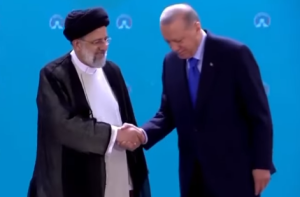 Turkey’s Pres. Erdogan meets Iranian Supreme Leader Ayatollah Khamenei. Screengrab via Youtube.
Despite being 1,000 miles apart and in different time zones, Turkey and the Sudanese Armed Forces (SAF) maintain a military partnership that operates in direct violation of a standing UN arms embargo. Turkish combat drones initially helped SAF reverse the tide of the civil war. However, by late summer, counter-momentum by rival forces erased those gains, forcing Sudanese Chief of Staff Yasir al-Atta to travel to Ankara to request expanded, urgent military assistance from his Turkish counterpart, Selcuk Bayraktaroglu. But what is Turkey doing intervening in Africa?
Turkey’s intervention in Sudan is not an isolated incident, but rather a window into a massive, calculated geopolitical trajectory.
An institutional answer emerged during the anniversary of the Battle of Manzikert, on Aug. 26. Speaking at the historic battlefield, Turkish President Recep Tayyip Erdogan outlined an uncompromising vision for the future, introducing concepts like the Century of Turkey.
His address signaled an era of Turkish regional military expansion and absolute dominance, utilizing harsh warnings directed at global and regional competitors.
Erdogan openly declared that “history is being rewritten in our region” and argued that Turkey was shaping the region. He threatened “any forces attempting to block Turkey’s geopolitical momentum,” stating clearly that those who dream of stopping it “will be destroyed.”
To turn this imperial rhetoric into geographical reality, Ankara has constructed a strategic military corridor stretching deep across Africa.
In Libya, Turkish forces operate major land and naval facilities in Misrata, alongside the strategic Al-Watiya Air Base, cementing their presence on the Mediterranean coast.
In the Sahel, Turkey has deployed regular troops and tactical advisers to Nigerien airfields to directly oversee drone training.
In Chad, Turkish forces now control the Abeche and Faya-Largeau military outposts, utilizing these newly acquired installations for critical aerial reconnaissance near unstable borders.
Further east, Erdogan signed a presidential motion extending Turkey’s armed forces deployment in Somalia and its strategic maritime zones. His office noted that Somalia’s security and stability are important for the entire region, permanently solidifying a Turkish naval and military anchor in the Horn of Africa.
Yet, Africa is merely one theater in a multi-front Turkish campaign. Syria, Iraq, Lebanon, and Gaza represent an interconnected Eastern Mediterranean front where Ankara increasingly asserts its political and military dominance.
In Syria and Iraq, Turkey has moved past temporary cross-border incursions, establishing permanent military bases and a continuous troop presence to dismantle Kurdish networks and create a deep, irreversible security buffer zone.
Meanwhile, when Lebanese President Aoun visited Ankara, Erdogan offered to deploy Turkish troops to the Lebanese border with Israel.
Like in Lebanon, Turkey offered to deploy troops to Gaza as part of the UN’s International Security Force. Israel vetoed such deployment. Yet Ankara continues to leverage its widespread aid networks in the strip, and firm alignment with local leadership to position itself as an indispensable regional broker.
This vast transregional expansion is happening despite severe economic indicators at home that should theoretically constrain such Turkish ambition.
Turkey’s military and security budget this year spiked over 30 percent to roughly $27.34 billion, consuming over 2.3 percent of its national GDP. Pumping larger portions of national revenue into foreign defense means less public funding is available to tackle domestic productivity and welfare crises. The Turkish Central Bank forecasted a year-end inflation of 24 percent, which places serious doubt on Ankara’s long-term ability to sustain conventional military expansion through state coffers alone.
To bypass these fiscal limitations and avoid deploying massive, costly conventional armies, Ankara relies heavily on the transnational ideological infrastructure of the Muslim Brotherhood.
By cultivating tight alliances with Brotherhood-aligned movements, as seen in Sudan, Libya, Syria, and Gaza, Turkey gains low-cost access to regional proxies, local governance structures, and strategic territory.
In Libya, Turkey works directly through political factions in Tripoli to anchor its permanent bases. Across Sudan and Somalia, Ankara taps into established Islamist networks to build defense capacity and secure vital trade corridors. In Gaza, close ideological synchronization with Hamas positions Turkey as an indispensable regional broker, while localized extensions in Lebanon and loyalist militias in Syria help build cross-border buffer zones.
Such strategy allows Turkey to maintain an expansive military footprint by converting local ideological loyalty into low-cost operational sustainability.
Given this consistent pattern of behavior, Turkey is clearly working to inherit the mantle of revolutionary Iran as the premier Islamic Empire in the Middle East and Africa.
Ankara is replacing Tehran’s destabilized Shiite proxy network with a far more potent, state-backed Sunni framework. Erdogan even explicitly borrowed the classic ideological slogan traditionally used by Iran regarding global revisionism, proclaiming that Turkey will always stand by all the downtrodden and wronged with all its strength wherever they are in the world.
“We stand by all the downtrodden and wronged with all our strength wherever they are in the world. We set an example for humanity with this dignified stance of ours everywhere from Syria to Palestine to Somalia to Arakan,” the Turkish president said.
Turkey’s interventions across Africa and the Middle East are not disconnected regional maneuvers. They are the foundational pillars of an emerging Islamic empire.
Hussain Abdul-Hussain is a research fellow at The Foundation for the Defense of Democracies (FDD).
Israpundit is entirely dependent on readers support. Please help me continue educating people with the truth about what is going on in Israel and around the world.

And there you have it, a back door into the EU.