
By Jalal Tagreeb
 Click Image to Enlarge. Image created via AI.
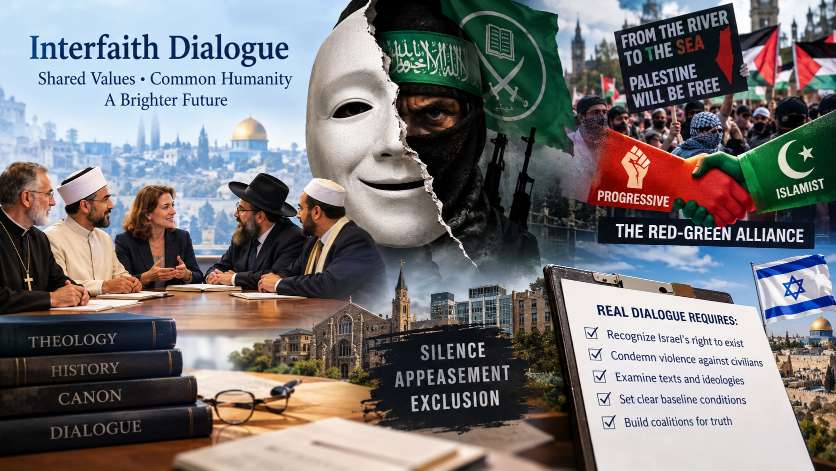
The podcast hosted by Dexter Van Zile for Focus on Western Islamism features scholar Tim Warr. In this discussion, Warr outlines how the events of October 7, 2023, completely dismantled the conventional assumptions surrounding Western interfaith dialogue. The broad systemic failure to confront radical ideology stems from structural blind spots, historical concessions, and institutional dynamics within religious and political spaces.
The Myth of Benign Dialogue and Verbal Tactics
A central defect in contemporary Western interfaith initiatives is the strong tendency to engage with Islamic theology exclusively through its most benign, idealized presentation. Well-meaning Western actors often approach interfaith encounters with a posture of high moral idealism. In this environment, complex theological tenets, historical grievances, and canonical texts that promote hostility toward non-Muslims or Jewish communities are frequently set aside.
This dynamic aligns with a strategic concept referred to as the jihad of the word. By presenting a curated, polished image of faith to non-Muslim audiences, radical movements neutralize external critique and soften Western institutional defenses. When Western participants accept this curated presentation without critical examination, dialogue transforms from an authentic search for truth into an exercise in ideological appeasement. By failing to interrogate illiberal elements, Western dialoguers create a false baseline of security that quickly collapses during geopolitical crises.
Mask-Off Moments in Interfaith Spaces
The fragility of sanitized interfaith consensus becomes glaringly obvious when interlocutors express positions that directly contradict pluralistic assumptions. In calm periods, vague statements about shared Abrahamic values allow participants to maintain an illusion of unity. However, significant military and geopolitical events act as immediate stress tests.
In the transcript, Tim Warr highlights his experience after landing in London on October 7, 2023. Within hours of the Hamas attacks, before Israel had launched any broad military campaign, mass demonstrations were already fully organized and utilizing specific political vocabulary. The total absence of empathy or moral hesitation regarding civilian casualties exposed a stark reality. Dialogue partners who had spent years in friendly discussion rapidly retreated into ideological frameworks, framing brutal acts of violence as legitimate political resistance.
The Institutional Cost of Criticizing Radicalism
Within current academic and interfaith circles, a severe personal and professional toll is imposed on individuals who express support for Israel or publicly criticize Islamist ideology. A subtle yet rigid form of social coercion governs these spaces, enforcing an anti-Israel orthodoxy under the threat of complete exclusion.
Tim Warr illustrates this dynamic directly by sharing a message from scholar Amina Inloes. After Warr publicly condemned the October 7 massacre and supported Israel, Inloes cut off all professional and personal ties, stating she could not stomach his views and regretting her past support for his academic endeavors. This asymmetrical enforcement allows anti-Israel actors to operate with complete freedom while forcing defenders of Israel to face immediate professional exile and social isolation.
The Dynamic of the Red-Green Alliance
Understanding the swift, organized mobilization against Israel requires analyzing the operational partnership known as the Red-Green Alliance. This coalition unites progressive or left-wing activists with Islamist organizations. Although these two groups hold opposing worldviews on social liberties, religious rights, and governance, they share a common tactical objective in opposing Western democratic structures and the State of Israel.
Progressive ideologies, anchored in post-modern critical frameworks, divide the world strictly into oppressors and oppressed. Within this system, Western nations and Israel are classified as permanent oppressors, while minority or anti-Western movements are automatically categorized as oppressed. Progressivism supplies the moral vocabulary, academic legitimacy, and media access. In return, Islamist organizations provide a focused grassroots mobilization capability.
Intellectual Hesitation in Mainstream Interfaith Communities
The inability to firmly confront radical ideology is exceptionally evident within liberal Protestant and progressive religious institutions. Heavily influenced by subjective post-modern concepts, these groups often operate under self-imposed boundaries against criticizing religious doctrines directly. Driven by a desire to avoid causing offense, institutional leaders regularly sacrifice objective evaluation for the outward appearance of harmony.
In the transcript, Dexter Van Zile and Tim Warr discuss how liberal Protestant institutions have historically maintained a commitment to an idealistic worldview. Warr notes that for many leaders in these spaces, evidence alone fails to prompt a shift in perspective because doing so would require abandoning core ideological assumptions regarding subjectivity and social justice. Consequently, when antisemitic rhetoric emerges from radical movements, these organizations often attempt to reframe the issue purely as a political reaction rather than confronting rooted ideological hostility.
Distinguishing Ordinary Believers from Ideological Networks
To establish a coherent analysis, a clear distinction must be maintained between individual Muslim citizens and organized ideological networks. Conflating individual faith with political radicalism leads to strategic and analytical errors.
The majority of individual Muslims living in Western democracies do not function as political agents for radical organizations. Many moved to Western nations to seek rule of law, individual stability, and economic freedom away from authoritarian conditions in their countries of origin. However, organized networks such as the Muslim Brotherhood or foreign-backed state entities operate with specific, long-term institutional goals. Problems arise when Western institutions treat self-appointed leadership bodies as sole representatives of whole populations, thereby empowering radical factions while sidelining moderate voices.
Reevaluating Interfaith Engagement
Given these structural failures, interfaith dialogue cannot continue under its historic rules. For engagement to serve a meaningful purpose, it must abandon sanitized polite consensus in favor of diagnostic clarity. Dialogue must openly evaluate canonical texts, explicit political goals, and underlying eschatological frameworks that influence hostility toward Israel.
A reformed approach requires setting explicit baseline conditions. Unconditional recognition of Israel’s right to exist as a sovereign Jewish state, along with the unambiguous condemnation of violence against civilians, must serve as prerequisite standards for dialogue. When radical interlocutors reject these terms, that rejection provides valuable clarity regarding their long-term objectives. Moving forward requires forming coalitions among conservative Christians, orthodox Jews, Islamic reformers, and secular figures who prioritize truth over institutional compromise.
Source: https://www.youtube.com/watch?v=zVHzK5wj5MQ&t=1897s
Jalal Tagreeb is an East Jordanian freelance researcher and translator who works in the United Kingdom and abroad, specializing in Islamic Studies and History. Formerly rooted in conservative Sunni Islam, he was once an active Muslim apologist who frequently debated secularists. Following a series of decisive intellectual defeats, he undertook a profound re-evaluation of his beliefs, ultimately culminating in his public renunciation of Islam.
He now focuses on analyzing cultural and ideological contrasts between the West and the Middle East. Through his writings and translations, he aims to foster meaningful dialogue, encourage critical engagement with Islamic tradition, and promote intellectual honesty. His writings, debates, and a selection of his previously refuted Islamic arguments can be found here: Jalal Tagreeb, Author at The Freethinker.
He can be contacted at servantjiff@gmail.com.


Leave a Reply
You must be logged in to post a comment.