
By Ari Bussel
Translation by Peloni
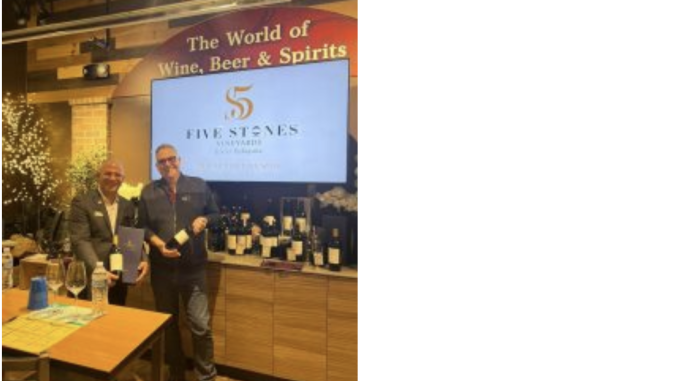 The owner of the Five Stones Winery, Ilan Hasson, was last week in Los Angeles to promote and taste his wines. In the picture (right) in a wine total which is in Pico
Once there were very few wineries in the country. Among the well-known ones: Carmel Mizrahi in Rishon LeZion, Binyamina Winery at the foot (south) of the Carmel, Barkan Wineries on the way from Rehovot via Mazkeret Batya and Hulda to Jerusalem, Golan Heights Wineries, and others.
It seems that Israelis in the country discovered the potential inherent in wineries, and the golden age of wine in the country began. Agricultural areas were uprooted and vines were planted in their place (for example, on the way to Jerusalem). Throughout Judea and Samaria, across the Golan Heights, and more and more. Everywhere there is a piece of land with a micro-climate, and thus we were reminded that the vine is one of the Seven Species with which the land was blessed.
The public in the country was so supportive and enthusiastic that every wine that reached the consumer was snatched up and disappeared. Prices were sky-high, but in this country everything is extremely expensive, so no one was particularly bothered by it. The problem was that when output is very limited and the local market snatches up everything that comes along, there is no incentive to export. And when there is no incentive to export, there is no safety net when the wheel turns—when domestic consumption or interest declines, or when various unexpected blows befall us (missiles from Iran, captives in Gaza, the halt in the arrival of Jews and Israelis to the country, and so on).
From a small number of wineries to an industry of many hundreds of wineries, including fine wines in quantities easy to boast of—to the glory of the State of Israel. But since almost no one troubled himself to invest in the future and to export, the markets abroad simply did not exist (and that was when they still tolerated us and agreed with our very existence). Of course there is the kosher wine market, but it is an almost exclusive market limited to Jewish communities around the world. And I still argue that we have a selection of wines among the finest in the world. And not only the wines, but also the accompanying stories, which take us back to the stories of the Bible as well as to the land of our forefathers.
Of course, in these days this is a very dangerous thing: any attempt to promote something connected to the land contains great danger. For years they have been throwing away and sabotaging Israeli products (for example, Ahava products from the Dead Sea, Bamba, or chopped frozen spices in the Trader Joe’s chain, and more). Only wines were not focused on, apparently because they were in a ghetto and in the past intended only for religious communities and not for the regular consumer.
Today it is even harder. Not only because of hatred of Israel and everything connected to it, but also because of the strength of the shekel. Business owners in the country became accustomed to enormous profit margins, to immediate returns, and truly not to working so hard. But in life one must invest, labor, see beyond the tip of one’s nose. One must simply… work. And the fruits will come, and they will be glorious, sweet and beautiful. And perhaps then we will enjoy even more, because what comes with great labor is appreciated more.
Now, when things are difficult and nothing is taken for granted, the winery owners have come to their senses and understood that export is essential. For example, the owners of Tura Winery, which is in the “occupied territories”—so-called “occupied”—are a couple whose children and grandchildren serve as combat soldiers, and who, like the rest of Israel, have gone through seven circles of hell since October 7, 2023.
In November, when representatives from Christian media around the world came to visit Israel, the winery served its wines at a luncheon at “The Balcony of the State.” (I am not sure this was an especially wise idea, since evangelicals refrain from drinking, but one can never know what the outcome will be, even if the target audience does not drink.) One of the wines is unique, and we begin with the name: Victory. We did not exactly win, but it turned out that the younger generation is a generation of lions. They sacrificed all that was dear to them for all of us, and for that our infinite thanks. The winery owners tell that they “assembled a blend from the best barrels in the winery’s cellars. The grapes were harvested from the winery’s veteran and select plots. The wine aged for about two years in new French oak barrels.
‘Victory wine was created out of respect and appreciation for IDF soldiers and for the victory of the Israeli spirit. It symbolizes the strength of the fighters and of the entire people, who succeed in overcoming every challenge thanks to faith, courage and determination. Every bottle is a symbol of hope and victory of the spirit and the good that drives us forward, even in the most difficult times.
‘The wine is dedicated to raising national morale and strengthening faith in our strength as a people. It expresses our ability to continue and renew ourselves, out of faith in the inner victory and in the national strength that always leads us to a better future.’”
These are the words of Vered and Erez Ben Saadon, the couple who own the winery.
It is not easy to export—especially a product that celebrates our strength on high—we who glorify the sanctity of life—facing the Muslim death cult that sanctifies death and seventy virgins in the world to come. The example of the Ben Saadon couple is utterly simple: they combined reality (children and grandchildren serving and fighting) with livelihood (wines in the winery they established) and said to the world: this is not genocide, and we are not the new Nazis. Come visit and see for yourselves. Raise a glass to the life of this people—the people of Israel lives!
Yehoram Gaon sang to the words of Haim Hefer and the melody of Dubi Zelter:
Raise a glass and drink now without being ashamed
Before the youth who stood facing the fire
To the sons of Yemen, to the sons of Algiers, to the sons of the Yekkes—
To the members of Bnei Akiva and to the members of the discotheques
And we all join him with full force:
Ah…
To the life of this people, this people,
This people,
How good it is that it is such,
That it is such!
To the life of this people
How good it is that it is such!
L’chaim!


Leave a Reply
You must be logged in to post a comment.