
Peloni: Economic loopholes are closing as Iran’s trading partners are now to be targeted by US. Iran is finally to be all on its own.
Despite presenting public face of calm, Iranian leadership concerned about renewal of anti-regime protests
J. Micah Hancock | All Israel News | Published: August 20, 2026
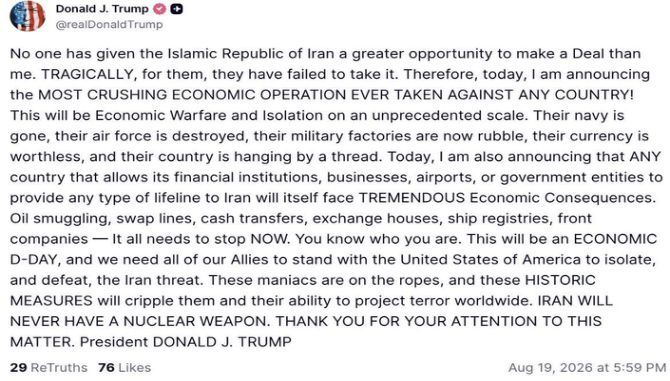 Click to Enlarge. Screengrab via Social Media
U.S. President Donald Trump has pivoted to “economic warfare” against the Islamic Republic, announcing a new economic strategy targeting Iran, after the expiration of the Memorandum of Understanding earlier this week and amid stalled negotiations with the Iranian regime.
In a post to his Truth Social account, Trump announced “the MOST CRUSHING ECONOMIC OPERATION EVER TAKEN AGAINST ANY COUNTRY!” saying, “This will be Economic Warfare and Isolation on an unprecedented scale.”
The announcement, which Trump referred to as “an ECONOMIC D-DAY,” represents the latest strategy shift announced by the president via social media. The move comes just days after Trump reversed his previous course, in which he had claimed ongoing negotiations between his administration and the Iranian regime, declaring on Tuesday that “There are no talks or conversations going on, or scheduled, with the Islamic Republic of Iran.”
In his Truth Social post on Wednesday night, Trump highlighted the economic impact of existing U.S. sanctions on Iran, while threatening “TREMENDOUS Economic Consequences” for any nation trading with the Islamic Republic.
“Today, I am also announcing that ANY country that allows its financial institutions, businesses, airports, or government entities to provide any type of lifeline to Iran will itself face TREMENDOUS Economic Consequences,” the president wrote. “Oil smuggling, swap lines, cash transfers, exchange houses, ship registries, front companies – It all needs to stop NOW. You know who you are.”
President Trump also called on U.S. allies to support the effort, in order to “isolate, and defeat, the Iran threat.”
“This will be an ECONOMIC D-DAY, and we need all of our Allies to stand with the United States of America to isolate, and defeat, the Iran threat,” he stated.
Claiming Iran is “on the ropes,” Trump reiterated his promise that “IRAN WILL NEVER HAVE A NUCLEAR WEAPON.”
“These maniacs are on the ropes, and these HISTORIC MEASURES will cripple them and their ability to project terror worldwide,” he wrote.
Trump’s announcement comes one day after the United Arab Emirates, which had maintained economic ties with the Islamic Republic despite bearing the brunt of Tehran’s ballistic missile attacks during the Iran war, announced it was suspending all trade and financial ties.
The UAE announced the decision after missiles targeted UAE maritime traffic in the Persian Gulf, which it blamed on Iran.
“In light of regional escalations that undermine regional and international peace and security, all trade, commercial exchanges, and financial transactions with Iran have been halted until further notice,” a statement by the UAE Foreign Ministry said.
The Islamic Republic denied responsibility for the attacks.
Meanwhile, the Iranian leadership appears to be taking steps to adapt to the new economic reality, deepening financial ties with BRICS nations such as Russia and China and seeking economic deals with neighboring Iraq.
Iranian Central Bank Governor Abdolnasser Hemmati recently admitted that Iranian oil exports “have almost stopped.”
“We are no longer exporting oil at all. This is a reality we acknowledge,” Hemmati said in comments on state television.
At the same time, Hemmati said that “So far, nothing has been released from the blocked funds in line with the Memorandum of Understanding.”
Hemmati also acknowledged that “budget imbalances, sanctions, and naval blockades have put the country under severe pressure.”
However, he said that the Islamic Republic leadership hopes to take steps to improve the situation through relations with BRICS members and through recent banking agreements with Iraq, which he visited earlier this week.
While there, Hemmati attempted to have frozen funds belonging to Iranian businessmen released as part of an agreement between the two states.
Additionally, he proposed creating “a financial channel based on cryptocurrencies of central banks” to help evade U.S. and Western sanctions. The U.S. Treasury Department has also been targeting cryptocurrency exchanges and transactions linked to Iranian accounts.
Hemmati’s admission that Iran has been crippled by U.S. economic actions even during the ceasefire and MoU comes alongside reports that the U.S. blockade of the Strait of Hormuz has led to an Iranian loss of control over the vital waterway, despite claims to the contrary.
A recent CNN report claims that despite Iranian claims to control the strait, Tehran is losing control of the critical waterway.
According to that report, over 80% of vessels transiting the strait over the past two weeks used the southern Omani route, rather than the IRGC-controlled northern route. This contrasts with the previous month when almost no vessels used the Omani route.
“It increasingly looks like Iran has at least partially lost control of the strait,” Homayoun Falakshahi, head of crude oil analysis at Kpler, told CNN.
At the same time, senior officials in the security apparatus of the regime are concerned that increased economic pressure could lead to renewed anti-regime protests, Iran International reported on Tuesday.
It cited a leaked audio recording in which senior Basij Force officials can be heard discussing “possible new demonstrations, the online identification of Basij members and plans to track anti-government activity and individuals on social media.”
After the recent killing of a Basij member, the officials were concerned that in future unrest, members of the regime-affiliated militia could be doxxed and targeted.
Publicly, however, senior Iranian figures are presenting a message of calm and control.
Foreign Minister Abbas Araghchi posted to social media that Trump’s “so-called ‘Economic D-Day’ is a diversion from America’s own crisis: unprecedented debt & surging interest costs.”
“Doubling down on failed policies will only bring further defeat – and enmity of Iranians,” Araghchi added, posting pictures of the increasing U.S. national debt.


Leave a Reply
You must be logged in to post a comment.