
Peloni: As the clock goes tick tock, Trump continues to display no rush in choosing to move forward with either the deal he claims to have with the Iranians or to return to war. Meanwhile a hush in recent days has been the most positive aspect of what came following the pregnant pause which met Trump’s demand that the Arab states join the Abraham Accords. Of course, forcing the Arabs to join a peace deal which undermines the rudimentary aspects of both their society and their religion has little chance of bringing peace, but it would provide Trump with a commitment to managed the strife which might arise in the region without the need of the US to fall back from its long anticipated pivot to China.
By Sarah Roderick-Fitch | The Center Square |May 29, 2026
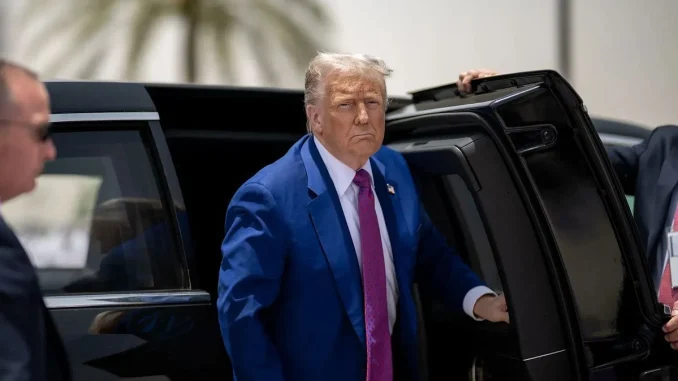 President Donald Trump arrives at the Royal Court Palace in Riyadh, Saudi Arabia, for a welcome ceremony with Crown Prince Mohammed bin Salman Al Saud, May 13, 2025. Photo: Daniel Torok / Official White House Photo via Flickr / United States Government Work
A final determination is being made on whether the U.S. and Iran will agree to a memorandum of understanding that would extend the ceasefire for 60 days and reopen the Strait of Hormuz, President Donald Trump announced Friday.
Trump reiterated repeated demands that Iran “never have a nuclear weapon,” calling on Iran to reopen the Strait of Hormuz, which has been essentially shut down since the early days of the U.S. strikes that began Feb. 28.
In the president’s Truth Social post, he said the naval blockade will be lifted, while demanding Iran remove “all water mines” in the strait and not impose tolls on the vital waterway.
“Iran will complete the immediate removal and/or detonation of any mines that are left, which will not be many!). Ships caught in the Strait due to our amazing and unprecedented Naval Blockade, which will now be lifted, may start the process of ‘heading home!’” Trump wrote.
The president added that any “nuclear dust” buried “deep unground” following last June’s military strikes on Iran’s nuclear sites, would be “unearthed” and “destroyed.”
He argues that the U.S. and China are the only two countries in the world capable of clearing the “nuclear dust.” Trump said the removal would be done in “close coordination and conjunction” with Iran and the International Atomic Energy Agency.
The president addressed concerns of money exchanging hands in pursuit of securing a deal, saying that “no money will be exchanged, until further notice.”
During a cabinet meeting Wednesday, Trump told reporters the U.S. was “not talking about any easing of sanctions or giving money.”
He added that Iran was “negotiating on fumes,” as their economy is in peril and “their money has no value.”
The blockade on Iranian ports has been costing the Islamic Republic an estimated $500 million a day in economic damage, the Trump administration argues.
It is unclear if the president agreed to lift the naval blockade in good faith to ease pressure on the Strait of Hormuz.
Trump concluded his post saying that “other items, of far less importance, have been agreed to” in the proposed deal.
The 60-day ceasefire extension would allow the two countries to enter into negotiations on dismantling Iran’s nuclear program. The ceasefire was initially implemented April 8 and originally set for two weeks.
The ceasefire has come under strain, especially in the last week, as the U.S. and Iran have exchanged fire twice, with Iran targeting an American base in Kuwait.


Leave a Reply
You must be logged in to post a comment.