
Peloni: As time creeps by, the US midterms draw closer and Trump becomes more dedicated towards leaving Iran to crash on the rocks of the ever tightening US economic war waged against the regime. The regime’s decided efforts to continue to become ever more desperate to raise the stakes in what some are describing as a game of political chicken. The economic consequences of the US blockade has left Iran with no customers bold enough to run afoul of US sanctions, and has led to Iran’s main export hub in Kharg Island shutting down its oil processing. Iran has little fear of any rising from its people as it has demonstrated its willingness to send any number of dissidents to a speedy end, but it must mainain the support of the regime forces and for this it needs some way to pay these forces. A recent report indicated that it might be saved by its role in BRICs, but the reality is that BRICs association is not capable of actually saving Iran without drawing the wrath of US sanctions war on the relevant nations involved, which again is why Iran currently has no oil sales and is in turn why its oil exports are going nowhere, making the below report of the US strike enforcing its blockade all the more relevant.
Iran warns its military is shifting to the offense, strikes Kurdish groups in Iraq
Hanan Lischinsky | All Israel News | Published: August 12, 2026
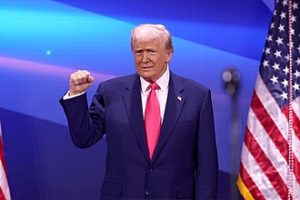 President of the United States Donald Trump speaking at the 2025 (CPAC). Photo by Gage Skidmore from Surprise, AZ, United States of America – Donald Trump, CC BY-SA 2.0, Wikipedia
U.S. President Donald Trump said the U.S. military has “total control” over the Strait of Hormuz amid the ongoing naval blockade of Iranian ports, while negotiations appear deadlocked and the Iranian regime continues to escalate its threats – leaving the future of the conflict unclear.
On Tuesday, Trump rejected the notion that he trusts the Iranian regime, saying he’s “the last person to trust Iran. They’ve lied to me constantly.”
Speaking to reporters, he added that the United States has “total control over the Hormuz Strait right now. They don’t have control… we own it,” while also noting that “at some point maybe they’ll do something and get blown away, but right now we’re in a very good position.”
His comments came a day after the U.S. military enforced its naval blockade after a Navy MH-60 helicopter fired two Hellfire missiles into the engine room of a vessel that had ignored repeated warnings, trying to cross the Gulf of Oman for an unspecified Iranian port, according to U.S. Central Command (CENTCOM).
“The ship is no longer transiting to Iran in violation of the U.S. blockade, which remains in full effect,” CENTCOM wrote on ?. So far, it has redirected 55 commercial ships, disabled three, and boarded two as part of the enforcement operations.
.@POTUS Trump: "I don't trust Iran…I'm the last person to trust Iran. They've lied to me constantly." pic.twitter.com/TG7xHVCN4C
— Israel War Room (@IsraelWarRoom) August 12, 2026
Despite Trump’s claim to have the situation under control, Yoni Ben Menachem, a senior researcher at the Jerusalem Center for Foreign and Security Affairs, warned that Iran retains the ability to disrupt freedom of navigation in the key waterway.
“Trump is presenting a false picture. The Americans have control of the strait, but the Iranians can still attack ships using drones, speedboats, or naval mines. Victory is still not in the hands of the United States,” he emphasized.
Amid the renewed fighting, traffic through the strait continued to decline, with only eight vessels identified in the waterway, down from a 10-day average of about 12, according to Reuters, citing shipping data from Kpler. Against this backdrop, oil prices rose slightly on Tuesday, with Brent crude reaching a two-week high of $90 a barrel before falling back.
According to Ben Menachem, the U.S. is currently pursuing a strategy of economic pressure, but as the Iranian regime retains military capabilities, it could choose to reignite the fighting.
“I estimate that the Iranians will initiate a massive escalation ahead of the midterm elections, in an attempt to politically harm Trump,” he warned, speculating that the recent lack of threats from Trump could point toward preparations to preempt such a scenario.
Several reports in recent days have highlighted the possible lack of preparedness on the American side, particularly regarding the low number of available interceptor missiles. The New York Times reported Tuesday that, during the most recent round of fighting, the regime sought to exploit this vulnerability by using advanced missiles capable of rapidly changing course, forcing the U.S. to use its already limited supply of Patriot interceptors.
Earlier today, CENTCOM forces disabled the steering gear of Panama-flagged M/V Vela Nova as the cargo vessel attempted to transit the Gulf of Oman and violate the U.S. blockade against Iran by sailing toward an Iranian port.
A U.S. Navy MH-60 helicopter fired two hellfire… pic.twitter.com/hqY1g2Ng8q
— U.S. Central Command (@CENTCOM) August 11, 2026
On July 17, this tactic succeeded after a missile struck housing units at an American base in Jordan, killing three soldiers and wounding over 100.
According to the NYT, citing sources briefed on the stockpile levels, the U.S. military used over 1,500 Patriot interceptor missiles against Iran and now has fewer than 1,700 left. Meanwhile, only about 600 interceptors were produced during all of 2025.
Against this background, Iranian officials continued to issue threats and blustering messages.
The regime’s forces are shifting from a defensive approach toward the offensive, an advisor to the commander of the Revolutionary Guard (IRGC), Mohammad Reza Naghdi, said on Tuesday.
“Whenever conditions require and an order is issued, we must have the capability to take operations to the enemy’s territory and conduct operations away from our own territory,” he said, adding, “our production of ballistic missiles exceeds the number being launched.”
“We also have a production capacity for drones that exceeds their rate of use and launch, and we have significant production capacity,” Naghdi said.
Iran fired several missiles and drones at Iranian Kurdish opposition positions northeast of Erbil in Iraq’s Kurdistan region, the Kurdish news site Rudaw reported Wednesday, citing a senior commander. Reuters, citing security sources, reported that another four drones targeted Kurdish opposition camps near Erbil.
Also on Wednesday, Mehdi Mohammadi, a senior advisor to Iran’s parliament speaker, vowed that the regime would not agree to reopen the Strait of Hormuz until there is a credible end to the war. He described the current situation as “the calm before the storm,” apparently echoing Ben Menachem’s assessment.


It seems like the only way to reduce the bluster volume is to take away their toys.