
The failed Exorcism : A Metaphor of Spiritual Division
Tucker Carlson
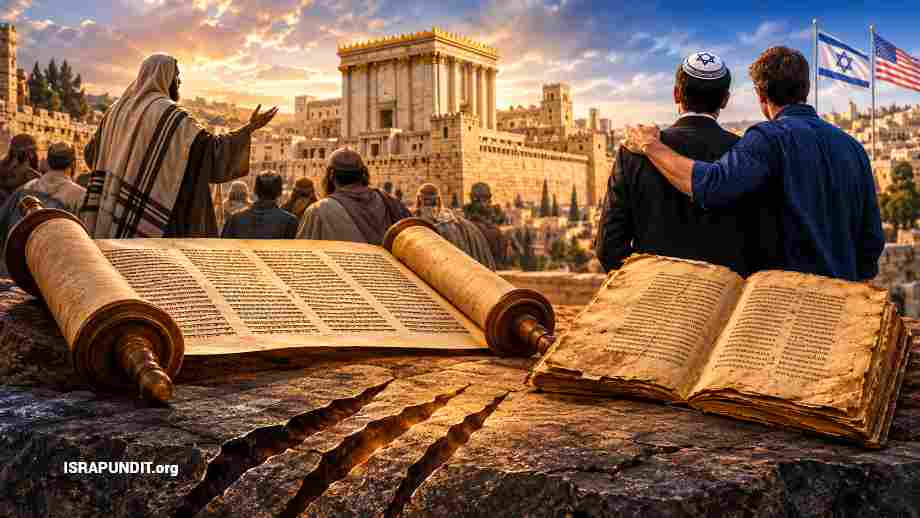 Click Image to Enlarge. Image created via AI.
In modern public discourse, commentator Tucker Carlson has famously recounted waking up with bleeding claw marks on his chest and sides, an experience he attributed to a physical attack by a demon that prompted him to begin reading the Bible.
Notably, rather than seeking medical care for his wounds[Exorcism] —in spite of claiming the scars remained visible over a year later—he treated the episode purely through his own corrupted spiritual lens. Beyond its literal recounting, that image serves as a striking spiritual metaphor for any believer navigating today’s cultural fractures.
In the Gospels, leaving physical wounds untreated mirrors the spiritual torment of the Gerasene demoniac in Mark 5:1–20, a man driven by a collective spirit of division named “Legion” to cry out and cut himself with stones until Jesus cast out the spirits with a spoken command, restoring him to his right mind.
That same healing authority was displayed inside the Jewish house of worship at Capernaum in Luke 4:33–36, where Yeshua rebuked an unclean spirit simply with his word. Failing to turn to Jesus—the ultimate healer—risks missing the true message of the Scriptures.
When voices within Western culture stray from these foundational biblical roots and sow division between Christians and Jews, those unhealed claw marks symbolize the spiritual wounds inflicted when ideological resentment tears at the Judeo-Christian bond.
In a very real sense, modern political commentary requires a spiritual cleansing—a casting out of the divisive myths and historical amnesia that seek to sever Jesus from his Jewish family or pit Christians against the people of Israel, running counter to the unity and love Yeshua taught.
Recognizing the true historical context of Yeshua illuminates why the modern alliance between American Christians and the Jewish people is a natural historical outcome. Rather than abandoning Jesus’s earthly family, Christian Zionism embraces the continuity of the biblical narrative—honoring the sacredness of Jerusalem, the covenant of Abraham, and the shared moral heritage of the Torah and the Gospels.
This shared commitment to unity is reflected in modern civic and political advocacy, where millions of American Christians actively stand alongside Jewish communities.
A widespread misconception in contemporary debate portrays the American Israel Public Affairs Committee (AIPAC) as a foreign or exclusively Jewish lobby. In reality, AIPAC is a strictly domestic American organization funded entirely by U.S. citizens, representing more than 6.5 million grassroots members across all 50 states—the vast majority of whom are non-Jewish Americans. Alongside Christian Zionist organizations like Christians United for Israel (CUFI)—which alone counts over 10 million members, exceeding the entire Jewish population of the United States—these coalitions demonstrate that American support for Israel is overwhelmingly driven by Christian citizens acting on their own biblical values. Today, as ancient Christian communities face severe instability and displacement across much of the Middle East, the sovereign democratic State of Israel stands as a rare sanctuary where Christians can practice their faith openly and safely—protected by the very Jewish nation whose ancestors were once exiled by Rome.
Acknowledging Yeshua as an observant Judean Jew honors the unbreakable connection between the Jewish people and the foundations of Western faith, reminding all believers to guard against forces that seek to tear that family apart.
The Second Temple Reality
To maintain this unity, modern historical education must correct one of its most significant oversights: the frequent separation of Jesus of Nazareth from his authentic Jewish environment. In many standard textbooks, the central figure of Western chronology is presented as though he were detached from the ancient Near East, obscuring his deep roots in first-century Judea.
Addressing this omission does not challenge Christian faith; rather, it restores the historical foundation upon which the Judeo-Christian tradition stands.
An accurate historical ledger begins with a foundational truth that many Christians actively affirm and honor: Jesus of Nazareth lived, taught, and died entirely within the framework of Second Temple Judaism.During the first century CE, Judaism was centered around the Second Temple in Jerusalem, and Jesus operated wholly inside this covenantal world:
Name, Scripture, and Teaching: In his native Judea, his Hebrew and Aramaic name was Yeshua, meaning “the Lord saves” or “salvation.” The scriptures he studied, memorized, and taught from were the Hebrew Bible—the Torah, the Prophets, and the Writings—delivering sermons and healing in Galilean houses of worship such as the Synagogue of Capernaum, whose ancient basalt foundations still stand along the Sea of Galilee today.
Covenantal Observance: On the eighth day of his life, he underwent circumcision in strict adherence to the commandment in Leviticus 12:3, binding him permanently to the Abrahamic covenant and the people of Israel. He wore ritual fringes (tzitzit), observed Jewish festivals, and was addressed by his followers as Rabbi.
The Meaning of Messiah: The title “Christ” is the Greek translation of the Hebrew word Mashiach(Messiah), meaning the “Anointed One.” Calling Yeshua the Messiah was a declaration rooted directly in Jewish prophetic expectations regarding the restoration of the Davidic line.
Roman Execution and the Inscription on the Cross: Just like thousands of other Judean Jews executed under imperial occupation, Yeshua was put to death by the Roman Empire via crucifixion—a brutal method of Roman state terror ordered by the Roman governor Pontius Pilate. Crucially, the official Roman charge fastened above his head on the cross—written in Hebrew, Latin, and Greek—explicitly identified him as Jesus of Nazareth, King of the Jews (Iesus Nazarenus, Rex Iudaeorum).
To claim otherwise or detach Jesus from Israel is to deny his own earthly Jewish family and the very identity Rome executed him for.
When modern curricula detach his identity from his ancestry, they obscure the reality that Christianity and Judaism share an unbreakable spiritual lineage. Contemporary political commentary sometimes introduces anachronistic claims—such as asserting that Yeshua was a “Palestinian” or a “Muslim”—which do not hold up under basic chronology, as Islam emerged in the 7th century CE and the geographic label Syria Palaestina was imposed by Roman Emperor Hadrian in 135 CE—a century after the crucifixion—to sever the Jewish connection to Judea following the Bar Kokhba Revolt.
Imperial Europe [Rome] vs. The New World Renewal [America]
In the decades following Yeshua’s death, the separation between early Christianity and rabbinic Judaism was accelerated by the [European] Roman Empire.
After destroying the Second Temple in 70 CE—an event documented in eyewitness detail by Flavius Josephus in The Wars of the Jews—and scattering Judeans into exile, imperial Rome eventually legalized Christianity under Emperor Constantine via the Edict of Milan in 313 CE. However, as the faith integrated into the power structures of the Old World, imperial authorities frequently obscured Jesus’s Jewish identity, enacting laws like the Theodosian Code that restricted Jewish civic rights and fostered centuries of European persecution.
The realization of a harmonious Judeo-Christian partnership found new soil across the Atlantic in America .
Many settlers and founders who established the United States sought to escape the religious coercion and authoritarianism of the Old World. Drawing directly from the Hebrew Bible—including the Ten Commandments, the Noahide moral framework, and the prophetic call to liberty
—alongside the teachings of the New Testament, the American founding established a framework rooted in individual moral agency
[Torah /Old Testament / Genesis/Jerusalem /David’s Fortress of Zion King of Israel not the enemies of Jerusalem: Goliath /Jalut /Philistines/Palestine ]
Across modern history, this shared Judeo-Christian commitment to God-given individual agency has stood in direct opposition to totalitarian ideologies—such as fascism, Nazism, Marxism, Islamism, Progressive Leftism, Atheism and state Communism—that subordinate the human soul to the state and to Tuckers “Demons”.
As historians and thinkers have long noted, the Hebrew legacy provided the moral bedrock for Western civilization:
“I will insist the Hebrews have [contributed] more to civilize men than any other nation. If I was an atheist and believed in blind eternal fate, I should still believe that fate had ordained the Jews to be the most essential instrument for civilizing the nations … They are the most glorious nation that ever inhabited this Earth. The Romans and their empire were but a bubble in comparison to the Jews. They have given religion to three-quarters of the globe and have influenced the affairs of mankind more and more happily than any other nation, ancient or modern.”
— John Adams, Second President of the United States
“If we were forced to choose just one, there would be no way to deny that Judaism is the most important intellectual development in human history.”
— David Gelernter, Yale University Professor
“The Jews started it all—and by ‘it’ I mean so many of the things we care about, the underlying values that make all of us, Jew and Gentile, believer and atheist, tick. Without the Jews, we would see the world through different eyes, hear with different ears, even feel with different feelings…”
— Thomas Cahill, The Gifts of the Jews
“The Jews, however, are beyond all doubt the strongest, toughest, and purest race at present living in Europe; they know how to succeed even under the worst conditions (in fact better than under favorable ones) by means of virtues of some sort, which one would like nowadays to label as vices—owing above all to a resolute faith which does not need to be ashamed before ‘modern ideas’…
It is certain that the Jew, if he desired—or if they were driven to it, as the antisemites seem to wish—could now have the ascendancy, nay, literally the supremacy, over Europe; that they are not working or planning for that end is equally sure… The resourcefulness of the modern Jews, both in mind and soul, is extraordinary…”
— Friedrich Nietzsche, German Philosopher (1844–1900)
“The dispersion of the Jews was both a boon and a bane; their nation was disjoined, but their culture was enormously enhanced. Whereas a unique monotheistic outlook set the Jews apart from other peoples, a common language, literacy and learning bound the disparate Jewish communities together and provided a firm foundation for further creativity. The exercise of this multifaceted creative propensity rebounded to benefit not only the societies that harbored the Jews, but all humankind.”
— Samuel Kurinsky, The Eighth Day: The Hidden History of the Jewish Contribution to Civilization(Northvale, New Jersey: Jason Aronson, Inc., 1994), xviii
Primary Historical Sources & Civic References for Further Reading
- Tucker Carlson Demon Attack Account (The Guardian): News coverage detailing Tucker Carlson’s documentary interview regarding his nighttime experience and resulting scars.
- Mark 5:1–20 — Healing of the Gerasene Demoniac (Bible Gateway): Gospel account of Jesus casting out the spirit named “Legion” and healing a man tormented by self-inflicted stone wounds.
- Luke 4:33–36 — Exorcism in the Capernaum Synagogue (Bible Hub): Gospel record of Jesus commanding an unclean spirit to leave a man inside the Jewish synagogue at Capernaum.
- AIPAC Myths and Facts (AIPAC.org): Documentation of AIPAC’s status as a domestic American membership organization funded solely by U.S. citizens.
- Christians United for Israel (CUFI.org): Overview of the largest Christian Zionist grassroots organization in the United States, representing over 10 million members.
- Archaeology of the Capernaum Synagogue (Israel Ministry of Foreign Affairs): Official archaeological overview of the first-century basalt synagogue foundations and later limestone structure where Jesus taught.
- Roman Crucifixion and Pontius Pilate (The Conversation): Historical examination of Roman imperial execution under Pontius Pilate and how blame was later shifted.
- Flavius Josephus (The Wars of the Jews, Book VI): Eyewitness account of the 70 CE siege of Jerusalem, the destruction of the Second Temple, and the Roman captivity of Judeans.
- The Edict of Milan (313 CE) (Fordham University Sourcebook): Text of the imperial decree establishing religious tolerance in the Roman Empire.
- The Theodosian Code (Codex Theodosianus, Book XVI, Title 8) (Posen Library): Historical analysis of fourth- and fifth-century Roman imperial laws governing Jewish communities.
- John Adams, Letter to F.A. van der Kemp (February 16, 1809) (National Archives): Primary correspondence detailing Adams’s reflections on the historical contributions of the Jewish people to civilization.
? Message 2 of 2. For JAWS, turn virtual PC Cursor on if needed.
read
To: Read · Fri, Nov 27 at 10:18 AM
Message Body
Tucker Carlson’s Demons and the Judeo-Christian Bond: How his Division Threatens a Shared Family
The failed Exorcism : A Metaphor of Spiritual Division
In modern public discourse, commentator Tucker Carlson has famously recounted waking up with bleeding claw marks on his chest and sides, an experience he attributed to a physical attack by a demon that prompted him to begin reading the Bible.
Notably, rather than seeking medical care for his wounds[Exorcism] —in spite of claiming the scars remained visible over a year later—he treated the episode purely through his own corrupted spiritual lens. Beyond its literal recounting, that image serves as a striking spiritual metaphor for any believer navigating today’s cultural fractures.
In the Gospels, leaving physical wounds untreated mirrors the spiritual torment of the Gerasene demoniac in Mark 5:1–20, a man driven by a collective spirit of division named “Legion” to cry out and cut himself with stones until Jesus cast out the spirits with a spoken command, restoring him to his right mind.
That same healing authority was displayed inside the Jewish house of worship at Capernaum in Luke 4:33–36, where Yeshua rebuked an unclean spirit simply with his word. Failing to turn to Jesus—the ultimate healer—risks missing the true message of the Scriptures.
When voices within Western culture stray from these foundational biblical roots and sow division between Christians and Jews, those unhealed claw marks symbolize the spiritual wounds inflicted when ideological resentment tears at the Judeo-Christian bond.
In a very real sense, modern political commentary requires a spiritual cleansing—a casting out of the divisive myths and historical amnesia that seek to sever Jesus from his Jewish family or pit Christians against the people of Israel, running counter to the unity and love Yeshua taught.
Recognizing the true historical context of Yeshua illuminates why the modern alliance between American Christians and the Jewish people is a natural historical outcome. Rather than abandoning Jesus’s earthly family, Christian Zionism embraces the continuity of the biblical narrative—honoring the sacredness of Jerusalem, the covenant of Abraham, and the shared moral heritage of the Torah and the Gospels.
This shared commitment to unity is reflected in modern civic and political advocacy, where millions of American Christians actively stand alongside Jewish communities.
A widespread misconception in contemporary debate portrays the American Israel Public Affairs Committee (AIPAC) as a foreign or exclusively Jewish lobby.
In reality, AIPAC is a strictly domestic American organization funded entirely by U.S. citizens, representing more than 6.5 million grassroots members across all 50 states—the vast majority of whom are non-Jewish Americans. Alongside Christian Zionist organizations like Christians United for Israel (CUFI)—which alone counts over 10 million members, exceeding the entire Jewish population of the United States—these coalitions demonstrate that American support for Israel is overwhelmingly driven by Christian citizens acting on their own biblical values. Today, as ancient Christian communities face severe instability and displacement across much of the Middle East, the sovereign democratic State of Israel stands as a rare sanctuary where Christians can practice their faith openly and safely—protected by the very Jewish nation whose ancestors were once exiled by Rome.
Acknowledging Yeshua as an observant Judean Jew honors the unbreakable connection between the Jewish people and the foundations of Western faith, reminding all believers to guard against forces that seek to tear that family apart.
The Second Temple Reality
To maintain this unity, modern historical education must correct one of its most significant oversights: the frequent separation of Jesus of Nazareth from his authentic Jewish environment. In many standard textbooks, the central figure of Western chronology is presented as though he were detached from the ancient Near East, obscuring his deep roots in first-century Judea.
Addressing this omission does not challenge Christian faith; rather, it restores the historical foundation upon which the Judeo-Christian tradition stands.
An accurate historical ledger begins with a foundational truth that many Christians actively affirm and honor: Jesus of Nazareth lived, taught, and died entirely within the framework of Second Temple Judaism.During the first century CE, Judaism was centered around the Second Temple in Jerusalem, and Jesus operated wholly inside this covenantal world:
Name, Scripture, and Teaching: In his native Judea, his Hebrew and Aramaic name was Yeshua, meaning “the Lord saves” or “salvation.” The scriptures he studied, memorized, and taught from were the Hebrew Bible—the Torah, the Prophets, and the Writings—delivering sermons and healing in Galilean houses of worship such as the Synagogue of Capernaum, whose ancient basalt foundations still stand along the Sea of Galilee today.
Covenantal Observance: On the eighth day of his life, he underwent circumcision in strict adherence to the commandment in Leviticus 12:3, binding him permanently to the Abrahamic covenant and the people of Israel. He wore ritual fringes (tzitzit), observed Jewish festivals, and was addressed by his followers as Rabbi.
The Meaning of Messiah: The title “Christ” is the Greek translation of the Hebrew word Mashiach(Messiah), meaning the “Anointed One.” Calling Yeshua the Messiah was a declaration rooted directly in Jewish prophetic expectations regarding the restoration of the Davidic line.
Roman Execution and the Inscription on the Cross: Just like thousands of other Judean Jews executed under imperial occupation, Yeshua was put to death by the Roman Empire via crucifixion—a brutal method of Roman state terror ordered by the Roman governor Pontius Pilate. Crucially, the official Roman charge fastened above his head on the cross—written in Hebrew, Latin, and Greek—explicitly identified him as Jesus of Nazareth, King of the Jews (Iesus Nazarenus, Rex Iudaeorum).
To claim otherwise or detach Jesus from Israel is to deny his own earthly Jewish family and the very identity Rome executed him for.
When modern curricula detach his identity from his ancestry, they obscure the reality that Christianity and Judaism share an unbreakable spiritual lineage. Contemporary political commentary sometimes introduces anachronistic claims—such as asserting that Yeshua was a “Palestinian” or a “Muslim”—which do not hold up under basic chronology, as Islam emerged in the 7th century CE and the geographic label Syria Palaestina was imposed by Roman Emperor Hadrian in 135 CE—a century after the crucifixion—to sever the Jewish connection to Judea following the Bar Kokhba Revolt.
Imperial Europe [Rome] vs. The New World Renewal [America]
In the decades following Yeshua’s death, the separation between early Christianity and rabbinic Judaism was accelerated by the [European] Roman Empire.
After destroying the Second Temple in 70 CE—an event documented in eyewitness detail by Flavius Josephus in The Wars of the Jews—and scattering Judeans into exile, imperial Rome eventually legalized Christianity under Emperor Constantine via the Edict of Milan in 313 CE. However, as the faith integrated into the power structures of the Old World, imperial authorities frequently obscured Jesus’s Jewish identity, enacting laws like the Theodosian Code that restricted Jewish civic rights and fostered centuries of European persecution.
The realization of a harmonious Judeo-Christian partnership found new soil across the Atlantic in America .
Many settlers and founders who established the United States sought to escape the religious coercion and authoritarianism of the Old World. Drawing directly from the Hebrew Bible—including the Ten Commandments, the Noahide moral framework, and the prophetic call to liberty
—alongside the teachings of the New Testament, the American founding established a framework rooted in individual moral agency
[Torah /Old Testament / Genesis/Jerusalem /David’s Fortress of Zion King of Israel not the enemies of Jerusalem: Goliath /Jalut /Philistines/Palestine ]
Across modern history, this shared Judeo-Christian commitment to God-given individual agency has stood in direct opposition to totalitarian ideologies—such as fascism, Nazism, Marxism, Islamism, Progressive Leftism, Atheism and state Communism—that subordinate the human soul to the state and to Tuckers “Demons”.
As historians and thinkers have long noted, the Hebrew legacy provided the moral bedrock for Western civilization:
“I will insist the Hebrews have [contributed] more to civilize men than any other nation. If I was an atheist and believed in blind eternal fate, I should still believe that fate had ordained the Jews to be the most essential instrument for civilizing the nations … They are the most glorious nation that ever inhabited this Earth. The Romans and their empire were but a bubble in comparison to the Jews. They have given religion to three-quarters of the globe and have influenced the affairs of mankind more and more happily than any other nation, ancient or modern.”
— John Adams, Second President of the United States
“If we were forced to choose just one, there would be no way to deny that Judaism is the most important intellectual development in human history.”
— David Gelernter, Yale University Professor
“The Jews started it all—and by ‘it’ I mean so many of the things we care about, the underlying values that make all of us, Jew and Gentile, believer and atheist, tick. Without the Jews, we would see the world through different eyes, hear with different ears, even feel with different feelings…”
— Thomas Cahill, The Gifts of the Jews
“The Jews, however, are beyond all doubt the strongest, toughest, and purest race at present living in Europe; they know how to succeed even under the worst conditions (in fact better than under favorable ones) by means of virtues of some sort, which one would like nowadays to label as vices—owing above all to a resolute faith which does not need to be ashamed before ‘modern ideas’…
It is certain that the Jew, if he desired—or if they were driven to it, as the antisemites seem to wish—could now have the ascendancy, nay, literally the supremacy, over Europe; that they are not working or planning for that end is equally sure… The resourcefulness of the modern Jews, both in mind and soul, is extraordinary…”
— Friedrich Nietzsche, German Philosopher (1844–1900)
“The dispersion of the Jews was both a boon and a bane; their nation was disjoined, but their culture was enormously enhanced. Whereas a unique monotheistic outlook set the Jews apart from other peoples, a common language, literacy and learning bound the disparate Jewish communities together and provided a firm foundation for further creativity. The exercise of this multifaceted creative propensity rebounded to benefit not only the societies that harbored the Jews, but all humankind.”
— Samuel Kurinsky, The Eighth Day: The Hidden History of the Jewish Contribution to Civilization(Northvale, New Jersey: Jason Aronson, Inc., 1994), xviii
Primary Historical Sources & Civic References for Further Reading
- Tucker Carlson Demon Attack Account (The Guardian): News coverage detailing Tucker Carlson’s documentary interview regarding his nighttime experience and resulting scars.
- Mark 5:1–20 — Healing of the Gerasene Demoniac (Bible Gateway): Gospel account of Jesus casting out the spirit named “Legion” and healing a man tormented by self-inflicted stone wounds.
- Luke 4:33–36 — Exorcism in the Capernaum Synagogue (Bible Hub): Gospel record of Jesus commanding an unclean spirit to leave a man inside the Jewish synagogue at Capernaum.
- AIPAC Myths and Facts (AIPAC.org): Documentation of AIPAC’s status as a domestic American membership organization funded solely by U.S. citizens.
- Christians United for Israel (CUFI.org): Overview of the largest Christian Zionist grassroots organization in the United States, representing over 10 million members.
- Archaeology of the Capernaum Synagogue (Israel Ministry of Foreign Affairs): Official archaeological overview of the first-century basalt synagogue foundations and later limestone structure where Jesus taught.
- Roman Crucifixion and Pontius Pilate (The Conversation): Historical examination of Roman imperial execution under Pontius Pilate and how blame was later shifted.
- Flavius Josephus (The Wars of the Jews, Book VI): Eyewitness account of the 70 CE siege of Jerusalem, the destruction of the Second Temple, and the Roman captivity of Judeans.
- The Edict of Milan (313 CE) (Fordham University Sourcebook): Text of the imperial decree establishing religious tolerance in the Roman Empire.
- The Theodosian Code (Codex Theodosianus, Book XVI, Title 8) (Posen Library): Historical analysis of fourth- and fifth-century Roman imperial laws governing Jewish communities.
- John Adams, Letter to F.A. van der Kemp (February 16, 1809) (National Archives): Primary correspondence detailing Adams’s reflections on the historical contributions of the Jewish people to civilization.
Israpundit is entirely dependent on readers support. Please help me continue educating people with the truth about what is going on in Israel and around the world.


Leave a Reply
You must be logged in to post a comment.