
Moshe Phillips
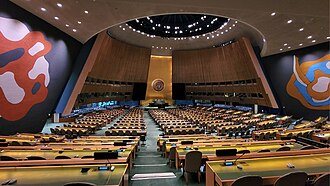 United Nations General Assembly. Photo by Mojnsen – Own work, CC BY-SA 4.0, Wikipedia
Far too many pro-Israel organizations and writers marked the 50th anniversary of the U.N. General Assembly vote to adopt Resolution 3379, which stated that Zionism “is a form of racism and racial discrimination,” by showcasing the efforts that the late Daniel Patrick Moynihan, the U.S. ambassador to the United Nations when the resolution was passed, made to work against it. While Moynihan was right in saying that “it is a lie which the United Nations has now declared to be a truth—and so the actual truth must be restated,” the United Nations still is an extremely anti-Israel institution.
Resolution 3379 was rescinded in 1991, but that’s not as important as recalling all of the times the international body was wrong for targeting Israel when Israel took action in self-defense. And that’s because the United Nations is a deeply flawed organization that continues to single out Israel for responding to terrorism and other threats it faces.
A quick review of the history of just a few of the very many times that Israel was criticized by the United Nations for its actions because it supposedly violated “international law” is instructive here. But first should come a reminder that “international law” is not something that really exists. And even if it did exist, there are times any country would be correct to ignore it, especially countries that reside in singularly rougher regions in the Middle East.
- After the Mossad’s capture of Adolf Eichmann in Argentina, the U.N. Security Council passed Resolution 138 on June 23, 1960, complaining it was a “violation of the sovereignty of a member state.”
Some 20 years later, Israel’s Prime Minister Menachem Begin initiated significant action three additional times that are well worth noting.
- On July 30, 1980, the Knesset ratified the “Basic Law: Jerusalem, Capital of Israel” that, among other things, applied sovereignty to the city, including the Old City, even though the law, rightly, did not use the terms sovereignty or annexation. U.N. Security Council Resolution 478 attacked Israel for the move.
- On June 7, 1981, an Israeli Air Force raid carried out on June 7, 1981, destroyed the Osirak nuclear reactor under construction in Iraq. The United Nations adopted Security Council Resolution 487, harshly criticizing Israel for the operation.
- On Dec. 14, 1981, Israel’s Knesset passed the Golan Heights Law, through which Israeli law was applied to the Golan Heights. The U.N. Security Council Resolution 497 called the Israeli action “null and void and without international legal effect.” In March 2019, Washington officially stated that it recognized Israeli sovereignty over the Golan.
The threat of resolutions did not stop Begin from doing what was in Israel’s best interest and was needed to protect its very existence.
Can one imagine what the Gulf War would have looked like for Israel and the United States had Saddam Hussein possessed nuclear-armed SCUD missiles, or what the Syrian Civil War would have meant for Israel if Assad controlled the Golan Heights?
In the end, what did the U.N. Security Council resolution really mean for Israel? Was there any tangible impact? Any lasting impact at all?
It is worth noting that Begin was not alone in the 1980s in seeing his actions criticized by the world body. President Ronald Reagan’s 1986 order to bomb Libya and 1983 order to invade Grenada were also condemned by the United Nations and called illegal.
But Begin was not alone. Former Prime Minister Yitzhak Rabin and Defense Minister Shimon Peres gave the go-ahead for the 1976 Entebbe rescue mission.
- In the aftermath of the Entebbe operation, then-U.N. Secretary-General Kurt Waldheim described the raid as “a serious violation of the national sovereignty of (Uganda), a United Nations member state.” The United Nations should have praised the Israeli victory against the terrorist hijackers, but failed to do so.
The world body sides with Israel’s enemies again and again, no matter what the issue. And that is the simple truth as we have seen again and again since the Hamas-led terrorist invasion of southern Israel on Oct. 7, 2023.
We cannot hold our breath and wait for the United Nations to ever praise Israel or approve of its actions.
What we can do is remind Israel’s leaders—and ourselves—that instead of hesitating, we should look to the examples mentioned above and gain the confidence necessary to do the necessary things. History has taught us this. It has also taught us that the State of Israel is not hurt by U.N. criticism and threats.
Moshe Phillips is national chairman of Americans For A Safe Israel (www.AFSI.org), a leading pro-Israel advocacy and education organization.


The important part can endure repetition: Israel’s politicians should lead the country and it’s IDF to solutions that fit and solve our problems. Quite clearly, some people need a lot of attention, such as terror organizations or overly clever neighbors such as Egypt and Jordan that have allowed too much smuggling across their borders. On the other hand, while Israel is quite adept at providing intelligence regarding evident terror attacks, they were unusually relaxed when it came to our own .
You did not go back far enough. At 84 I have a definite adolescent memory of Israel being in the [radio] news because it ran retaliation raids against Arab “Fedayeen” sonsored by Syria and Egypt to raid Israeli villages and transport. This was why Israel ran the Sinai /Suez Campaign to put a stop to it. While motormouth Nasser ran the Fedayeen he also with USSR complained to the UN which never did anything signficant except enjoin the parties to negotiate and refrain from violence BUT significantly because of Cold War politics never specificallyly condemned Egypt and Syria expressis verbis for sponsoring the raiding in the first place. Eventually in various memoirs there are 15 Israeli retaliatioon raids and 12 000 Arab inspired frontier incidents in 1949 – 56 and not a single UN condemnationof the Arabs then NOR their refusals to make peace since of which Hamas is only the repetition of an old policy.
Our problem (in the West) is that we have always judged islam by Western standards, and of course, look at the results. Take Western Europe for example.
And it wouldn’t be an exaggeration to suggest that islam’s attempts to capture the West have only gotten WORSE after 9/11 (and 10/7) in this respect. In other words, they are winning.
Having said that, it appears that Israel is the only country in the world with the ability to set things straight – at least for the Israelis…
The important part can endure repetition: Israel’s politicians should lead the country and it’s IDF to solutions that fit and solve our problems. Quite clearly, some people need a lot of attention, such as terror organizations or overly clever neighbors such as Egupt and Jordan that have allowed too much smuggling across their borders. On the other hand, while Israel is quite adept at providing intelligence regarding evident terror attacks, they were unusually relaxed when it came to our own .
Keelie: Unfortunately, some people in important positions don’t see clearly enough, or how would you rate their performance on Oct , 2023?