
Peloni: This is a devastating report on US Naval preparedness.
Stephen Bryen | Weapons & Strategy | Aug 17, 2026
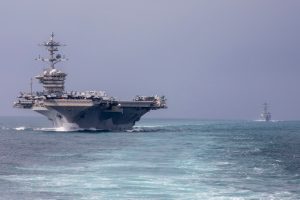 Abraham Lincoln, flagship of the Abraham Lincoln Carrier Strike Group, conducting routine operations in the U.S. 7th Fleet area of operations. (U.S. Navy photo by Mass Communication Specialist Seaman Joey Sitter) The appearance of U.S. Department of War (DoW) visual information does not imply or constitute DoW endorsement.
On August 6, 2026 a Town Hall Meeting between Navy officials including Acting Navy Secretary Hung Cao and more than 200 family members of the crew of the USS Abraham Lincoln took place at the Naval Air Station on North Island, San Diego. North Island is the home port of the Lincoln. The family members had been flooded by messages from their loved ones about deteriorating conditions on the Lincoln including moldy showers, water contamination, lack of supplies and bad food. The Lincoln by that date had been deployed for 260 days, with 240 consecutive days without a port visit.
The reason for the long deployment traces to a lack of deployable aircraft carriers. Despite 11 US aircraft carriers in service, the Lincoln was made to stay on station because there was no easy replacement available. The problem meant that most US carriers were being repaired, or crews needed training, or both. Thus most of the fleet was grounded and deterrence was gravely weakened as a result. With the return to port of the Lincoln, the carrier problem has grown even worse and deterrence further compromised.
The Abraham Lincoln (CVN-72) has long been regarded as a highly successful aircraft carrier and the ship received many awards for performance and excellence over the years. The carrier was commissioned in 1989 and features two nuclear reactors.
Were the complaints legitimate? There is clear evidence that conditions on the carrier were deteriorating, important maintenance had been deferred, and at sea resupply of the ship was irregular and slow at best.
The USS Abraham Lincoln (CVN 72) is a Nimitz-class nuclear-powered aircraft carrier serving as the flagship for Carrier Strike Group 3 (CSG-3). Though its deployment was originally slated to conclude around May 2026, it was extended indefinitely to support ongoing operations, including the enforcement of maritime restrictions and air-defense missions in the Persian Gulf and Red Sea.
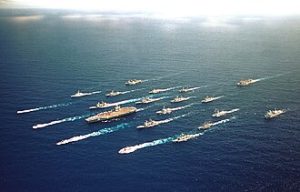 The U.S.S. Abraham Lincoln Battle Group along with ships from Australia, Chile, Japan, Canada, and Korea steam alongside one another for a Carrier Battle Group Photo during RIMPAC 2000. By PH2 Gabriel Wilson – Original source is Cpf.navy.mil (now a deadlink, see [1] for last version recorded by the Internet Archive., Public Domain, Link
The Lincoln includes Carrier Air Wing 9 (CVW-9). It operates strike fighter squadrons flying F/A-18E/F Super Hornets, F-35C Lightning IIs, electronic attack aircraft (EA-18G Growlers), and early-warning turboprops (E-2 Hawkeyes), alongside MH-60R/S Seahawk helicopters. Supporting it is Destroyer Squadron 21 (DESRON 21) consisting of Guided-missile destroyers providing layered air defense (AEGIS), anti-submarine capabilities, and land-strike options.
Onboard there are 3,200 sailors responsible for operating the nuclear reactors, navigation, engineering, maintenance, and daily shipboard functions. In addition there are 2,480 personnel (including pilots, maintenance crews, and support specialists) assigned to manage and service the aircraft on the carrier. There also are the crews of the destroyers and other ships part of the carrier task force. Destroyer Squadron 21 includes the USS Spruance, USS Frank E. Petersen Jr., and USS O’Kane , each with 300 to 400 crew. A carrier task force also includes one or two nuclear attack submarines.
Total personnel strength across the entire Carrier Strike Group usually falls between 6,500 and 7,500 officers and sailors.
While some crew onboard the Task Force ships other than the carrier can, and sometimes are, rotated, carrier personnel are not rotated. There are no backup crews to run the carrier.
Going as far back as the 1960s, the US Navy experimented with rotating crews as opposed to rotating hulls. In the early 2000s the Navy experimented with a Sea Swap program, only to find it problematic administratively and operationally. The Navy does swap out crews on submarines (Blue Gold system), and the Navy can sometimes rotate ships in a carrier task force (but not the carrier). Lurking behind the theory of swap outs are two realities: Navy recruitment falls short on adding qualified sailors even while eligible crew members leave the service; training is said to be far behind operational requirements, either because of a lack of capable personnel, or not having enough trainers. Recent reports (2025) say that the Navy is about 20,000 crew short.
Beyond a shortage of personnel, the Navy is short on aircraft carriers. In 1991 during Operation Desert Storm in 1991 (Battle Force Zulu), when an unprecedented four aircraft carriers operated simultaneously inside the Persian Gulf including the USS Midway (CV-41, retired in 1997), USS Ranger (CV-61, decommissioned 1993), USS America (CV-66, decommissioned 1996) and USS Theodore Roosevelt (CVN-71), the US today has only three carriers at sea. These are the USS Abraham Lincoln, the USS George H.W. Bush, and the USS George Washington. On August 22nd or shortly thereafter, the Lincoln will be heading back to North Island, San Diego where it will undergo maintenance. The George Washington, which is homeported at Fleet Activities Yokosuka in Yokosuka, Japan, is now enroute to to replace the Abraham Lincoln, leaving the entire Pacific region without an aircraft carrier task force. At the present time there are no US Carriers in the North or South Atlantic, the Caribbean, or the Mediterranean.
By law the US Navy is required to have 11 aircraft carriers. Most of those currently in service are Nimitz-class carriers. Its flagship, the USS Nimitz is scheduled for retirement in 2027, followed by the USS Eisenhower in 2030 (at its retirement date it will have served for 53 years). The newer Ford class carriers, the first to feature electronic (not steam) catapults, are supposed to begin replacing Nimitz carriers. The first of the lot, the USS Ford is is currently in port undergoing major maintenance following a 326-day deployment including extensive structural repairs to address damage caused by a major fire in the ship’s main laundry spaces that occurred back on March 12. Probably two carriers (not the Ford) currently in port could be activated in a crisis.
It isn’t clear how President Trump’s directive on steam catapults will impact the Ford-class carrier program.
The Lincoln carrier is the recipient of many awards including the Arleigh Burke Award where the carrier was recognized as the most improved command in the Pacific Fleet, the Navy E-Ribbon for battle effectiveness, and the Captain Edward F. Ney Memorial Award for food service excellence. The Lincoln also won the retention excellence award multiple times, demonstrating that over the years it maintained strong crew morale. The fact that its canteen food services was highly regarded in the past could indicate either the current problems were linked to supply shortages and not to food preparation, or the performance of the food service staff has deteriorated. It is unlikely there was a food service performance deficit: competition for food service excellence in the Navy and other military services is very strong.
The Lincoln is likely to spend many months, perhaps longer, under repairs when it reaches San Diego. Naval shipyards face severe capacity constraints and backlogs. When a carrier like the Lincoln accumulates accelerated wear-and-tear on catapults, arresting gear, flight deck infrastructure, and engineering plants, standard maintenance periods frequently stretch from several months to over half a year (and can extend much longer if deep depot-level overhauls or combat system upgrades are simultaneously due).
If aircraft carriers and naval task forces remain critical to US power protection and to deterrence, then the Navy needs to step up efforts at sailor recruitment and training, as well as improving carrier maintenance both at sea and in home port. Significant investment is needed. The US Navy should be able to keep more than two or three carriers operational at any time and ought not to have to scramble if there is a national emergency.


Leave a Reply
You must be logged in to post a comment.