
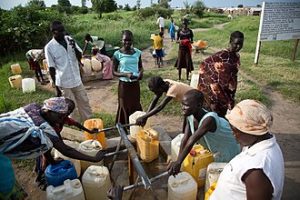
USAID Funded UNICEF Delivery of WMD’s to Sudan

by | Sept 10, 2026

USAID in Africa at Wikimedia Commons. By USAID in Africa - Sanitation projects in Renk, South Sudan, Public Domain, https://commons.wikimedia.org/w/index.php?curid=68779514USAID in Africa at Wikimedia Commons. By USAID in Africa – Sanitation projects in Renk, South Sudan, Public Domain, Link

The good news is we found the WMDs. The bad news is USAID and the UN were delivering them. And the media was blaming Trump and Musk for cutting off the WMD aid deliveries.

Even as the media barraged Americans with photos of sick Sudanese kids, the Sudanese military was sharing “a video of an apparent war victim with charred skin” with the message, ‘Your cooking” to celebrate its use of ‘humanitarian aid’ as chemical weapons.

“Trump Officials Celebrated With Cake After Slashing Aid. Then People Died of Cholera,” a ProPublica headline complained. The story by the leftist pressure group funded by the proceeds of a couple who helped cause the subprime meltdown advanced the media’s narrative.

Stories in the Washington Post, Time Magazine, and Reuters followed the usual playbook of suffering porn photos of children in third world countries accompanied by claims that they were dying because of the selfishness of conservatives who were cutting aid to them.

An ABC News headline declared that, “Sudan has become a ‘case study’ for the impact of USAID cuts.” Time Magazine claimed that, “Without USAID, My Neighbors in Sudan are Starving” and according to Reuters, “eight people in South Sudan, including five children, died on a three-hour walk to seek medical treatment for cholera after U.S. aid cuts”.

The Washington Post started out its story by depicting a 3-year-old boy mourning his mother and blaming her death on Trump and Elon Musk. “Supplies for cholera response were largely funded by USAID,” a UN World Health Organization spokesman claimed in the article, warning that the cuts “reduced our ability to distribute water-purifying supplies.”

Even as the media depicted Trump and Musk as monsters who partied while cutting off aid to dying children, fueling a new wave of Democrat outrage, it knew that the Islamic regime in Sudan had been using chlorine as a chemical weapon. Not only that, but in its final week in office, the Biden administration had sanctioned Sudan’s regime for using chemical weapons. There were no protests then, but when the Trump administration sanctioned Sudan again over the use of chemical weapons, there were complaints that would interfere with humanitarian aid.

With good reason. The ‘humanitarian aid’ was actually a WMD.

The media, including the Post, is now publishing evidence that the UN’s aid programs provided the chlorine used for chemical weapons: including a voice message from a member of the regime saying that the chlorine cylinders “come through U.N. health care programs or whatever.” UNICEF admitted to supplying chlorine gas to six plants, including al-Manara, during the same period when DOGE and the Trump administration were reining in abuses by USAID.

“Al-Manara has some of those cylinders, and we took them from there,” the Sudanese regime figure sanctioned by the Trump administration admitted.

Media stories profiled UNICEF, another UN agency, whose Sudan work was also funded by USAID. UNICEF, in whose name children will soon be told to knock on doors over Halloween, discussed how it os, “sustaining operations at Al Manara water treatment plant and providing essential treatment chemicals such as polymer and chlorine” for “clean and safe water.”

Other USAID-funded ‘aid’ groups that provided chlorine canisters to al-Manara included Cooperative for Assistance and Relief Everywhere (CARE) and the International Committee of the Red Cross (ICRC). Last year, the media ran outraged stories claiming that the Trump USAID shutdown had cost CARE $165 million and led to 850 layoffs especially impacting “health programs and food distribution programs in Sudan.”

In June, the Office of the Inspector General at USAID revealed that after directing over $1 billion in aid to Sudan, the agency had not been properly monitoring sites, had not followed its internal procedures and “did not have reasonable assurance that the awards were implemented as intended and may not have identified all program irregularities or taken corrective actions.”

This was obviously inevitable during a civil war. And it comes after USAID had been involved in everything from funding the Taliban and Al Qaeda groups. USAID was one key component of an international humanitarian aid complex that had been collaborating with Islamic terrorists, routing money to them and faking famines from Gaza to Afghanistan to Yemen to benefit them.

And ‘humanitarian aid’, from water pipes in Gaza to fertilizer in Yemen, found ‘dual use’ as weapons for Islamic terrorists. The fake famine in Yemen was used to ship large amounts of urea, a chemical used in explosives, and ammonium perchlorate, used in rocket fuel. The population in Yemen increased 30%, and the Houthi Jihadis in control of Yemen were soon pounding the US Navy with drones. Gaza’s water pipes became rockets and equipment meant for constructing irrigation and water systems was used to build terror tunnels instead.

With that kind of track record, there was every reason to suspect that there might be a ‘dual use’ for the ‘humanitarian aid’ being shipped to Yemen, but non-profit groups played dumb.

“Chlorine supplied by UNICEF has one purpose: making water safe to drink,” UNICEF’s spokesman claimed. “Any other use would be a serious breach of the terms on which it is provided, and of the principles under which humanitarian assistance is delivered.”

Islamic terrorists from Afghanistan to Gaza to Yemen to Syria have made a routine habit of ‘breaching’ the worthless UN principles. And the UN has done nothing to hold them accountable. The unspoken reason that the UN’s ‘humanitarian aid’ is so often weaponized is that UN personnel on the ground are often members of or collaborators with Islamic terror groups. Rather than address any of that, the UN and its non-profit allies roll out another fake famine accompanied by splashy photos of sick children published by the New York Times.

The latest USAID scandal is more evidence that President Trump and DOGE were on the right track. Our ‘humanitarian aid’ to Islamic terror states is not only beset by waste, fraud, and corruption, but is routinely abused by terrorists and military regimes for their own purposes.

Americans are not responsible for the sickness and death in Sudan. Only the Sudanese are. The Islamic ideology and Arab tribalism feeding that brutal conflict are not of our making and the only thing that throwing more billions of dollars in aid will do is continue to feed the killing.

We set out to save Sudan: instead our ‘life-saving aid’ was used to build chemical weapons.

In March, the UN’s World Health Organization (WHO) congratulated Sudan for “ending the cholera outbreak” through the work of the UN and Sudan’s Federal and State Ministries of Health.” Now that the chemical weapons have been cut off, the cholera outbreak also ended.

Photo credit: USAID in Africa at Wikimedia Commons.

Israpundit is entirely dependent on readers support. Please help me continue educating people with the truth about what is going on in Israel and around the world.

USD:

ILS:

CDN:

September 10, 2026 | 9 Comments »

Leave a Reply

9 Comments / 9 Comments

  1. Query:

    US AID TO ISRAEL 1948 to 1967

    Google:

    Between 1948 and 1967, U.S. assistance to Israel focused almost entirely on economic development and humanitarian support rather than large-scale military funding.

    Early Economic and Financial Support (1948–1960)
    * Initial Recognition: The U.S. recognized Israel in 1948, providing early support through Export-Import Bank loans totaling around $100 million for agricultural and economic development.
    *
    * Economic Grants: Throughout the 1950s, aid consisted mainly of economic assistance, technical cooperation, and surplus food distribution under the Food for Peace program.
    *

    Shift Toward Military Sales (1961–1967)
    * First Arms Sale: In 1962, the administration of President John F. Kennedy approved the sale of defensive Hawk anti-aircraft missiles, marking the first major U.S. military sale to Israel.
    *
    * Pre-1967 Scope: Prior to the 1967 Six-Day War, military assistance remained relatively modest, as the U.S. tried to maintain a regional arms balance and avoid a formal military alliance. Substantial, multi-billion-dollar military aid packages and grants did not begin until after 1967, when Israel emerged as a key strategic partner during the Cold War.

  2. My Query:

    USAID sent $200 before oct 7 and over a billion after before Trump stopped this

    Google AI Overview:

    The figures you mentioned align closely with reports regarding U.S. humanitarian and development spending in the West Bank and Gaza. i
    Before the October 7, 2023 attacks, the U.S. Agency for International Development (USAID) allocated roughly $200 million annually for various assistance and development projects in the Palestinian territories. Following the outbreak of the war, the Biden administration drastically increased humanitarian aid, distributing over $2.1 billion in assistance to Gaza. In early 2025, the second Trump administration enacted a sweeping global freeze on foreign aid and dismantled the vast majority of USAID programs.

    Break down of the Funding Timeline
    * Before October 7, 2023: In the years leading up to the conflict, USAID allocated around $150 million to $200 million annually to the West Bank and Gaza for economic recovery, health, and development programs. Watchdog groups later noted that a specific $200 million chunk of these pre-war allocations faced criticism for opaque oversight regarding local partners.
    *
    * After October 7, 2023: Following the Hamas attacks, the Biden administration heavily escalated humanitarian funding. Between October 2023 and January 2025, the U.S. distributed $2.1 billion in emergency food, healthcare, shelter, and sanitation to conflict-affected civilians in Gaza. [
    *
    *
    * The Trump Administration Shutdown: Upon taking office on January 20, 2025, President Trump implemented a 90-day freeze on foreign aid. Working with the newly formed Department of Government Efficiency (DOGE), the administration ultimately eliminated over 80% to 90% of USAID contracts and grants globally, effectively absorbing the remaining fragments of the agency into the State Department.
    *

    The Debate and Controversy
    The rapid halt of these funds ignited a massive political and humanitarian debate:
    * Administration Rationale: Proponents of the shutdown, alongside conservative lawmakers, argued that USAID’s vetting mechanisms were lax. They pointed to warnings from the agency’s Inspector General and argued that U.S. taxpayer money was inadvertently underwriting Hamas-controlled areas and benefiting NGOs tied to terrorist groups.
    *
    * Humanitarian Backlash: Conversely, international aid organizations like Oxfam America and U.N. personnel warned that abruptly halting the funds would devastate the delivery of life-saving medical supplies and clean water. Aid groups also noted that freezing the hundreds of millions in promised Gaza aid threw a wrench into the logistics of the U.S.-brokered ceasefire and hostage release agreements. [

    • annual U.S. funding of UNRWA FROM 1950 to present

      The United States has given more than $7.3 billion in total historical aid to UNRWA since 1950, but providing a complete list of every single annual amount from 1950 to the present requires a large data set that is not fully detailed year-by-year here. [1] (https://www.congress.gov/crs-product/IF12863)Historical U.S. Funding OverviewTotal Contributions: Over $7.3 billion since UNRWA’s founding operations began in 1950.Historical Role: The U.S. has historically been the largest single financial contributor to the agency.Recent Trends: In 2023, U.S. funding reached approximately $422 million, making up nearly 30% of UNRWA’s total donor contributions. [1] (https://www.unrwausa.org/news/unrwa-usa-ramps-up-focus-on-the-restoration-of-us-government-funding-for-humanitarian-aid-including-for-gaza), [2] (https://www.congress.gov/crs_external_products/IF/PDF/IF12863/IF12863.1.pdf)Major Funding Shifts and Suspensions2018 Cuts: The Trump administration halted nearly all U.S. funding to UNRWA.2021 Restoration: The Biden administration resumed financial support, providing hundreds of millions of dollars.2024–2025 Suspension: Following allegations linking certain UNRWA employees to attacks in Israel, U.S. funding was paused, and subsequent legislation prohibited contributions through early 2025. [1] (https://www.everycrsreport.com/reports/RS22967.html), [2] (https://globalaffairs.org/commentary/blogs/how-much-financial-assistance-has-us-given-palestinian-territories), [3] (https://www.congress.gov/crs-product/IF12863)For comprehensive year-by-year accounting tables, you can consult the Congressional Research Service Report on UNRWA Funding. [1] (https://www.congress.gov/crs-product/IF12863)If you’d like, tell me:Do you need a breakdown for a specific decade or administration?Are you looking for exact figures for recent years (like 2020–2026)?I can provide more targeted financial data for those periods.

    • annual U.S. funding of UNRWA FROM 1950 to present

      The United States has given more than $7.3 billion in total historical aid to UNRWA since 1950, but providing a complete list of every single annual amount from 1950 to the present requires a large data set that is not fully detailed year-by-year here.

      Historical U.S. Funding Overview
      * Total Contributions: Over $7.3 billion since UNRWA’s founding operations began in 1950.
      *
      * Historical Role: The U.S. has historically been the largest single financial contributor to the agency.
      *
      * Recent Trends: In 2023, U.S. funding reached approximately $422 million, making up nearly 30% of UNRWA’s total donor contributions.
      *

      Major Funding Shifts and Suspensions
      * 2018 Cuts: The Trump administration halted nearly all U.S. funding to UNRWA.
      *
      * 2021 Restoration: The Biden administration resumed financial support, providing hundreds of millions of dollars.
      *
      * 2024–2025 Suspension: Following allegations linking certain UNRWA employees to attacks in Israel, U.S. funding was paused, and subsequent legislation prohibited contributions through early 2025.
      *
      For comprehensive year-by-year accounting tables, you can consult the
      If you’d like, tell me:
      * Do you need a breakdown for a specific decade or administration?
      * Are you looking for exact figures for recent years (like 2020–2026)?
      I can provide more targeted financial data for those periods.

      • compare u.s. aid to israel with that of “palestinian” arabs 1948-1967

        From 1948 to 1967, U.S. aid to Israel was relatively modest and focused on economic loans and food, while U.S. aid to Palestinian Arabs was primarily humanitarian relief channeled through the United Nations.

        U.S. Aid to Israel (1948–1967)

        Economic Focus: Early U.S. assistance to Israel consisted mostly of economic development loans and surplus agricultural commodities rather than military grants.

        Limited Military Aid: Large-scale military assistance did not begin during this period. France served as Israel’s primary arms supplier before 1967. Direct military sales and loans from the U.S. only began in the early 1960s on a small scale.

        Overall Scale: Over 99% of cumulative U.S. Aid to Israel occurred after the 1967 Six-Day War. Before 1967, annual assistance was counted in millions of dollars rather than the billions seen in later decades.

        U.S. Aid to Palestinian Arabs (1948–1967)Refugee Relief: Following the 1948 war, hundreds of thousands of displaced Palestinians became refugees.

        Channeled Through the UN: The United States began funding Palestinian relief in 1950 by becoming the largest financial contributor to the United Nations Relief and Works Agency (UNRWA).

        Scope of Support: The U.S. provided roughly half to two-thirds of the total UNRWA budget during the 1950s and 1960s. This money paid for emergency food, basic healthcare, shelter, and primary education for registered refugees.

        Key DifferencesPurpose: Aid to Israel aimed to support economic stability and diplomatic alignment during the Cold War. Aid to Palestinian Arabs was strictly humanitarian and managed by an international body.

        Delivery Method: Aid to Israel was given directly (bilateral aid) between governments. Aid to Palestinians was multilateral, given mostly through the United Nations

        Would you like to know more about how U.S. aid changed after the 1967 Six-Day War or specific funding amounts for UNRWA during the 1950s?

        • specific U.S. funding amounts for UNRWA 1950-67 From its inception in 1950 through 1967, the United States was by far the largest single donor to the United Nations Relief and Works Agency for Palestine Refugees in the Near East (UNRWA). During this foundational era, U.S. financial contributions generally fluctuated between $22 million and $30 million annually, typically accounting for roughly 70% of the agency’s total budget in the 1950s, which gradually scaled down closer to 60% by the mid-1960s as other nations increased their share.

          • how much money did the U.S. give to Jewish refugees from Arab countries

            The U.S. government has not provided direct, specific financial aid or compensation funds to the roughly 850,000 Jewish refugees who fled or were expelled from Arab countries and Iran after 1948.
            Instead, the response and financial dynamics regarding these refugees have taken place through international diplomacy, bilateral foreign aid, and legal claims:
            * Absorption via General Foreign Aid to Israel: The vast majority of Jewish refugees from Arab lands (over 600,000) were quickly absorbed and granted citizenship by Israel. While the U.S. did not earmark specific refugee funds for them, the U.S. has provided Israel with over $317 billion in cumulative foreign assistance since World War II, which historically helped support the infrastructure of a state absorbing massive influxes of immigrants.
            *
            * No Equivalent to UNRWA: Unlike Palestinian refugees, who receive dedicated, long-standing funding through the United Nations Relief and Works Agency (UNRWA)—to which the U.S. has contributed over $6 billion since 1950—there was never an international or U.S.-funded agency established specifically to provide aid to displaced Middle Eastern and North African Jews.
            *
            * U.S. Policy Recognizes Their Claims: While no direct payouts have been made by the U.S., American policy explicitly recognizes their plight. In 2008, the U.S. House of Representatives passed a resolution declaring that any comprehensive Middle East peace agreement must include recognition and redress for the displacement of both Arab and Jewish refugees.
            *
            The Property Claims Baseline
            Property restitution remains an active political issue rather than a disbursed aid package. The Israeli government and advocacy organizations, such as Justice for Jews from Arab Countries (JJAC), estimate that Jewish refugees left behind $150 billion to upwards of $250 billion in abandoned property, real estate, and assets. Israel mandates by law that these billions in confiscated assets must be raised as counterclaims in any future peace negotiations with Arab nations

            • was absorbing 850,000 Jewish refugees from Muslim countries and please tell me how many from Europe after 1948 difficult? Who helped?

              Absorbing roughly 850,000 Jewish refugees from Muslim countries alongside more than 300,000 from post-war Europe nearly doubled Israel’s total Jewish population in just a few years, creating an immense economic and logistical crisis.

              The Scale and Difficulty
              * European Influx (1948–1952): Over 300,000 Jewish refugees and Holocaust survivors arrived from European communist bloc countries and displaced persons camps.
              *
              * The Hardship: The newborn state faced severe food rationing, extreme housing shortages, and massive financial strain. Refugees were initially placed in primitive tent cities called ma’abarot, lacking proper plumbing and electricity.
              *

              Who Helped?
              * The Israeli Government & Public: Bore the primary burden, constructing housing and enacting the Law of Return to grant citizenship.
              *
              * World Jewry: Organizations like the United Jewish Appeal (UJA), the Joint Distribution Committee (JDC), and Jewish communities in North America raised critical funds for rescue operations and relief.
              *
              * Philanthropy and Loans: Diaspora fundraising and international bonds provided the financial lifeline needed to feed, clothe, and shelter the incoming populations.
              *

              Would you like to explore how the transition camps (ma’abarot) functioned or the specific financial mechanisms used to support this mass migration?

              My comment: Enough with the gratititude party.

              “[We] did it [our] way.” – Frank Sinatra (foundational friend and ally.)