
History shows how quickly allies can turn into adversaries.
Moshe Phillips | Dec 29, 2025
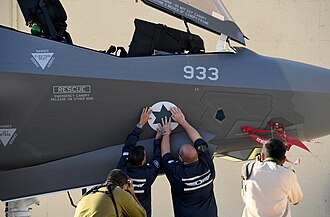 27th Adir F35 arrival at Nevatim, August 2020. Photo by U.S. Embassy Jerusalem – DSC_0863SM, CC BY 2.0, Wikipedia
When Tom Barrack, the U.S. ambassador to Turkey, tweeted on Dec. 9 that America “is in ongoing discussions with Turkey regarding their desire to rejoin the F-35 program,” it should have sent chills through any American who cares about the future of the Middle East. An F-35 stealth fighter jet taking off from Turkey could reach Israeli airspace in about 15 minutes. Cyprus is even closer, and Turkey doesn’t even recognize the Republic of Cyprus.
The reaction to Barrack’s statement was both swift and intense—and that should come as no surprise.
At a summit in Jerusalem on Dec. 22, Greece, Cyprus and Israel adopted a strident tone and agreed to strengthen trilateral cooperation in the Mediterranean. Israeli Prime Minister Benjamin Netanyahu, Greek Prime Minister Kyriakos Mitsotakis and Cypriot President Nikos Christodoulides signed a joint declaration to advance an energy deal and pledged to “reinforce our ongoing trilateral cooperation on security, defense and military matters.”
Clearly addressing Turkey and its president, Recep Tayyip Erdogan, during a joint press conference, Netanyahu stated: “To those who fantasize they can re-establish their empires and their dominion over our lands, I say: Forget it. It’s not going to happen. Don’t even think about it.”
Erdogan responded by sharply criticizing Israel and Cyprus. “We will not permit the violation of the rights and interests of Turkish Cypriots,” he said. About Israel, he said: “Turkey … will not back down, we will not stay silent, we will not forget; we will never leave Gaza alone.”
It is also worthwhile to consider who might come after Erdogan.
Turkish Foreign Minister Hakan Fidan is often mentioned as a possible successor and has repeatedly condemned Israeli actions. On Nov. 30, while in Iran, he described Israel as “the biggest threat to stability in the Middle East,” even as he touted expanded Turkish cooperation with Iran on energy, trade, border security and regional security matters.
In August, Fidan said that “Israel’s reckless attacks on Gaza, Lebanon, Yemen, Syria, Iran are the clearest sign of a terrorist state mentality defying international order,” and accused Israel of “committing genocide in Gaza for the past two years, ignoring basic humanitarian values right before the world’s eyes.”
While Turkey presents itself as a U.S. ally and a NATO member with regional influence, this nominal status cannot override its extensive ties to Hamas. These ties raise serious questions about whether Turkey should be a recipient of advanced American F-35 fighter jets, especially when Fidan’s frequent anti-Israel rhetoric is taken into account.
For years, Turkey has described Hamas as a “liberation movement” and has not formally designated it as a terrorist organization. Hamas has used Turkish territory as a base for coordination, recruitment and financial operations linked to terrorism. U.S. and allied security services have repeatedly warned about networks tied to Hamas activities on Turkish soil.
Since at least 2023, senior Hamas leaders have had connections with Turkey. Ismail Haniyeh, the former head of Hamas’s political bureau, was killed in Tehran in July 2024, and Turkey publicly mourned his death.
Turkey’s ruling party, the AKP, and Hamas share ideological roots in the broader Muslim Brotherhood movement. Erdogan has been a vocal critic of Israel’s response to the Hamas-led terrorist attacks in southern Israel on Oct. 7, 2023, and has used his international platform to offer political support to Hamas. And he has consistently rejected characterizing Hamas as a terrorist organization.
Washington must reconsider selling advanced weapons to authoritarian rulers in the Middle East. History shows how quickly allies can turn into adversaries.
Selling cutting-edge weapons like the F-35 to autocratic governments is a national security risk. Congress must act quickly to place strict limits on these sales. Greece, Cyprus and Israel are depending on America to do the right thing.
Moshe Phillips is national chairman of Americans For A Safe Israel (www.AFSI.org), a leading pro-Israel advocacy and education organization.


These two statements show that
If it’s about Jews
it makes the news.
This rhyme shows that the reason anything is highlighted in the MENA is if Jews are involved. Other activities seldom make the news although a lot of people may have been killed in whatever strike or police act.
The “reckless attacks” are acts of self defense. Rockets were fired into Israel from all of those countries. Defending yourself is reckless because the violence is returned, measure for measure.
It’s easy to pile up on the one guy who is trying to make peace work but it’s not so easy to be on the receiving end of a devastating return salvo (think Iran or Lebanon.).