
PELONI: Cultural distinctions have civilizational consequences.
Ambassador (ret.) Yoram Ettinger | “Second Thought: a US-Israel Initiative” | October 9, 2026
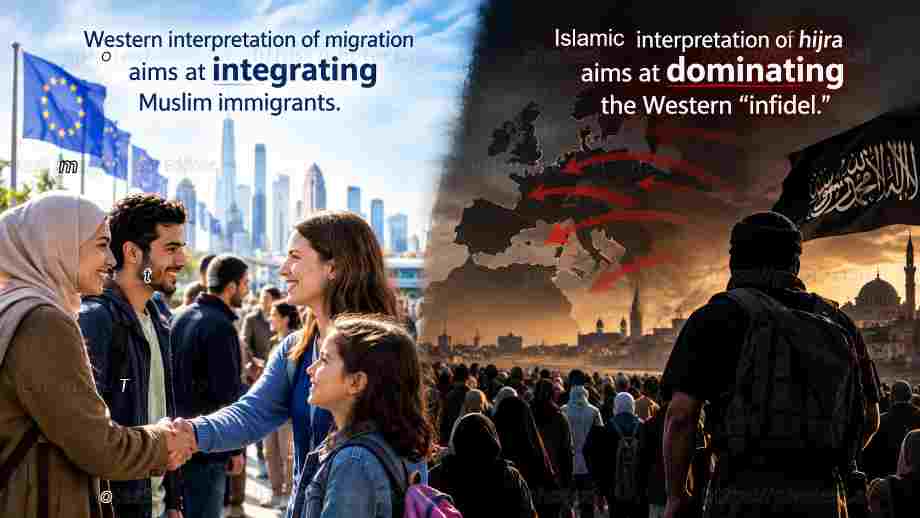 Click Image to Enlarge. Image created via AI.
*On April 10, 2006, Muammar Gaddafi gave a speech in Timbuktu, Mali: ”The fifty million Muslims of Europe will turn it into a Muslim continent within a few decades…. Allah will grant Islam victory in Europe without swords, without guns….”
*The Western and Islamic concepts of migration differ fundamentally, ideologically, religiously, legally, socially, economically, tactically and strategically. The Western concept is driven by secular, moral, legal, and socio-economic precepts, focusing on rights, borders, labor markets, and humanitarian protection under international law. In contrast, the Islamic concept of migration (hijra) is doctrinal, theological, ideological and strategic, deeply rooted in the 14-century-old legacy of the Prophet Muhammad and the Qur’an. In fact, the Hijra marks the first year of the Islamic calendar (Hijri).
*Prof. Kelly M. Greenhill, MIT and Tufts University Political Science, the author of Weapons of Mass Migration (Cornell University Press, 2016) has documented Gaddafi’s and Erdogan’s practice to intimidate West Europe by the threat of induced Islamic migration.
The Hijra Doctrine
*The Hijra doctrine refers to the Prophet Muhammad’s migration from Mecca to Abyssinia and Medina as a divinely-ordained act. It was perceived as a strategic migration to reorganize and expand Islamic dominion “in the cause of Allah,” followed by armed Jihad once a power base evolved in Medina.
*Hijra is explicitly treated in the Qur’an and hadith (an account of Muhammad’s actions and pronouncements) as a prototype of non-violent Jihad “for the sake of Allah,” where migration and fighting are coupled as complementary and commanded acts of devotion to Allah. Conceptually, Hijra has been a precursor and an ongoing key component of Jihad – a preliminary tactic toward the subjugation of enemies.
*Linguistically and theologically, the Qur’an lumps together faith, migration (hijra) and combat (qital/jihad) in several verses. For example, according to the Quran 8:74, “Those who believe, and adopt exile [migrate], and fight for the sake of Allah… they are the true believers.” Hijra is not merely a form of relocation; it is a spiritually, significant strategic (preferably non-violent) struggle undertaken for Allah.
Hijra Foundational precedents
*In 615AD, the Prophet Muhammed migrated to Abyssinia (Ethiopia) and in 622AD to Medina, establishing the Islamic precedent of hijra (migration), a divinely ordained move to advance the cause ofAllah – victory of the Abode of Islam over the Abode of the Infidel. Muhammed’s hijra aimed at avoiding obliteration by Mecca’s non-Muslim tribe of Quraysh, while establishing a strategic base, and upgrading capabilities. Consequently, Hijra enabled Muhammed to bring the Quraysh tribe to submission, dominating Mecca in 630 AD, and proceeding to sweeping military conquests and Islamization, regionally and globally. The Qur’an’s Surah 4:97-100 and Surah 8:72-75 are the key texts on Hijra, recognizing its foundational role in shaping Islamic strategy and tactics.
*In 670AD, Muslim warriors and their families/tribes migrated to amsar (garrison towns), such as Basra, Kufa, Fustat, and Qayrawan, designed to launch a large-scale Arabization/Islamization in conquered areas in the Arabian Peninsula and the Middle East at-large, Egypt and eventually the Maghreb (North Africa), and extending to southern Spain. In the 11th century, Turkmen tribes migrated to Anatolia, gradually shifting the region from Greek-Christian to Turkish-Muslim. In the 14th-16th centuries, the Ottoman/Islamic expansion employed military migration into the Balkan region, including Bulgaria, Serbia, Greece, south Croatia, Albania, Bosnia and Herzegovina.
*In 1804, Usman dan Fodio led a hijra in West Africa, before conducting the Sokoto jihad in the contemporary Nigeria and Cameroon.
*In the 20th and 21st centuries, the concept of Hijra was reinterpreted by radical Islamist theoreticians as a revolutionary terror methodology. For example, Sayyid Qutb, the leading Muslim Brotherhood radical/terrorist ideologue of the 1950s and 1960s, and Shukri Mustafa founder and leader of the radical Islamist group Takfir wal-Hijra in the 1960s and 1970s. Also,Al-Qaeda and ISIS used the concept of Hijra to attract foreign fighters to areas outside state control, such as the Afghan-Pakistani borderlands in the 1980s–1990s, and eastern Syria/western Iraq in 2014.
*While the Western interpretation of migration aims at integrating Muslim immigrants, the radical Islamist interpretation of hijra aims at dominating the Western “infidel.”
*Western interpretation of migration, on the one hand, and Islamic interpretation of migration, on the other hand, constitute contradiction in terms.
*Awareness to this conceptual difference is essential for Western democracies, in order to avoid dire consequences.


Leave a Reply
You must be logged in to post a comment.